


My new research project asks whether a personal algorithm, inspired by social media, can help us filter our email, group chats, and other personal correspondence.
Personal information firehose · Adam Wiggins
My new research project asks whether a personal algorithm, inspired by social media, can help us filter our email, group chats, and other personal correspondence.
Tech, Socials, & Online by @sweetbee.vip
Curated list of accounts in tech space, sorted with a personalized algorithm

Blog
For quite some time now, i have been working on and off on a fully self-hosted search engine, in hope to make it easier to search across Personal data in an end to end manner. Even as individuals, we are hoarding and generating more and more data with no end in sight. Such "personal" data is being stored from local hard-disks to corporate controlled cloud-centers which makes it distributed in nature. So for following discussion, "Personal" meaning would be flexible enough to accommodate resources on a remote server and/or on different devices, as long the user could prove authentication and/or authorization to that data. Current implementation supports only "images", but eventual goal is also to support other modalities like video, text and audio, some code would be shared, while some new code would be required to better extract Features for each modality.
InnerNets - Make internet personal again
Our mission is to bring the right information to the right person, in the right way.
Optimizing web search using social annotations
This paper is concerned with the problem of browsing social annotations. Today, a lot of services (e.g., Del.icio.us, Filckr) have been provided for helping users to manage and share their favorite URLs and photos based on social annotations. Due to the ...

Data Minimisation: a Language-Based Approach (Long Version)
Data minimisation is a privacy-enhancing principle considered as one of the pillars of personal data regulations. This principle dictates that personal data collected should be no more than...

For You, For Everyone - Graze Newsletter
How Graze built a "composable personalization" engine for the open social web — and why it matters right now.
For You, For Everyone - Graze Newsletter
How Graze built a "composable personalization" engine for the open social web — and why it matters right now.
Modelling Opinion Dynamics in the Age of Algorithmic Personalisation
Modern technology has drastically changed the way we interact and consume information. For example, online social platforms allow for seamless communication exchanges at an unprecedented scale. However, we are still bounded by cognitive and temporal constraints. Our attention is limited and extremely valuable. Algorithmic personalisation has become a standard approach to tackle the information overload problem. As result, the exposure to our friends' opinions and our perception about important issues might be distorted. However, the effects of algorithmic gatekeeping on our hyper-connected society are poorly understood. Here, we devise an opinion dynamics model where individuals are connected through a social network and adopt opinions as function of the view points they are exposed to. We apply various filtering algorithms that select the opinions shown to users i) at random ii) considering time ordering or iii) their current beliefs. Furthermore, we investigate the interplay between such mechanisms and crucial features of real networks. We found that algorithmic filtering might influence opinions' share and distributions, especially in case information is biased towards the current opinion of each user. These effects are reinforced in networks featuring topological and spatial correlations where echo chambers and polarisation emerge. Conversely, heterogeneity in connectivity patterns reduces such tendency. We consider also a scenario where one opinion, through nudging, is centrally pushed to all users. Interestingly, even minimal nudging is able to change the status quo moving it towards the desired view point. Our findings suggest that simple filtering algorithms might be powerful tools to regulate opinion dynamics taking place on social networks
Andrej Karpathy on Twitter / X
LLM Knowledge BasesSomething I'm finding very useful recently: using LLMs to build personal knowledge bases for various topics of research interest. In this way, a large fraction of my recent token throughput is going less into manipulating code, and more into manipulating…— Andrej Karpathy (@karpathy) April 2, 2026
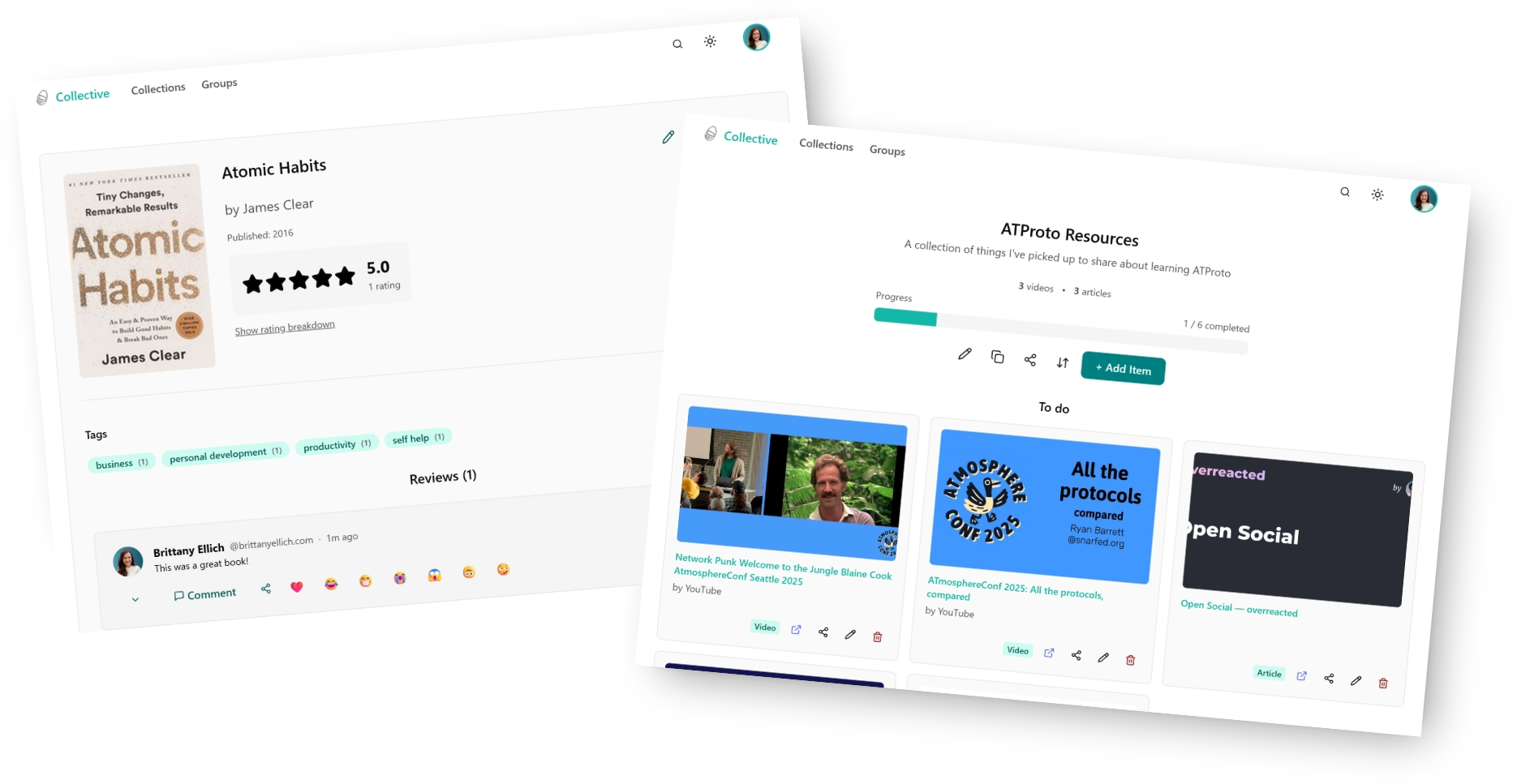
Collective Social | Track what you love. Share what matters.
Curate lists, track your progress, and share recommendations across books, movies, TV shows, and more — all on the open social web.
The Panoptic Sort: A Political Economy of Personal Information
A Political Economy of Personal Information

Social media algorithms don't allow us to understand or control what we see online and why... until now! Top scholars @jonathanstray.com and @noupside.bsky.social are sharing @mysky.social, a tool that allows users to adjust their feed’s priorities and explains why certain posts appear over others.

🎛️📲 Meet the algorithm you can actually control and understand
newpublic.substack.com@toni.bsky.team @alexbenzer.com i think yall need to wrestle with the fact that the app’s most distinctive feature (“custom feeds”) is something only (relative) nerds use and benefit from. normal people won’t swipe between many algorithms or whatever. have a look at past designs for “communities”
Google: Organize the world's information Atmosphere: Let the world's information self-organize

TJ
In some ways, atproto, bluesky, @semble.so, @sill.social, @standard.site and so on are building new indexes for the web. I really hope atproto succeeds and goes fully mainstream. Think of the amazing search engines that can be built on such rich index data. Maybe web3 can actually happen.
Social Media - Algorithmic Distortions and Polarization


Who Participates in Politics on Social Media, and Why?

We are going to kill “unalive” - Anil Dash

Beyond Misinformation: Social Media and the Sculpting of Epistemic Agency

You’ll do anything for your baby. The algorithm knows how to exploit that.
The Like Button Helped Social Media Put Profit Over People. We Can’t Let AI Do the Same.
Middleware for Feed Recommendation in Practice: How Feed Creators...


