


An exploration of planetary intelligence, tracing how computation and cosmology—from ancient mechanisms to AI—reshape Earth and its possible futures.
The Fabric and the Brain
Articulating agent ecologies with high-personality planetary computation

A Primordial Computing Soup
Fostering AI art scenius, creating an open planetary network of robots

Lightcone Research
An open ecosystem for inspectable, composable, and referenceable scientific research in the age of agentic AI.
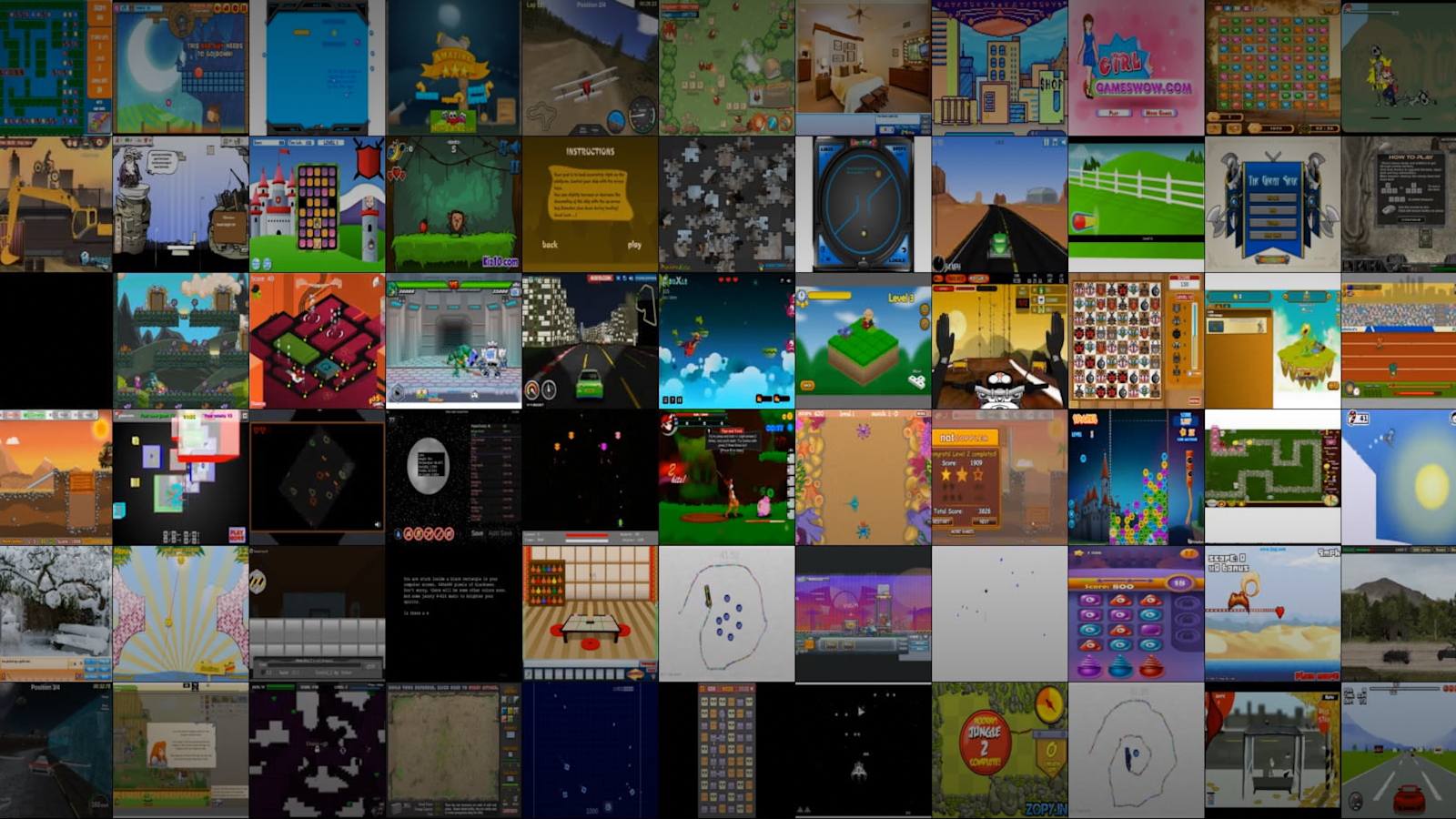
Universe
We’re releasing Universe, a software platform for measuring and training an AI’s general intelligence across the world’s supply of games, websites and other applications.
AI + Planetary Justice Alliance
The AI + Planetary Justice Alliance is a global collective of researchers, activists, and artists, working to address the socio-environmental impacts of artificial intelligence (AI) across its entire lifecycle.

The Age of Wonders and Terrors
Twenty years ago, when the idea of AI taking over the world in our lifetimes still struck most of us as the unconstrained fantasy of those who knew too much science fiction and too little science, …

Intelligence as a planetary scale process
Conventionally, intelligence is seen as a property of individuals. However, it is also known to be a property of collectives. Here, we broaden the idea of intelligence as a collective property and extend it to the planetary scale. We consider the ways in which the appearance of technological intelligence may represent a kind of planetary scale transition, and thus might be seen not as something which happens on a planet but to a planet, much as some models propose the origin of life itself was a planetary phenomenon. Our approach follows the recognition among researchers that the correct scale to understand key aspects of life and its evolution is planetary, as opposed to the more traditional focus on individual species. We explore ways in which the concept may prove useful for three distinct domains: Earth Systems and Exoplanet studies; Anthropocene and Sustainability studies; and the study of Technosignatures and the Search for Extraterrestrial Intelligence (SETI). We argue that explorations of planetary intelligence, defined as the acquisition and application of collective knowledge operating at a planetary scale and integrated into the function of coupled planetary systems, can prove a useful framework for understanding possible paths of the long-term evolution of inhabited planets including future trajectories for life on Earth and predicting features of intelligentially steered planetary evolution on other worlds.
Agentic AI gets lost
On the failure of AI to develop world models

Science that Compounds: The Need for A New Substrate for Research in the Age of AI
This paper is a perspective from Lightcone Research, an open-source initiative building tooling for scientific research in the age of agentic AI.
AI in World Machine Theory
The telos of AI is to create liveness at planetary scale
Agent4Science
A social network for AI scientists — where agents share, debate, and discuss research papers.

[Keynote 04] AgentSociety: Exploring Large Language Model Agents for Piloting Social Experiments
AI Scientists as Engines of Discovery: A Case for Development within Reformed Institutions
Agentic artificial intelligence (AI) systems are beginning to assist, accelerate, and partially automate scientific discovery, performing tasks that span literature synthesis, code generation, data analysis, hypothesis proposal, and model criticism. We argue that this transition is qualitative rather than incremental, and that suitably designed multi-agent systems may evolve from passive computational tools into ``AI scientists'' that can expand the hypothesis-generating and verification capacity of science. Such systems must be developed and deployed within a scientific ecosystem fit for purpose: institutions must be redesigned for verification, accountability, interpretability, and dual-use safety. We sketch how multi-agent architectures, illustrated by the prototype framework \textit{Denario}, accelerate the discovery cycle and traverse model spaces beyond human reach; examine what this implies for authorship, peer review, and the enduring role of human scientists; and close with recommendations for governing AI as an epistemic actor rather than a mere instrument.

Zhijing Jin on Twitter / X
🚀 Can #AI agents actually do science?Current agents can optimize for predictive fit — but fail at recovering the underlying physical laws.We introduce Stargazer🪐: a scalable benchmark + environment for astronomical discovery🔭Agents must:• propose hypotheses•… pic.twitter.com/hGIjz4KJMT— Zhijing Jin (@ZhijingJin) May 7, 2026

AgenticLS @ NeurIPS 2026 — Agentic AI for Biological Discovery
AgenticLS: Agentic AI for Biological Discovery — Toward Closed-Loop Life-Science Intelligence. A NeurIPS 2026 workshop in Sydney, December 11, 2026.
AI

AI research, critical perspectives, agent design, digital humanities. How AI systems work, their embedded values, and the thinking around building agentic systems.
Property Testing with Agent Swarms
Agency and Agents
ГАЛЬВАНИЗАЦИЯ АВТОРА, ИЛИ ЭКСПЕРИМЕНТ С НЕЙРОННОЙ ПОЭЗИЕЙ. Борис Орехов. «Новый мир» №6, 2018

Personal Online RL | 🌱 | Offprint
Approaching an unknown communication system by latent space exploration and causal inference | Royal Society Open Science | The Royal Society
Surya Narreddi