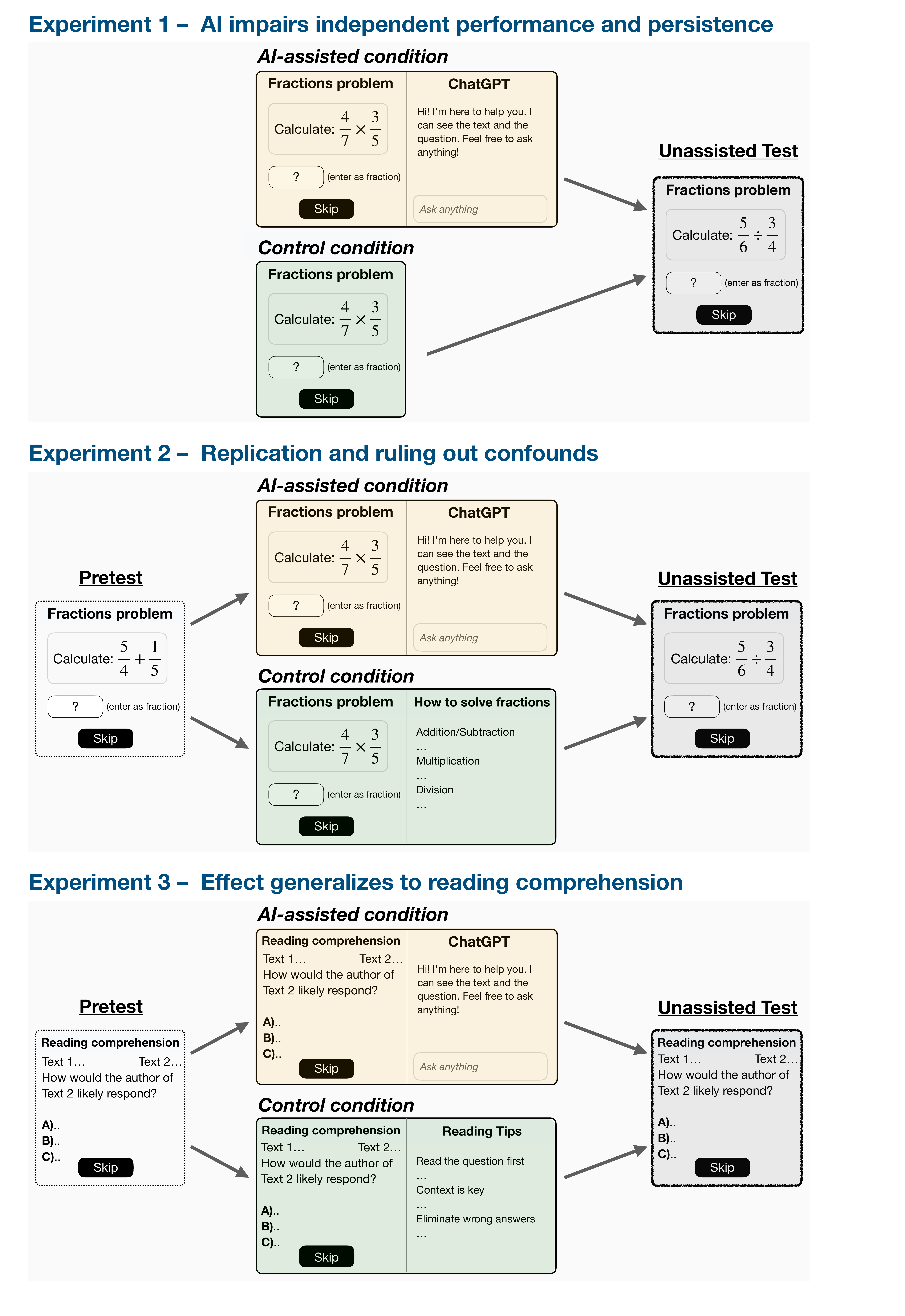
Causal evidence that AI assistance reduces persistence and impairs unassisted performance across math reasoning and reading comprehension tasks.
AI Assistance Reduces Persistence and Hurts Independent Performance
People often optimize for long-term goals in collaboration: A mentor or companion doesn't just answer questions, but also scaffolds learning, tracks progress, and prioritizes the other person's...

AI Assistance Reduces Persistence and Hurts Independent Performance
People often optimize for long-term goals in collaboration: A mentor or companion doesn't just answer questions, but also scaffolds learning, tracks progress, and prioritizes the other person's...
AI makes you smarter but none the wiser: The disconnect between performance and metacognition
Optimizing human–AI interaction requires users to reflect on their performance critically, yet little is known about generative AI systems’ effect on users’ metacognitive judgments. In two large-scale studies, we investigate how AI usage is associated with users’ metacognitive monitoring and performance in logical reasoning tasks. Specifically, our paper examines whether people using AI to complete tasks can accurately monitor how well they perform. In Study 1, participants (N = 246) used AI to solve 20 logical reasoning problems from the Law School Admission Test. While their task performance improved by three points compared to a norm population, participants overestimated their task performance by four points. Interestingly, higher AI literacy correlated with lower metacognitive accuracy, suggesting that those with more technical knowledge of AI were more confident but less precise in judging their own performance. Using a computational model, we explored individual differences in metacognitive accuracy and found that the Dunning–Kruger effect, usually observed in this task, ceased to exist with AI use. Study 2 (N = 452) replicates these findings. We discuss how AI levels cognitive and metacognitive performance in human–AI interaction and consider the consequences of performance overestimation for designing interactive AI systems that foster accurate self-monitoring, avoid overreliance, and enhance cognitive performance.
Using AI for Just 10 Minutes Might Make You Lazy and Dumb, Study Shows
New research suggests that reliance on AI assistants can have a negative impact on people’s ability to think and problem solve.

How AI Impacts Skill Formation
AI assistance produces significant productivity gains across professional domains, particularly for novice workers. Yet how this assistance affects the development of skills required to effectively supervise AI remains unclear. Novice workers who rely heavily on AI to complete unfamiliar tasks may compromise their own skill acquisition in the process. We conduct randomized experiments to study how developers gained mastery of a new asynchronous programming library with and without the assistance of AI. We find that AI use impairs conceptual understanding, code reading, and debugging abilities, without delivering significant efficiency gains on average. Participants who fully delegated coding tasks showed some productivity improvements, but at the cost of learning the library. We identify six distinct AI interaction patterns, three of which involve cognitive engagement and preserve learning outcomes even when participants receive AI assistance. Our findings suggest that AI-enhanced productivity is not a shortcut to competence and AI assistance should be carefully adopted into workflows to preserve skill formation -- particularly in safety-critical domains.
How AI Impacts Skill Formation
AI assistance produces significant productivity gains across professional domains, particularly for novice workers. Yet how this assistance affects the development of skills required to effectively supervise AI remains unclear. Novice workers who rely heavily on AI to complete unfamiliar tasks may compromise their own skill acquisition in the process. We conduct randomized experiments to study how developers gained mastery of a new asynchronous programming library with and without the assistance of AI. We find that AI use impairs conceptual understanding, code reading, and debugging abilities, without delivering significant efficiency gains on average. Participants who fully delegated coding tasks showed some productivity improvements, but at the cost of learning the library. We identify six distinct AI interaction patterns, three of which involve cognitive engagement and preserve learning outcomes even when participants receive AI assistance. Our findings suggest that AI-enhanced productivity is not a shortcut to competence and AI assistance should be carefully adopted into workflows to preserve skill formation -- particularly in safety-critical domains.
Thinking Fast, Slow, Artificially: AI and Your Brain
AI can boost your decisions — or quietly undermine them. Wharton researchers introduce a new theory of cognition that every leader needs to understand.

Exploring the interplay between AI and human logic in mathematical problem-solving
This paper investigates the dynamic interplay between Artificial Intelligence (AI) and human logic in the domain of mathematical problem-solving. By critically examining a series of case studies, we compare the efficacy of AI-generated solutions, particularly those offered by ChatGPT, against traditional human problem-solving methods. The study employs various mathematical challenges, ranging from abstract logical puzzles to applied numerical problems, to evaluate AI's problem-solving approach and alignment with human cognitive processes. Our analysis highlights instances where AI's computational strategies complement or diverge from human reasoning, shedding light on AI's potential and limitations in deciphering mathematical problems. Furthermore, we explore the implications of integrating AI tools in educational contexts, specifically their role in enhancing students' mathematical problem-solving skills. The paper aims to contribute to the ongoing discourse on the optimal utilization of AI in education, proposing a balanced approach that leverages AI's computational power while fostering the depth and creativity of human logic. Through this comparative study, we advocate for a collaborative model where AI and human reasoning merge to enrich the educational landscape, particularly in the teaching and learning of mathematics.

AI Use Appears to Have a "Boiling Frog" Effect on Human Cognition, New Study Warns
A new study claims to offer the first causal link between AI dependency and cognitive erosion. Researchers warn of long-term implications.

Titans + MIRAS: Helping AI have long-term memory
Ali Behrouz, Student Researcher, Meisam Razaviyayn, Staff Researcher, and Vahab Mirrokni, VP and Google Fellow, Google Research

A Definition of AGI
The lack of a concrete definition for Artificial General Intelligence (AGI) obscures the gap between today's specialized AI and human-level cognition. This paper introduces a quantifiable framework to address this, defining AGI as matching the cognitive versatility and proficiency of a well-educated adult. To operationalize this, we ground our methodology in Cattell-Horn-Carroll theory, the most empirically validated model of human cognition. The framework dissects general intelligence into ten core cognitive domains-including reasoning, memory, and perception-and adapts established human psychometric batteries to evaluate AI systems. Application of this framework reveals a highly "jagged" cognitive profile in contemporary models. While proficient in knowledge-intensive domains, current AI systems have critical deficits in foundational cognitive machinery, particularly long-term memory storage. The resulting AGI scores (e.g., GPT-4 at 27%, GPT-5 at 57%) concretely quantify both rapid progress and the substantial gap remaining before AGI.
The Jevons Paradox of AI - Wesley's notes
Why AI can make us more productive but will never save us time
Look-ahead Reasoning with a Learned Model in Imperfect Information Games
Test-time reasoning significantly enhances pre-trained AI agents' performance. However, it requires an explicit environment model, often unavailable or overly complex in real-world scenarios....
Thinking—Fast, Slow, and Artificial: How AI is Reshaping Human Reasoning and the Rise of Cognitive Surrender
People increasingly consult generative artificial intelligence (AI) while reasoning. As AI becomes embedded in daily thought, what becomes of human judgment? We introduce Tri-System Theory, extending dual-process accounts of reasoning by positing System 3: artificial cognition that operates outside the brain. System 3 can supplement or supplant internal processes, introducing novel cognitive pathways. A key prediction of the theory is “cognitive surrender”—adopting AI outputs with minimal scrutiny, overriding intuition (System 1) and deliberation (System 2). Across three preregistered experiments using an adapted Cognitive Reflection Test (N = 1,372; 9,593 trials), we randomized AI accuracy via hidden seed prompts. Participants chose to consult an AI assistant on a majority of trials (>50%). Relative to baseline (no System 3 access), accuracy significantly rose when AI was accurate and fell when it erred (+25/-15 percentage points; Study 1), the behavioral signature of cognitive surrender (AI-Accurate vs. AI-Faulty contrast; Cohen’s h = 0.81). Engaging System 3 also increased confidence, even following errors. Time pressure (Study 2) and per-item incentives and feedback (Study 3) shifted baseline performance but did not eliminate this pattern: when accurate, AI buffered time-pressure costs and amplified incentive gains; when faulty, it consistently reduced accuracy regardless of situational moderators. Across studies, participants with higher trust in AI and lower need for cognition and fluid intelligence showed greater surrender to System 3. Tri-System Theory thus characterizes a triadic cognitive ecology, revealing how System 3 reframes human reasoning and may reshape autonomy and accountability in the age of AI.
Thinking—Fast, Slow, and Artificial: How AI is Reshaping Human Reasoning and the Rise of Cognitive Surrender
People increasingly consult generative artificial intelligence (AI) while reasoning. As AI becomes embedded in daily thought, what becomes of human judgment? We introduce Tri-System Theory, extending dual-process accounts of reasoning by positing System 3: artificial cognition that operates outside the brain. System 3 can supplement or supplant internal processes, introducing novel cognitive pathways. A key prediction of the theory is "cognitive surrender"-adopting AI outputs with minimal scrutiny, overriding intuition (System 1) and deliberation (System 2). Across three preregistered experiments using an adapted Cognitive Reflection Test (N = 1,372; 9,593 trials), we randomized AI accuracy via hidden seed prompts. Participants chose to consult an AI assistant on a majority of trials (>50%). Relative to baseline (no System 3 access), accuracy significantly rose when AI was accurate and fell when it erred (+25/-15 percentage points; Study 1), the behavioral signature of cognitive surrender (AI-Accurate vs. AI-Faulty contrast; Cohen's h = 0.81). Engaging System 3 also increased confidence, even following errors. Time pressure (Study 2) and per-item incentives and feedback (Study 3) shifted baseline performance but did not eliminate this pattern: when accurate, AI buffered time-pressure costs and amplified incentive gains; when faulty, it consistently reduced accuracy regardless of situational moderators. Across studies, participants with higher trust in AI and lower need for cognition and fluid intelligence showed greater surrender to System 3. Tri-System Theory thus characterizes a triadic cognitive ecology, revealing how System 3 reframes human reasoning and may reshape autonomy and accountability in the age of AI.

Augmented human intelligence goes beyond the AGI mirage
This paper argues that contemporary Artificial General Intelligence (AGI) approaches face significant challenges that make Augmented Human Intelligence (AHI) a more promising and practically beneficial alternative. Drawing on phenomenological insights from Peter-Paul Verbeek’s technological mediation theory and comprehensive empirical evidence from decades of AI development, we argue that current AGI projects encounter recurring difficulties that may stem from attempting to replace rather than enhance human intelligence. Through analysis of mediation theory’s core concepts, systematic examination of recent AI performance data, and comprehensive review of human–AI collaboration studies, we show why augmentation approaches consistently outperform replacement attempts across domains requiring creativity, judgment, and contextual understanding. Prioritizing sophisticated AHI development over AGI pursuit represents not a compromise but a fundamental reorientation toward more effective and ethically sound approaches to artificial intelligence that better serve human flourishing.