

Constrain only the think block with a tiny grammar. On Qwen3.6 coding evals, explicit reasoning gets 22x-43x shorter without losing pass@1 in these runs.
Recursive Language Models
We study allowing large language models (LLMs) to process arbitrarily long prompts through the lens of inference-time scaling. We propose Recursive Language Models (RLMs), a general inference paradigm that treats long prompts as part of an external environment and allows the LLM to programmatically examine, decompose, and recursively call itself over snippets of the prompt. We find that RLMs can successfully process inputs up to two orders of magnitude beyond model context windows and, even for shorter prompts, dramatically outperform the quality of vanilla frontier LLMs and common long-context and coding scaffolds (e.g., on GPT-5 by a median across the evaluated benchmarks of $26\%$ against compaction, $130\%$ against CodeAct with sub-calls, and $13\%$ against Claude Code) across four diverse long-context tasks while having comparable cost. At a small scale, we post-train the first model around the RLM. Our model, RLM-Qwen3-8B, outperforms the underlying Qwen3-8B model by $28.3\%$ on average and even approaches the quality of vanilla GPT-5 on three long-context tasks. Code is available at https://github.com/alexzhang13/rlm.

Performative Thinking? The Brittle Correlation Between CoT Length and Problem Complexity
Intermediate token generation (ITG), where a model produces output before the solution, has been proposed as a method to improve the performance of language models on reasoning tasks. While these reasoning traces or Chain of Thoughts (CoTs) are correlated with performance gains, the mechanisms underlying them remain unclear. A prevailing assumption in the community has been to anthropomorphize these tokens as "thinking", treating longer traces as evidence of higher problem-adaptive computation. In this work, we critically examine whether intermediate token sequence length reflects or correlates with problem difficulty. To do so, we train transformer models from scratch on derivational traces of the A* search algorithm, where the number of operations required to solve a maze problem provides a precise and verifiable measure of problem complexity. We first evaluate the models on trivial free-space problems, finding that even for the simplest tasks, they often produce excessively long reasoning traces and sometimes fail to generate a solution. We then systematically evaluate the model on out-of-distribution problems and find that the intermediate token length and ground truth A* trace length only loosely correlate. We notice that the few cases where correlation appears are those where the problems are closer to the training distribution, suggesting that the effect arises from approximate recall rather than genuine problem-adaptive computation. This suggests that the inherent computational complexity of the problem instance is not a significant factor, but rather its distributional distance from the training data. These results challenge the assumption that intermediate trace generation is adaptive to problem difficulty and caution against interpreting longer sequences in systems like R1 as automatically indicative of "thinking effort".
Performative Thinking? The Brittle Correlation Between CoT Length and Problem Complexity
Intermediate token generation (ITG), where a model produces output before the solution, has been proposed as a method to improve the performance of language models on reasoning tasks. While these reasoning traces or Chain of Thoughts (CoTs) are correlated with performance gains, the mechanisms underlying them remain unclear. A prevailing assumption in the community has been to anthropomorphize these tokens as "thinking", treating longer traces as evidence of higher problem-adaptive computation. In this work, we critically examine whether intermediate token sequence length reflects or correlates with problem difficulty. To do so, we train transformer models from scratch on derivational traces of the A* search algorithm, where the number of operations required to solve a maze problem provides a precise and verifiable measure of problem complexity. We first evaluate the models on trivial free-space problems, finding that even for the simplest tasks, they often produce excessively long reasoning traces and sometimes fail to generate a solution. We then systematically evaluate the model on out-of-distribution problems and find that the intermediate token length and ground truth A* trace length only loosely correlate. We notice that the few cases where correlation appears are those where the problems are closer to the training distribution, suggesting that the effect arises from approximate recall rather than genuine problem-adaptive computation. This suggests that the inherent computational complexity of the problem instance is not a significant factor, but rather its distributional distance from the training data. These results challenge the assumption that intermediate trace generation is adaptive to problem difficulty and caution against interpreting longer sequences in systems like R1 as automatically indicative of "thinking effort".
Measuring short-form factuality in large language models
We present SimpleQA, a benchmark that evaluates the ability of language models to answer short, fact-seeking questions. We prioritized two properties in designing this eval. First, SimpleQA is challenging, as it is adversarially collected against GPT-4 responses. Second, responses are easy to grade, because questions are created such that there exists only a single, indisputable answer. Each answer in SimpleQA is graded as either correct, incorrect, or not attempted. A model with ideal behavior would get as many questions correct as possible while not attempting the questions for which it is not confident it knows the correct answer. SimpleQA is a simple, targeted evaluation for whether models "know what they know," and our hope is that this benchmark will remain relevant for the next few generations of frontier models. SimpleQA can be found at https://github.com/openai/simple-evals.
Measuring short-form factuality in large language models
We present SimpleQA, a benchmark that evaluates the ability of language models to answer short, fact-seeking questions. We prioritized two properties in designing this eval. First, SimpleQA is challenging, as it is adversarially collected against GPT-4 responses. Second, responses are easy to grade, because questions are created such that there exists only a single, indisputable answer. Each answer in SimpleQA is graded as either correct, incorrect, or not attempted. A model with ideal behavior would get as many questions correct as possible while not attempting the questions for which it is not confident it knows the correct answer. SimpleQA is a simple, targeted evaluation for whether models "know what they know," and our hope is that this benchmark will remain relevant for the next few generations of frontier models. SimpleQA can be found at https://github.com/openai/simple-evals.
The Illusion of Thinking: Understanding the Strengths and Limitations of Reasoning Models via the Lens of Problem Complexity
Recent generations of frontier language models have introduced Large Reasoning Models (LRMs) that generate detailed thinking processes…

Caveman | Lithic Token Compression
A semantic constraint engine for Claude Code & Codex. Forces agentic communication into minimal-token lithic structures. Retain 100% technical accuracy while destroying up to 87% of output latency.
GSM-Symbolic: Understanding the Limitations of Mathematical Reasoning in Large Language Models
Recent advancements in Large Language Models (LLMs) have sparked interest in their formal reasoning capabilities, particularly in mathematics. The GSM8K benchmark is widely used to assess the mathematical reasoning of models on grade-school-level questions. While the performance of LLMs on GSM8K has significantly improved in recent years, it remains unclear whether their mathematical reasoning capabilities have genuinely advanced, raising questions about the reliability of the reported metrics. To address these concerns, we conduct a large-scale study on several SOTA open and closed models. To overcome the limitations of existing evaluations, we introduce GSM-Symbolic, an improved benchmark created from symbolic templates that allow for the generation of a diverse set of questions. GSM-Symbolic enables more controllable evaluations, providing key insights and more reliable metrics for measuring the reasoning capabilities of models.Our findings reveal that LLMs exhibit noticeable variance when responding to different instantiations of the same question. Specifically, the performance of all models declines when only the numerical values in the question are altered in the GSM-Symbolic benchmark. Furthermore, we investigate the fragility of mathematical reasoning in these models and show that their performance significantly deteriorates as the number of clauses in a question increases. We hypothesize that this decline is because current LLMs cannot perform genuine logical reasoning; they replicate reasoning steps from their training data. Adding a single clause that seems relevant to the question causes significant performance drops (up to 65%) across all state-of-the-art models, even though the clause doesn't contribute to the reasoning chain needed for the final answer. Overall, our work offers a more nuanced understanding of LLMs' capabilities and limitations in mathematical reasoning.
GSM-Symbolic: Understanding the Limitations of Mathematical Reasoning in Large Language Models
Recent advancements in Large Language Models (LLMs) have sparked interest in their formal reasoning capabilities, particularly in mathematics. The GSM8K benchmark is widely used to assess the mathematical reasoning of models on grade-school-level questions. While the performance of LLMs on GSM8K has significantly improved in recent years, it remains unclear whether their mathematical reasoning capabilities have genuinely advanced, raising questions about the reliability of the reported metrics. To address these concerns, we conduct a large-scale study on several SOTA open and closed models. To overcome the limitations of existing evaluations, we introduce GSM-Symbolic, an improved benchmark created from symbolic templates that allow for the generation of a diverse set of questions. GSM-Symbolic enables more controllable evaluations, providing key insights and more reliable metrics for measuring the reasoning capabilities of models.Our findings reveal that LLMs exhibit noticeable variance when responding to different instantiations of the same question. Specifically, the performance of all models declines when only the numerical values in the question are altered in the GSM-Symbolic benchmark. Furthermore, we investigate the fragility of mathematical reasoning in these models and show that their performance significantly deteriorates as the number of clauses in a question increases. We hypothesize that this decline is because current LLMs cannot perform genuine logical reasoning; they replicate reasoning steps from their training data. Adding a single clause that seems relevant to the question causes significant performance drops (up to 65%) across all state-of-the-art models, even though the clause doesn't contribute to the reasoning chain needed for the final answer. Overall, our work offers a more nuanced understanding of LLMs' capabilities and limitations in mathematical reasoning.
Rethinking the Multilingual Reasoning Gap with Layer Swap
Recent reasoning Large Language Models produce a chain-of-thought (CoT) predominantly in English, even when prompted in non-English languages. Prior work suggests that forcing the CoT to remain in the input language (\emph{native reasoning}) substantially degrades performance relative to allowing the model to reason in English before answering in the input language (\emph{English-pivoted reasoning}). However, most studies of this native reasoning gap rely on inference-time interventions or limited native-language training data. We revisit this comparison at a larger scale and under comparable supervision. We construct long multilingual reasoning datasets across six languages (English, French, German, Spanish, Chinese and Swahili); fine-tune specialists in both native and English-pivoted regimes on top of \texttt{Qwen/Qwen3-8B-Base}, and evaluate across mathematics, science, general knowledge, and code. In this setting, the average native reasoning gap shrinks to 1.9--3.5\% across the five non-English languages, considerably smaller than previously reported. Weight-space analysis of the native specialists reveals aligned fine-tuning updates in the middle layers and divergence in the outer layers. This points to a largely language-agnostic reasoning core surrounded by language-specific layers. Exploiting this structure, we introduce a Layer Swap: transferring the English specialist's stronger reasoning mid-layers into each native specialist, closing most of the native reasoning gap across the five non-English languages while preserving CoT in the target language. We release all models and datasets.
GBNF Grammar-Constrained Tool Calling | Atomic Agent
GBNF grammars make it structurally impossible for a local model to emit an invalid tool call. Here's the mechanism that turns small models into reliable agents.

Structured Outputs with Will Kurt and Cameron Pfiffer - Weaviate Podcast #119!
Muse Glimmer: Meta’s 30B Model Built for Efficient Inference
Inside Meta’s 30B local reasoning model and its tiny KV cache

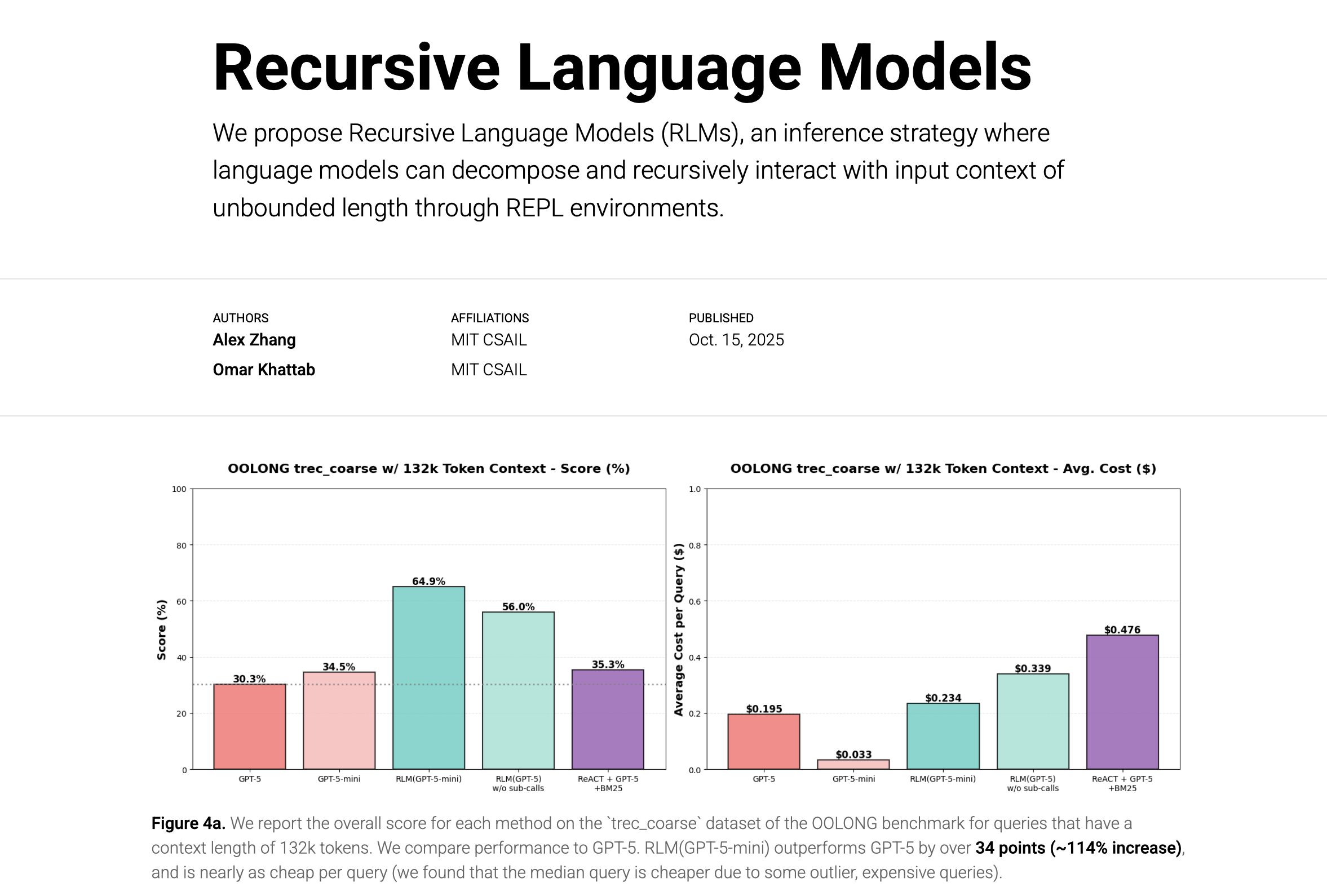
Recursive Language Models
We propose Recursive Language Models (RLMs), an inference strategy where language models can decompose and recursively interact with input context of unbounded length through REPL environments.
Compiling Higher-Order Specifications to SMT Solvers: How to Deal with Rejection Constructively | Proceedings of the 12th ACM SIGPLAN International Conference on Certified Programs and Proofs
We present a decision procedure that combines reasoning about datatypes and codatatypes. The dual of the acyclicity rule for datatypes is a uniqueness rule that identifies observationally equal codatatype values, including cyclic values. The procedure ...

Qwen3-Coder: Agentic Coding in the World
GITHUB HUGGING FACE MODELSCOPE DISCORD Today, we’re announcing Qwen3-Coder, our most agentic code model to date. Qwen3-Coder is available in multiple sizes, but we’re excited to introduce its most powerful variant first: Qwen3-Coder-480B-A35B-Instruct — a 480B-parameter Mixture-of-Experts model with 35B active parameters which supports the context length of 256K tokens natively and 1M tokens with extrapolation methods, offering exceptional performance in both coding and agentic tasks. Qwen3-Coder-480B-A35B-Instruct sets new state-of-the-art results among open models on Agentic Coding, Agentic Browser-Use, and Agentic Tool-Use, comparable to Claude Sonnet 4.