

Poland once was in economic ruins when communism fell more than three decades ago. Now it's the 20th largest economy in the world.
The myth of catch-up development: trends in core–periphery inequality from 1960 to 2023
The conventional narrative in international development holds that poorer countries are “catching up” with richer countries through the process of capitalist growth. This paper assesses this claim ...

The Formation and Evolution of the Soviet Union’s Oil and Gas Dependence
Between the end of World War II and the mid-1960s, the Soviet Union’s economy was one of the most vibrant in the world. The country had successfully launched the first man into space and was competing with the United States in developing cutting-edge military technology. However, by the end of the 1980s, the economy was in a miserable state.
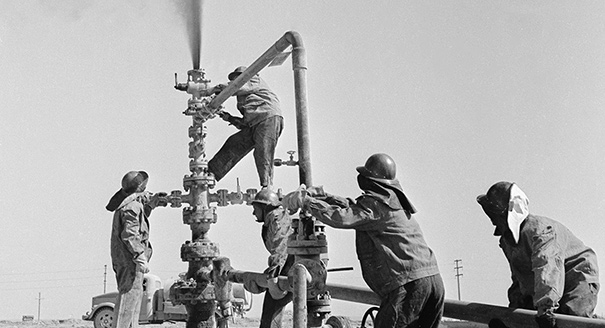
The Triumph of Broken Promises — Harvard University Press
A powerful case that the economic shocks of the 1970s hastened both the end of the Cold War and the rise of neoliberalism by forcing governments to impose austerity on their own people.Why did the Cold War come to a peaceful end? And why did neoliberal economics sweep across the world in the late twentieth century? In this pathbreaking study, Fritz Bartel argues that the answer to these questions is one and the same. The Cold War began as a competition between capitalist and communist governments to expand their social contracts as they raced to deliver their people a better life. But the economic shocks of the 1970s made promises of better living untenable on both sides of the Iron Curtain. Energy and financial markets placed immense pressure on governments to discipline their social contracts. Rather than make promises, political leaders were forced to break them.In a sweeping narrative, The Triumph of Broken Promises tells the story of how the pressure to break promises spurred the end of the Cold War. In the West, neoliberalism provided Western leaders like Ronald Reagan and Margaret Thatcher with the political and ideological tools to shut down industries, impose austerity, and favor the interests of capital over labor. But in Eastern Europe, revolutionaries like Lech Walesa in Poland resisted any attempt at imposing market discipline. Mikhail Gorbachev tried in vain to reform the Soviet system, but the necessary changes ultimately presented too great a challenge.Faced with imposing economic discipline antithetical to communist ideals, Soviet-style governments found their legitimacy irreparably damaged. But in the West, politicians could promote austerity as an antidote to the excesses of ideological opponents, setting the stage for the rise of the neoliberal global economy.

Capital in the Twenty First Century
What are the grand dynamics that drive the accumulation…

The Fallacy of Endless Economic Growth
What economists around the world get wrong about the future.

The Authoritarian Stack: Mapping Big Tech’s Capture of State Power - Rosa-Luxemburg-Stiftung
A new project exposes the infrastructure of techno-oligarchic control — and why Europe must act

Denizen
What are some of the fundamental flaws of capitalism? How might we instantiate a market-based economy that is growth agnostic?
1% for the People
Capitalism is the undisputed powerplant of global prosperity. Since Adam Smith first described the “invisible hand” that allows economies to be efficiently self-organizing and self-renewing, every attempt to supplant it with a competing system has failed spectacularly.

Roadmap - New Economies for Eradicating Poverty
Rights-based, post-growth policies that make poverty eradication a deliberate outcome of restructured economies — not a trickle-down side effect of destructive growth.
Denizen
What is out there, now, that represents a market-based economy beyond capitalism? Post Growth Institute Founder Donnie Maclurcan shares his views on what's working around the world today and his theory of change towards the next economy.
Exocapitalism: economies with absolutely no limits
There is a touch of destiny with this one. We have real…

Capitalism
Capitalism is an economic system based on the private ownership of the means of production and its use for the purpose of obtaining profit. This socioeconomic system has developed historically in several stages, and is defined by a number of constituent elements: private property, profit motive, capital accumulation, competitive markets, commodification, wage labor, and an emphasis on innovation and economic growth. Capitalist economies may experience business cycles of economic expansion followed by recessions.
Corporations and the Nazi regime
It is apparent, 90 years after the beginnings of the Nazi period, that large corporations played an important and lamentable role in Nazi power and administration, and the implementation of the atr…
Capitalism, Inequality, and the Myth of Catch-Up Development
Prevailing narratives in international development hold that poorer countries can and will "catch-up" with richer countries through the process of
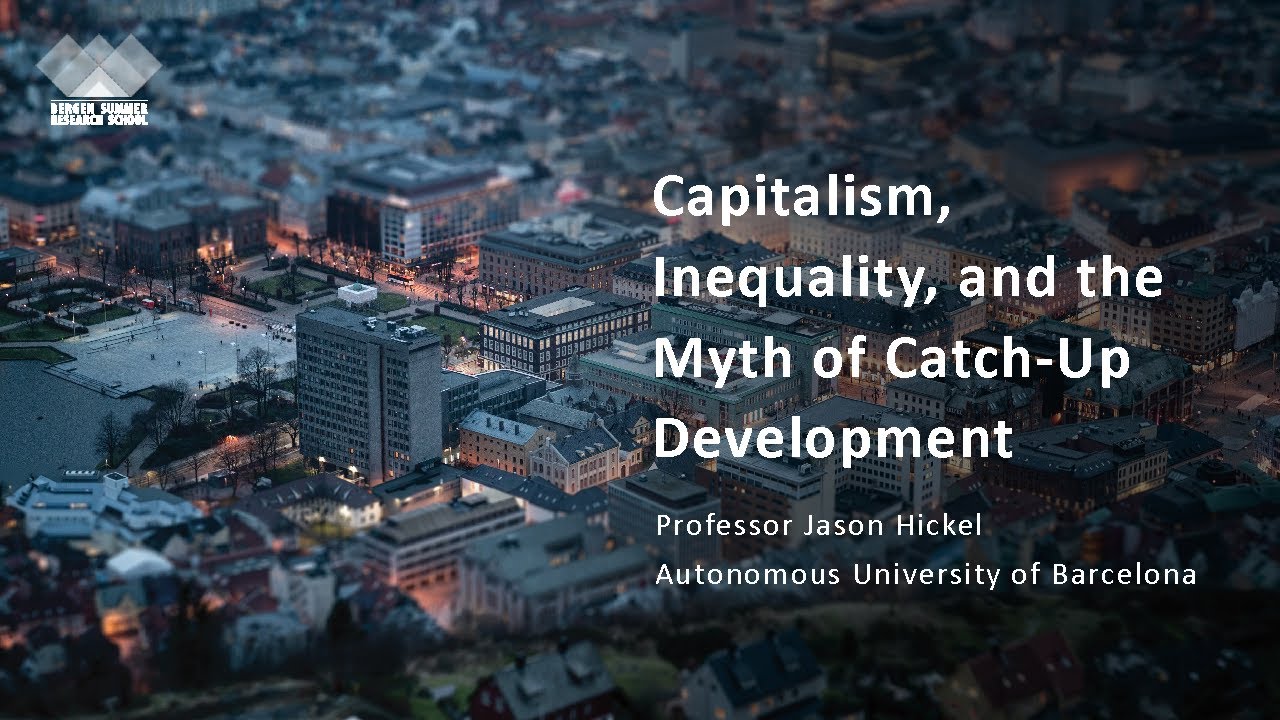
The role of small and medium-sized enterprises in development: What can be learned from the German experience?
Small and medium-sized enterprises (SMEs) play an important role for development. Of importance are Schumpeterian SMEs, which include start-ups that trigger innovation, boost productivity and bring about structural change. Normal SMEs, which only adjust to market pressure, are also important for development and employment. Germany is a role model for SMEs. This is due to several important factors: Germany's local banking system, which is not profit oriented (made up of Sparkassen, or savings banks); the dual vocational system, with its combination of practical and theoretical education; the high social capital of strong employers' associations and trade unions; government support of SME clusters and a big, government-owned development bank (the KfW). SMEs in developing countries typically suffer from limited access to long-term and affordable finance, insufficient institutions for developing a skilled class of entrepreneurs and workers, a low income, and poor policies to support economic and social upgrading of SMEs. Economic upgrading in developing countries is necessary, but it will not be successful without social upgrading. Germany - with its high social capital within the framework of a social market economy, its financial and education system, and its government support for SMEs - can stimulate debates about SMEs in developing countries.
