

A recent article in "The Atlantic" has been the subject of many comments in my Twittersphere. It's about scientific communication in the age of computer-aided research, which requires communicating computations (i.e. code, data, and results) in addition to the traditional narrative of a paper. The article focuses on computational notebooks, a technology introduced in the late 1980s by Mathematica but which has become accessible to most researchers only since Project Jupyter (formerly known as the IPython notebook) started to offer an open-source implementation supporting a wide range of programming languages. The gist of the article is that today's practice of publishing science in PDF files is obsolete, and that notebooks are the future.
Linking the world's research to the code it runs on - OpenAlex blog
Research relies on software. Software written by scientists, for science, runs through the entire modern research stack: NumPy and SciPy, R and ggplot2, Jupyter, BLAST, ImageJ, AlphaFold. Yet in the scholarly record, that software is nearly invisible. Software is not usually cited formally in publications and is usually just mentioned in the text, which means […]

Project Jupyter
The Jupyter Notebook is a web-based interactive computing platform. The notebook combines live code, equations, narrative text, visualizations, interactive dashboards and other media.

The Bazaar of Scientific Knowledge | shishyko!
Is the current form of the scientific paper still optimal in 2025? How do we preserve, and efficiently leverage, the uncut gems of the scientific process?
papers-we-love/papers-we-love
Papers from the computer science community to read and discuss.
Zechen Zhang on Twitter / X
1/ For nearly 350 years, science has communicated itself through one object: the paper. A linear narrative, frozen as a PDF, written for a human reader. We've come to treat that format as the medium of science itself.It doesn't have to be. It's a historical artifact. 🧵 pic.twitter.com/P5UUhceLkC— Zechen Zhang (@ZechenZhang5) April 30, 2026
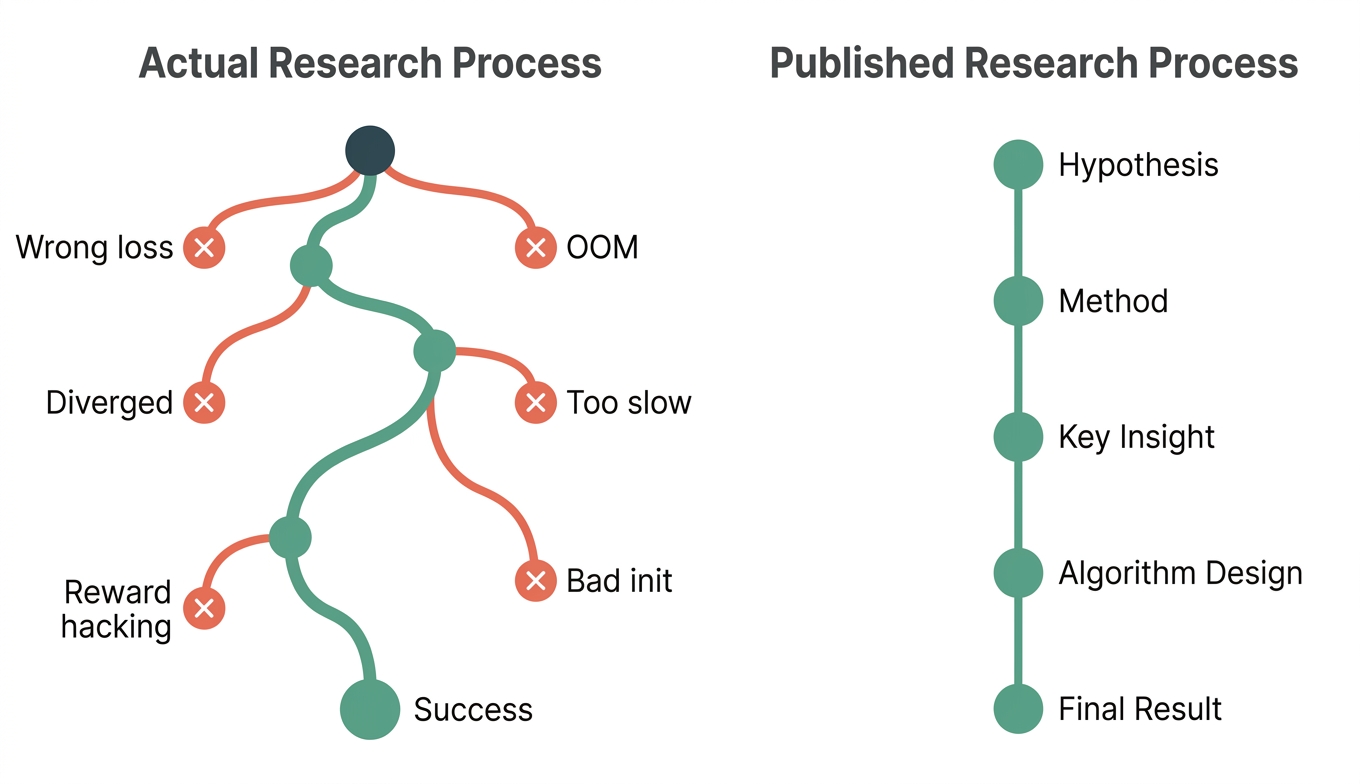
The new way we’ll do science
Papers should become human-readable views over a graph of data, tools, results, and certificates.
Introducing Aris: The publishing platform for the Post-PDF Era - Aris
We're building the future of academic publishing: tools that make it easy to create, share, and preserve knowledge in formats designed for the web, not the printing press.
A protocol for attributable modular research contribution - Matsuthoughts
I wrote this essay in response to Seemay Chou's call for essays on systemic bottlenecks to science. Structural change in scholarly communication practices i…
Scholarly Communication Is a Research Problem. This Means You.
Scholarly Communication Is a Research Problem.

Scientific production in the era of Large Language Models
Large Language Models (LLMs) are rapidly reshaping scientific research. We analyze these changes in multiple, large-scale datasets with 2.1M preprints, 28K peer review reports, and 246M online accesses to scientific documents. We find: 1) scientists adopting LLMs to draft manuscripts demonstrate a large increase in paper production, ranging from 23.7-89.3% depending on scientific field and author background, 2) LLM use has reversed the relationship between writing complexity and paper quality, leading to an influx of manuscripts that are linguistically complex but substantively underwhelming, and 3) LLM adopters access and cite more diverse prior work, including books and younger, less-cited documents. These findings highlight a stunning shift in scientific production that will likely require a change in how journals, funding agencies, and tenure committees evaluate scientific works.

From Albums to Streams: How Modularity Changes Systems
Scientific publishing is breaking under document-centric formats designed for a physical world. Borrowing from music’s shift from albums to streaming, we make the case that open access alone cannot deliver reuse, trust, or scale. The future of science depends on modular, interoperable research components that move across tools, enabling new workflows, tools, and ecosystems.
Frontiers In Research webinar on changes in science communication, the role of social media, and new infrastructure/tools - tomorrow (7/18) at 2 pm ET Looking forward to chatting with @ronentk.me & @joelchan86.bsky.social luma.com/7l18yyg4

Frontiers In Research: Open Science · Zoom · Luma
luma.comWish there was a better academic publishing system? Bluesky and its underlying ATProto technology, along with services like @chive.pub and the broader @atproto.science ecosystem, could do the job. #AcademicSky 🧪 leaflet.pub/2f431faf-c125-4d34-ac52-e41a2…

Each academic paper should have its own Bluesky account
leaflet.pub
Chive
We're ramping up our alpha, and we'd love for you to join at chive.pub! Since we launched back in January, we've been adding a ton of fun features; and to introduce them, we're going to be doing a series of deep dives over the next couple weeks on chive.leaflet.pub.
Great survey of the "scholarly interface design" frontier that also highlights the emerging role of the atproto.science and modular research ecosystems - @chive.pub @paperstarsorg.bsky.social @cosmik.network @semble.so @margin.at @discoursegraphs.bsky.social @curvenote.com and many more!

leotrs
1/ Scholarly publishing spent thirty years arguing about access. It has barely started arguing about what readers do with the paper once they have it. That second argument is turning into a field, forming around how science gets read and judged. Here is the map as I see it: aris.pub/blog/scholarly-interface-desi…
Science in the Digital Era

How does scientific research adapt to digital media and automated information processing? What are the opportunities, what are the risks?
Leibniz book
Konrad Hinsen's blog
Konrad Hinsen's blog
Konrad Hinsen's blog
Konrad Hinsen's blog
Konrad Hinsen's blog


