

Over the last years, an interesting metaphor for information and knowledge curation is beginning to take root. It compares knowledge to a landscape in which it identifies in particular two key elements: streams and gardens. The first use of this metaphor that I am aware of is this essay by Mike Caulfield, which I strongly recommend you to read first. In the following, I will apply this metaphor specifically to scientific knowledge and its possible evolution in the digital era.
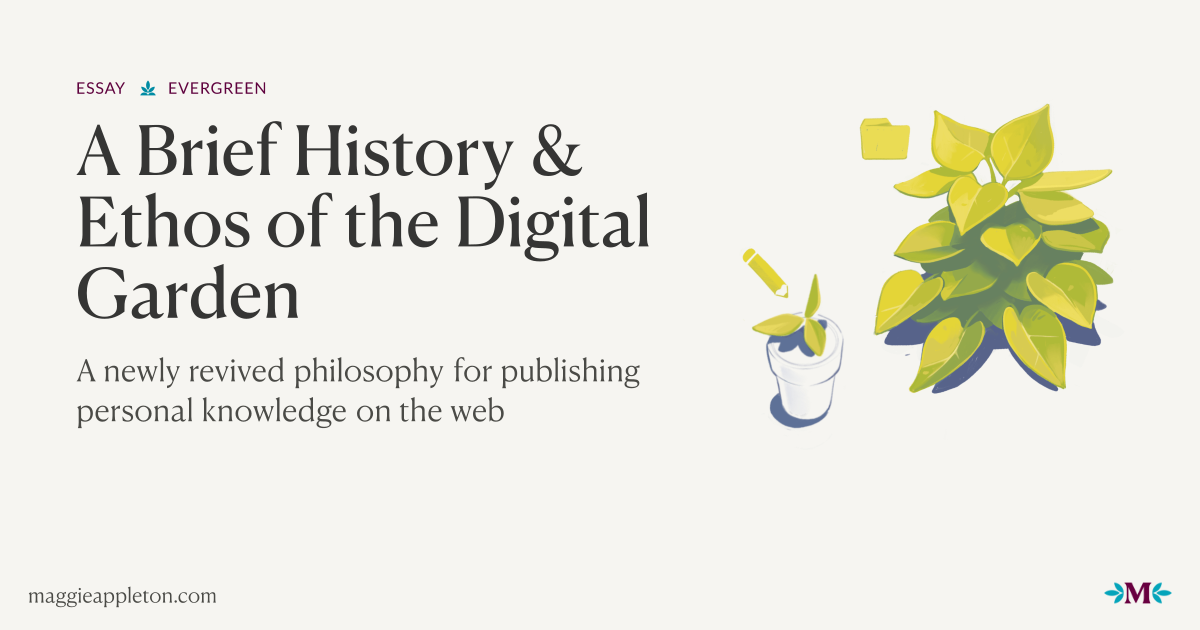
A Brief History & Ethos of the Digital Garden
A newly revived philosophy for publishing personal knowledge on the web
Everything is miscellaneous : the power of the new digital disorder
Includes bibliographical references (p. [235]-257) and index; Prologue : information in space -- The new order of order -- Alphabetization and its discontents -- The geography of knowledge -- Lumps and splits -- The laws of the jungle -- Smart leaves -- Social knowing -- What nothing says -- Messiness as a virtue -- The work of knowledge -- Coda : misc; Philosopher Weinberger shows how the digital revolution is radically changing the way we make sense of our lives. Human beings constantly collect, label, and organize data--but today, the shift from the physical to the digital is mixing, burning, and ripping our lives apart. In the past, everything had its one place--the physical world demanded it--but now everything has its places: multiple categories, multiple shelves. Everything is suddenly miscellaneous. Weinberger charts the new principles of digital order that are remaking business, education, politics, science, and culture. He examines how Rand McNally decides what information not to include in a physical map (and why Google Earth is winning that battle), how Staples stores emulate online shopping to increase sales, why your children's teachers will stop having them memorize facts, and how the shift to digital music stands as the model for the future.--From publisher description; From A to Z, Everything Is Miscellaneous will completely reshape the way you think - and what you know - about the world. Includes information on alphabetical order, Amaxon.com, animals, Aristotle, authority, Bettmann Archive, blogs (weblogs), books, broadcasting, British Broadcasting Corporation (BBC), business, card catalog, categories and categorization, clusters, companies, Colon Classification, conversation, Melvil Dewey, Dewey Decimal Classification system, Encyclopaedia Britannica, encyclopedia, essentialism, experts, faceted classification system, first order of order, Flickr.com, Google, Great Books of the Western World, ancient Greeks, health and medical information, identifiers, index, inventory tracking, knowledge, labels, leaf and leaves, libraries, Library of Congress, links, Carolus Linnaeus, lumping and splitting, maps and mapping, marketing, meaning, metadata, multiple listing services (MLS), names of people, neutrality or neutral point of view, New York Public Library, Online Computer Library Center (OCLC), order and organization, people, physical space, everything having place, Plato, race, S.R. Ranganathan, Eleanor Rosch, Joshua Schacter, science, second order of order, simplicity, social constructivism, social knowledge, social networks, sorting, species, standardization, tags, taxonomies, third order of roder, topical categorization, tree, Uniform Product Code (UPC), users, Jimmy Wales, web, Wikipedia, etc

epistemic garden - mapping how ideas spread online
We're building tools to help communities understand their information landscape and protect against harmful coordinated narratives.
See what you think
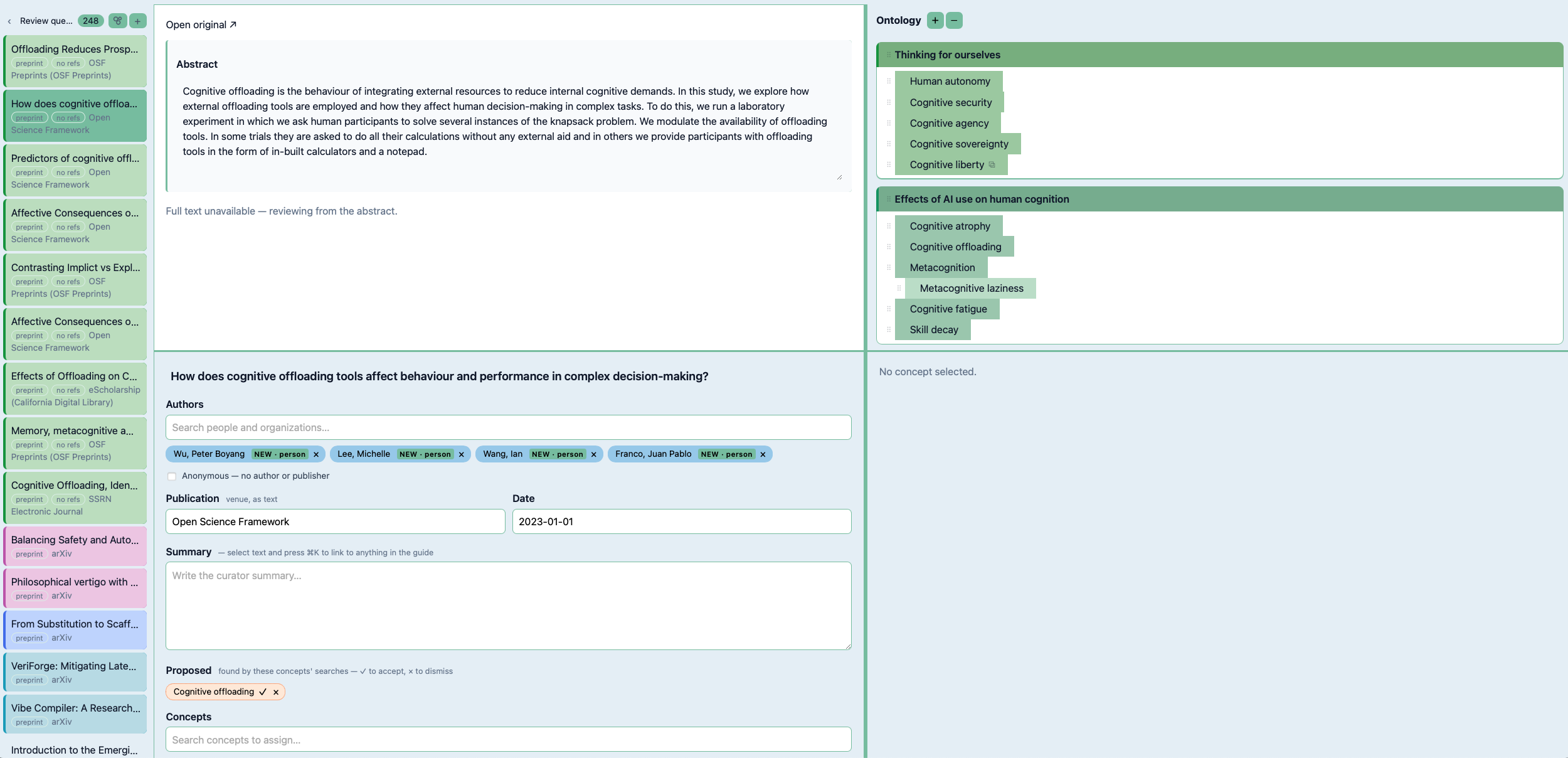
Allegra A. Beal Cohen's blog about knowledge curation, new interfaces, and large-scale qualitative data.
digital garden
A digital garden is effectively an interconnected set of publicly available notes. You can think of it as a highly personal wiki, except its objective isn’t ...
Information is Beautiful
Distilling the world's data, information & knowledge into beautiful infographics & visualizations

Of Digital Streams, Campfires and Gardens
Building personal learning environments across the different time horizons of information consumption
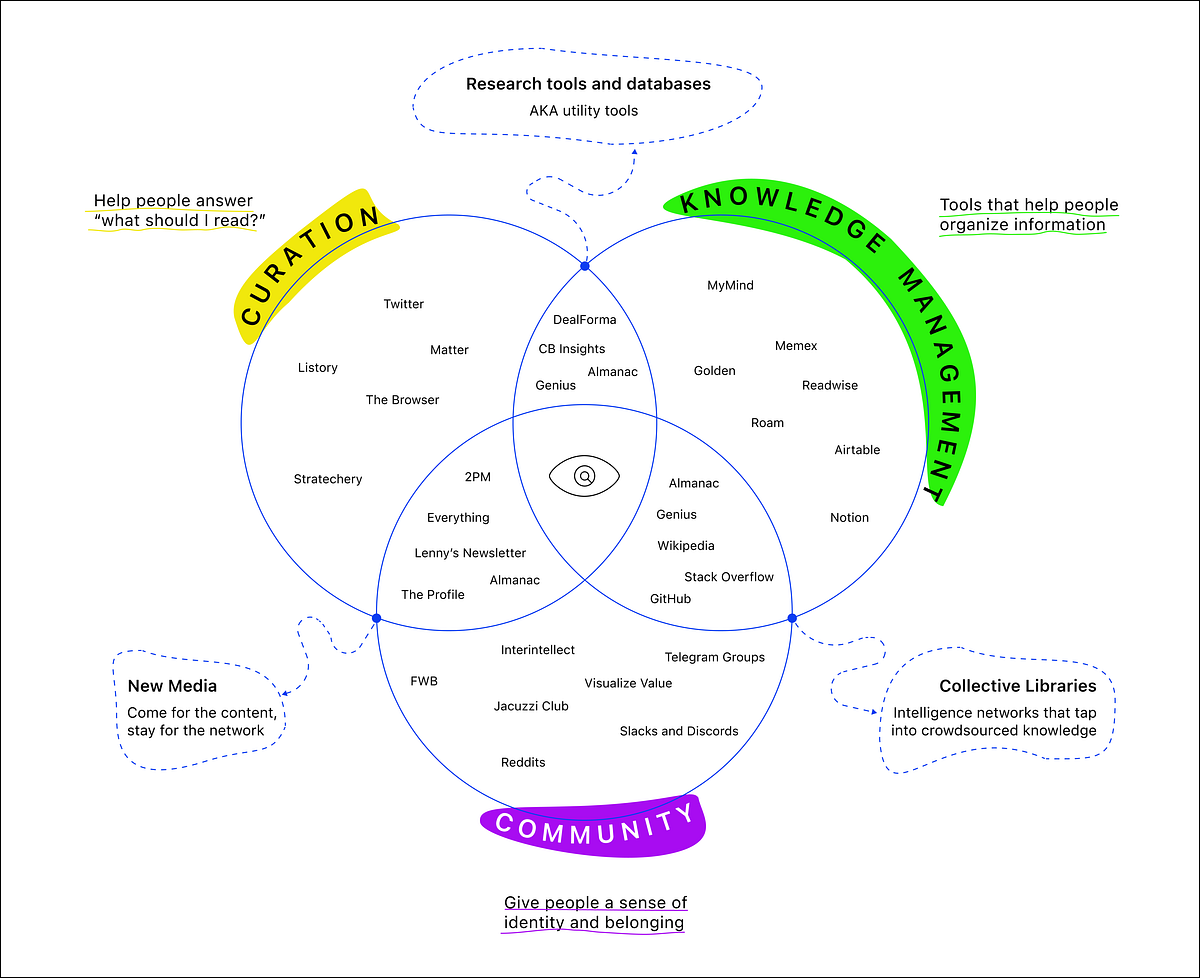
The rise of community-curated knowledge networks
The Internet put thousands of years of human thought at our fingertips, and enabled billions of people to create content. At least 2.5…
Digital Degrowth: Radically Rethinking our Digital Futures
We are fast approaching the point of “peak digital”, with the continued mass production and excessive consumption of digital technologies set to become a key driver of climate crisis, ecological breakdown and ongoing societal instability.<br /> <br /><i>Digital Degrowth</i> is a call to completely rethink our digital futures in these fast-changing times. It explores how degrowth thinking and alternate forms of “radically sustainable computing” might support ambitions of sustainable, scaled-down and equitable ways of living with digital technologies. Neil Selwyn proposes a rebalancing of digital technology use: digital degrowth is not a call for simply making reduced use of the digital technologies that we already have – rather it is an argument to reimagine digital practices that maximise societal benefits with minimal environmental and social impact. Drawing on illustrative examples from across computer science, hacker and environmental activist communities, this book examines how core degrowth principles of conviviality, autonomy and care are already being used to reimagine alternate forms of digital technology.<br /> <br />Original and stimulating, this is essential reading for students and scholars of media and communication, sustainability studies, political ecology, computer/data sciences, and across the social sciences.

The Garden and the Stream: A Technopastoral
Opening keynote for dLRN 2015. Delivered October 16th @ Stanford. Actual keynote may have gone on significant tangents… 1 | a year in the garden A week or so ago, I was reading about the Oreg…

Garden and the Stream - thoughts
Revisiting a prescient 2015 keynote called The Garden and the Stream and analyzing where the AT protocol fits in the web
Reinventing Discovery: The New Era of Networked Science
In Reinventing Discovery, Michael Nielsen argues that w…

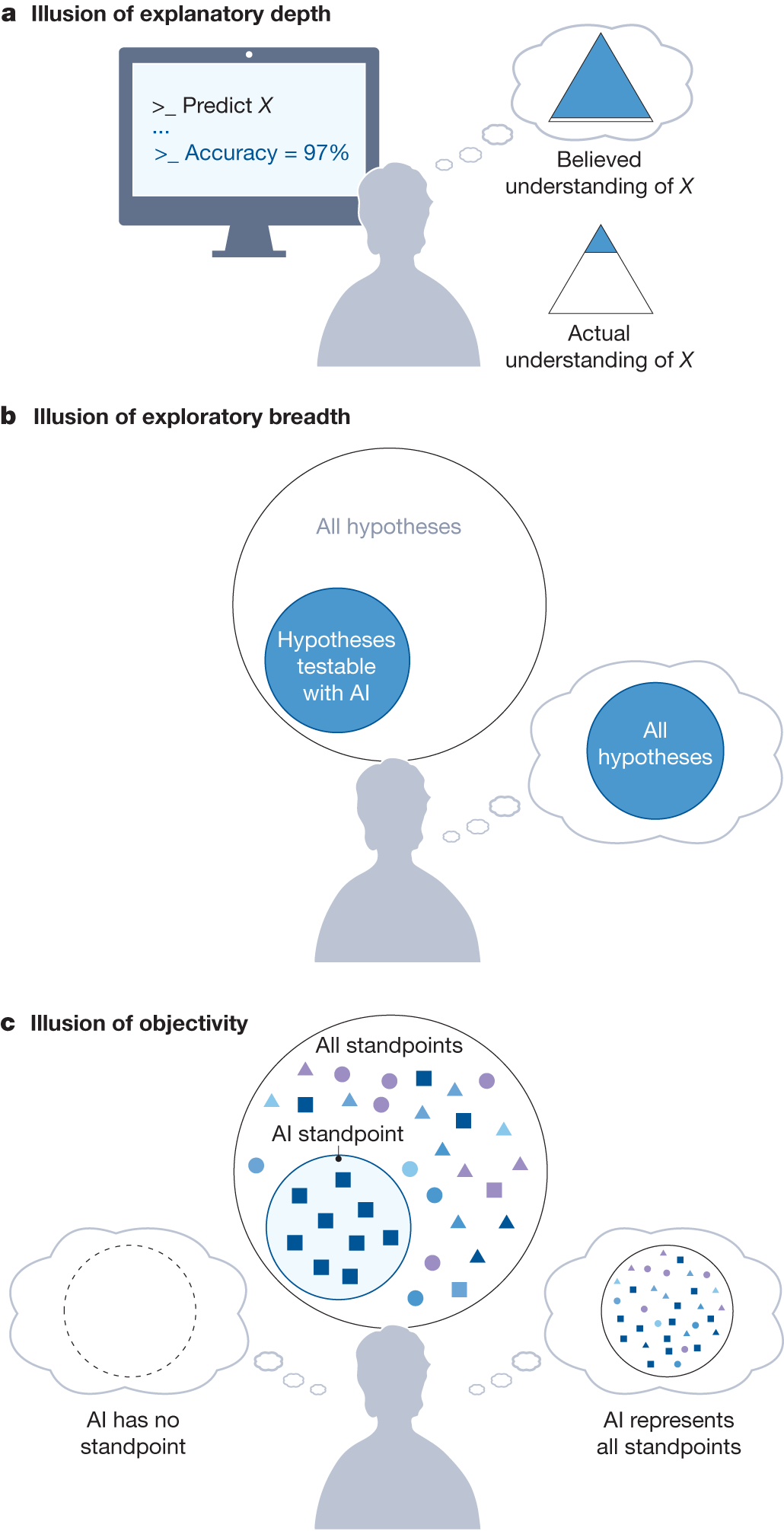
Artificial intelligence and illusions of understanding in scientific research
Scientists are enthusiastically imagining ways in which artificial intelligence (AI) tools might improve research. Why are AI tools so attractive and what are the risks of implementing them across the research pipeline? Here we develop a taxonomy of scientists’ visions for AI, observing that their appeal comes from promises to improve productivity and objectivity by overcoming human shortcomings. But proposed AI solutions can also exploit our cognitive limitations, making us vulnerable to illusions of understanding in which we believe we understand more about the world than we actually do. Such illusions obscure the scientific community’s ability to see the formation of scientific monocultures, in which some types of methods, questions and viewpoints come to dominate alternative approaches, making science less innovative and more vulnerable to errors. The proliferation of AI tools in science risks introducing a phase of scientific enquiry in which we produce more but understand less. By analysing the appeal of these tools, we provide a framework for advancing discussions of responsible knowledge production in the age of AI.
Digital Gardens

"A garden is a collection of evolving ideas that aren’t strictly organised by their publication date. "
Digital gardening

Digital gardens in theory and practice
Science in the Digital Era

How does scientific research adapt to digital media and automated information processing? What are the opportunities, what are the risks?

Home
Welcome
The Garden of Maggie Appleton
Desert Thunder's Digital Garden
Hey stranger, I'm Hayleigh.
A Brief History & Ethos of the Digital Garden
oleeskild/obsidian-digital-garden
Tranquil PDS
Garden and the Stream - thoughts
Digital Gardens (by owais) — Semble
digital gardens (by treethought) — Semble
Leibniz book
Konrad Hinsen's blog
Konrad Hinsen's blog
Konrad Hinsen's blog
Konrad Hinsen's blog
Konrad Hinsen's blog