

being utopian about the web is very 90s but this is like everything people dreamed the web would be. I need to read more about atproto asap overreacted.io/open-social/

Cosmik Network
Semble alpha is now open! ✨ Check it out at semble.so More details in our leaflet pub! (link in next post > )
Nov 7, 2025 at 6:46 PM
Rewilding the internet with ATProto
So far, many of the projects in the ATProtocol ecosystem have focused on bringing parity—making projects that replicate our existing tools and platforms, but with the affordances of the protocol instead. That's cool and we need to do that, but I think we can go much farther, and take this opportunity to challenge some of the biggest assumptions of what the modern internet is for, who builds it, and how we interact with it. This talk is in conversation with several of the talks from last year, and in I'll argue that we'll never get away from skeuomorphism until we've fundamentally changed the definition of what "the social internet" means in the first place.
Historical pragmatism and the internet
This article argues that the literature describing the internet revolution in the 1990s was characterized by the rhetoric of the technological sublime. This rhetoric suffered from three fatal flaws: (1) it was not sufficiently grounded in the historical development of technology; (2) it viewed the internet in isolation, failing to consider the wider technological context; and (3) it failed to examine the internet in view of the social, economic, religious and political circumstances of its users. Several examples from history are cited, demonstrating that changes in various systems for the production, dissemination and preservation of cultural information both border and deborder the world. The article suggests that if internet researchers take a pragmatic, historically grounded approach, they will discover that the introduction of internet technology can be seen to have similar consequences. While the technology overcomes many boundaries (of space and time, politics and economics), other social borders may be created at the same time. It is easier to see old boundaries coming down than to see new ones being erected. Rather than being swept by utopian or dystopian enthusiasms, the article insists that the really interesting discoveries are to be made in locating the subtle social shifts taking place, relatively unnoticed, as a consequence of technological change.

ATProto ideas
If AT Protocol becomes “a meaningful layer of the web” — even if it’s only tens of millions of users — then the winning ideas probably won’t only be futuristic...
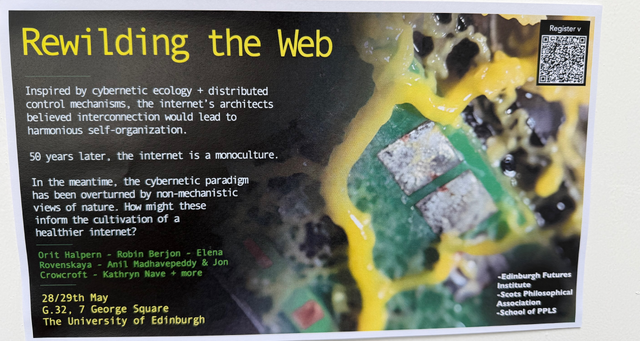
Rewilding the Web: my workshop report from Edinburgh
Notes from a wonderfully interdisciplinary Edinburgh workshop on 'Rewilding the Web', ranging coopetition and biological variety through the philosophy of self-organisation, polycrisis governance, protopian science fiction, and moderation seen through the lens of artisanal cheese.
Utopian media studies: Introduction
This introduction to the special issue ‘Utopian Media Studies’ sketches a framework for how media studies can become a site of utopian praxis, research and experimentation. It first addresses three apprehensions media scholars might have about the notion of utopian media studies and its appeal to a loaded concept like ‘utopia’. The introduction then outlines five sensibilities to explicate the nature and significance of this special issue’s contribution to the field: a utopian media studies must adopt an ecological approach to media; recognize and be invigorated by limits; work toward the technological liberation of time; connect imagination with practice; and emphasize and enable conditions for transmitting hope. Lastly, the introduction considers Ruth Levitas’s distinction between utopia’s archaeological, ontological, and architectural mode to map some of the concrete ways in which existing media studies research is doing utopian work that aligns with these sensibilities. In connecting work that operates in these modes with the various contributions to this special issue, the introduction reveals the utopian currents that already run through media studies as a discipline and opens up new conceptual and methodological approaches to studying and modeling digital utopias.
Utopian media studies: Introduction
This introduction to the special issue ‘Utopian Media Studies’ sketches a framework for how media studies can become a site of utopian praxis, research and experimentation. It first addresses three apprehensions media scholars might have about the notion of utopian media studies and its appeal to a loaded concept like ‘utopia’. The introduction then outlines five sensibilities to explicate the nature and significance of this special issue’s contribution to the field: a utopian media studies must adopt an ecological approach to media; recognize and be invigorated by limits; work toward the technological liberation of time; connect imagination with practice; and emphasize and enable conditions for transmitting hope. Lastly, the introduction considers Ruth Levitas’s distinction between utopia’s archaeological, ontological, and architectural mode to map some of the concrete ways in which existing media studies research is doing utopian work that aligns with these sensibilities. In connecting work that operates in these modes with the various contributions to this special issue, the introduction reveals the utopian currents that already run through media studies as a discipline and opens up new conceptual and methodological approaches to studying and modeling digital utopias.
Decentralisation and blogging on atproto - Connected Places
The space for blogging and long-form writing on atproto is rapidly developing, and it gives some interesting insight in what decentralisation on atproto looks like

My journey to the heart of the forgotten internet
Slowly but surely, huge swaths of the internet are vanishing. But the artefacts of the early web are still out there, and they have lessons for the future.

Why I'm betting on ATProto (and why you should, too) — Brittany Ellich
Social media was supposed to connect us, but most of it has turned into ads, division, and loneliness. I'm betting on ATProto as a way to fix that, and not just for developers. Whether you're a scientist, journalist, or just someone who wants the internet to feel human again, I think ATProto matters for you too.

The web was always social Diving into the idea of bridging different social networks and protocols like ATproto and ActivityPub to enhance the web. Looking back at my personal web journey, from Web 2.0 to now, emphasizing that building connections... herve.bzh/the-web-was-always-social/
The web was always social
herve.bzhCheck more about the concept on Open Social Media (and back to Open Web), and how it might be the future (hopefully) of the web.

Open Social Media (and back to Open Web)
www.ssp.shConversation here is very helpful framing for ATProto builders. The protocol has re-created the opportunity to restore the web as an open curation ecosystem that isn't controlled by any one platform, built not just on links between pages, but on the relationships between people, links and sources.

Building Through Every Wave: Mike Mcue on the Internet, Mobile, & AI Eras
www.youtube.comI wrote something about atproto from the perspective of having lived through the early days of the internet. timtrautmann.com/blog/the-nerds-are-building-a…

The nerds are building a new internet, and I could feel it in the room
timtrautmann.comIf you had asked me a year ago, I would have told you that the ATProtocol was the future of social media. If you'd asked me at the end of last year, I would have told you that it was the future of the web as well. Today I think it could be bigger even than that.

Atmosphere conference report
mathewlowry.leaflet.pubatproto-reads

blogs and writing about atproto (maybe also open social generally)

The Bluesky ecosystem has the juice (ATProto for normies) - Nate Spilman

nothin' but blue skies from now on
What It Means for Universities to Run Their Own PDS: The Potential of DID as Academic Infrastructure - Nightflight
From Attention to Intention - The Open Garden
Practical Decentralization


