

Ooof, this is really bad and their lackadaisical response is even worse

Robin Berjon
It looks like W Identity, the part of @wsocial.eu that checks your papers before you go in, has a very basic XSS on its admin backend, found hours after launch. This seems almost too predictable... Cyberfriends, any thoughts on how bad? 23.social/@kantorkel/116767220594438841
Jun 19, 2026 at 1:17 PM
Ask don't tell: Reducing sycophancy in large language models
Sycophancy, the tendency of large language models to favour user-affirming responses over critical engagement, has been identified as an alignment failure, particularly in high-stakes advisory and...

More On An Internal OpenAI Model Hacking Into HuggingFace
We now have more details of what happened. Every time we learn more details, it somehow makes things seem worse.

Why Idle games make good satire, and how it was ruined.
Do LLMs Exhibit Human-like Response Biases? A Case Study in Survey Design
Abstract One widely cited barrier to the adoption of LLMs as proxies for humans in subjective tasks is their sensitivity to prompt wording—but interestingly, humans also display sensitivities to instruction changes in the form of response biases. We investigate the extent to which LLMs reflect human response biases, if at all. We look to survey design, where human response biases caused by changes in the wordings of “prompts” have been extensively explored in social psychology literature. Drawing from these works, we design a dataset and framework to evaluate whether LLMs exhibit human-like response biases in survey questionnaires. Our comprehensive evaluation of nine models shows that popular open and commercial LLMs generally fail to reflect human-like behavior, particularly in models that have undergone RLHF. Furthermore, even if a model shows a significant change in the same direction as humans, we find that they are sensitive to perturbations that do not elicit significant changes in humans. These results highlight the pitfalls of using LLMs as human proxies, and underscore the need for finer-grained characterizations of model behavior.1

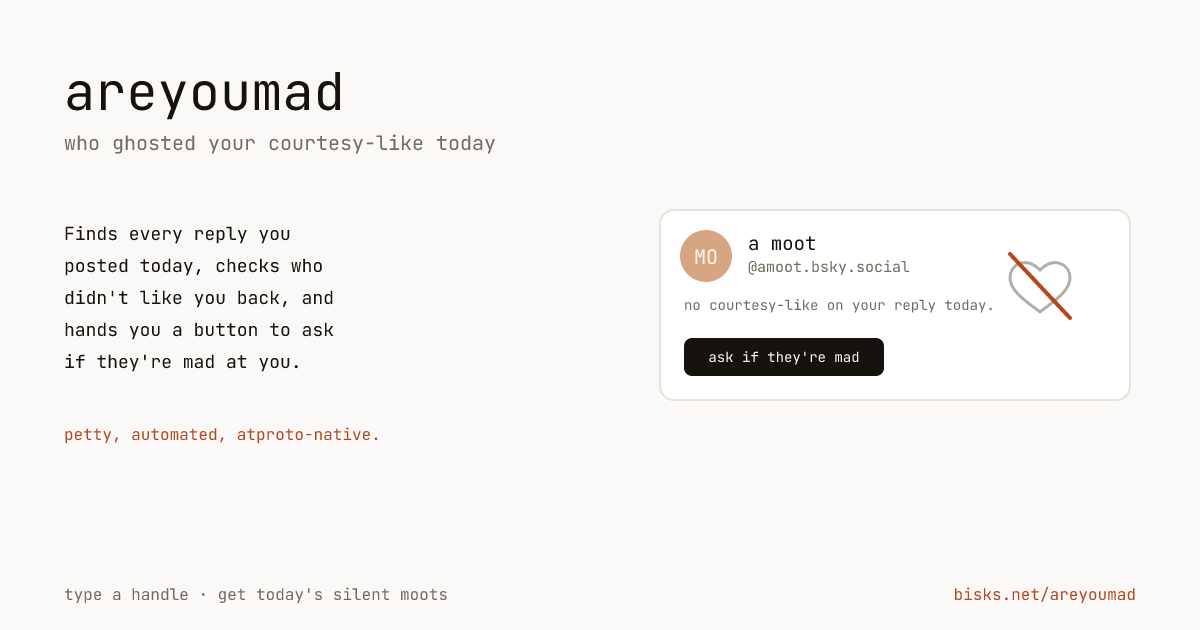
areyoumad — who ghosted your courtesy-like today
Finds today's replies, checks who didn't like you back, gives you a button to ask if they're mad.
Australia’s teen social media ban is a flop. But there’s no joy in ‘I told you so’ | Samantha Floreani
Around seven in 10 children remain on major platforms. Who could possibly have predicted that this wasn’t going to work? Well, lots of people

The Failure Mode of Clever
So, apropos of nothing in particular, let’s say you wish to communicate privately with someone you’ve not communicated with privately before, for whatever reason you might have. And, wa…

Refusal in Language Models Is Mediated by a Single Direction
Conversational large language models are fine-tuned for both instruction-following and safety, resulting in models that obey benign requests but refuse harmful ones. While this refusal behavior is widespread across chat models, its underlying mechanisms remain poorly understood. In this work, we show that refusal is mediated by a one-dimensional subspace, across 13 popular open-source chat models up to 72B parameters in size. Specifically, for each model, we find a single direction such that erasing this direction from the model's residual stream activations prevents it from refusing harmful instructions, while adding this direction elicits refusal on even harmless instructions. Leveraging this insight, we propose a novel white-box jailbreak method that surgically disables refusal with minimal effect on other capabilities. Finally, we mechanistically analyze how adversarial suffixes suppress propagation of the refusal-mediating direction. Our findings underscore the brittleness of current safety fine-tuning methods. More broadly, our work showcases how an understanding of model internals can be leveraged to develop practical methods for controlling model behavior.
A big week for AI denialism
In the wake of OpenAI’s cyberattack against Hugging Face, few seem ready to acknowledge the implications
Jan Kulveit on Twitter / X
To take the most egregious example, in the tweet you say"No. Agents lines of code. They do not feel emotions, assume things, think things, want things, or figure things out." [frame is asking people to not use such language]This is wrong on many levels.The meta-problem is…— Jan Kulveit (@jankulveit) September 1, 2026
Okay, who's going to write a response to this... @eikofried.bsky.social @ajshackman.bsky.social @awaisaftab.bsky.social @nicolecrust.bsky.social nature.com/articles/s41398-026-03943-5
humble opinon: it's hard to be taken seriously when you tell everyone about respecting users' agency and then force a change of *their content presentation* with no controls in other words: why do y'all have so much care at the protocol level and seems to have so little on everything user facing?!
Ooof, this is really bad and their lackadaisical response is even worse
Robin Berjon
It looks like W Identity, the part of @wsocial.eu that checks your papers before you go in, has a very basic XSS on its admin backend, found hours after launch. This seems almost too predictable... Cyberfriends, any thoughts on how bad? 23.social/@kantorkel/116767220594438841
ABC Australia has a YouTube series called “You Can’t Ask That” in which they bring in people from various marginalized/stereotyped groups who have volunteered to answer “inappropriate” questions. I’m sure they aren’t fully representative but they do foster empathy & I think they’re generally great.

Muslim women on hijabs, gender inequality, abuse and faith | You Can't Ask That | Full Episode
youtu.beI increasingly believe that most replies in big-room social spaces are really semantic tagging: "this post is that kind of thing!" "this post has a keyword I don't like!" Sometimes you get canned responses that people deliver in response to the tagging/sorting they've done. "I have a meme!"


