

bruh was nobody going to tell me I was cited in the February issue of the New Scientist magazine by name (page 48, a few inches in the Feedback column)? this is wild lol fliphtml5.com/oddka/ehpw/

hikikomorphism
If you can substitute "hungry ghost trapped in a jar" for "AI" in a sentence it's probably a valid use case for LLMs. Take "I have a bunch of hungry ghosts in jars, they mainly write SQL queries for me". Sure. Reasonable use case. "My girlfriend is a hungry ghost I trapped in a jar"? No. Deranged.
Nov 7, 2026 at 4:02 AM
Strange New Rules
Issue #1: A new magazine of stories, studies, and science
White House Health Report Included Fake Citations (Published 2025)
A report on children’s health released by the Make America Healthy Again Commission referred to scientific papers that did not exist.

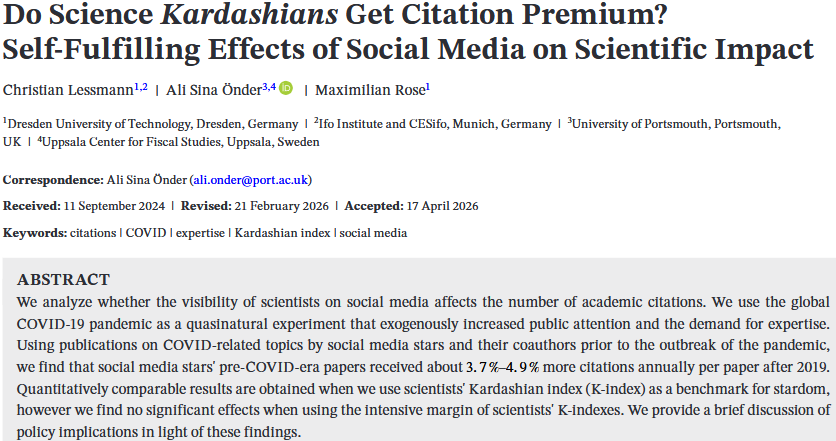
Do Science <i>Kardashians</i> Get Citation Premium? Self‐Fulfilling Effects of Social Media on Scientific Impact
ABSTRACT We analyze whether the visibility of scientists on social media affects the number of academic citations. We use the global COVID‐19 pandemic as a quasinatural experiment that exogenously increased public attention and the demand for expertise. Using publications on COVID‐related topics by social media stars and their coauthors prior to the outbreak of the pandemic, we find that social media stars' pre‐COVID‐era papers received about – more citations annually per paper after 2019. Quantitatively comparable results are obtained when we use scientists' Kardashian index (K‐index) as a benchmark for stardom, however we find no significant effects when using the intensive margin of scientists' K‐indexes. We provide a brief discussion of policy implications in light of these findings.

Decolonising Science Reading List
In the last couple of weeks, a lot of people have been asking me about what I’ve been reading as reference points for my commentary on the…
Quotation errors in general science journals
Abstract. Due to the incremental nature of scientific discovery, scientific writing requires extensive referencing to the writings of others. The accuracy
Dan Singleton 🏳️🌈🏳️⚧️ on Twitter / X
1. Ok, this is the thread to end all threads, or possibly my career. I am about to trash a new paper in @sciencemagazine, its editors, its reviewers, C&E News, others who stated or wrote adoring commentaries, anyone who looked at the paper or its commentaries without seeing pic.twitter.com/K5O1cX1BJP— Dan Singleton 🏳️🌈🏳️⚧️ (@dasingleton) April 8, 2019
Breaking the silence
Research on science communication has largely focused on teaching scientists how to describe their studies in ways that interest the public while deepening their understanding of scientific exploration. However, there is another, often overlooked side to science communication—how scientists respond when questions arise about the integrity of their research. Often, the tendency has been to stay silent and wait for any controversy to pass or be resolved in professional forums. But in an age of growing, intense attacks on science, silence can be detrimental to both public trust and the careers of scientists who are under scrutiny. For better or worse, journalists, social media professionals, and the public may take a response of “no comment” as a concession that the critics are correct, so forthright communication about research questions is more urgent than ever.

The Curious About Everything Newsletter #48
The many interesting things I read in February 2025
Q&A from the slop trenches – GeoSpatial ML
We reviewed 22 ML conference submissions this summer. Fifteen had fabricated citations, hallucinated authors, or clear LLM slop, so we complain about that a bit, and release the paper references audit we now run.
Citing Less Critically: LLMs Reshape the Rhetoric and Reach of Scientific Citation
Scientific citations carry rhetorical intent. Scholars may cite prior work positively (supporting), negatively (contrasting), or neutrally (mentioning). As large language models (LLMs) increasingly assist scientific writing, whether they reproduce citations with the same rhetorical intent as humans remains unclear. We introduce a masked-citation task to compare human and LLM-generated citation behavior. For each citation context, an LLM generates a replacement citation sentence, producing a counterfactual corpus directly comparable to human citation. We analyze what, whom, and how models cite, using an LLM-as-a-judge to classify citation intent and a 20-million-edge coauthorship network to measure social distance between cited authors. Across six popular LLMs and 1,746 top NLP conference papers (63k+ contexts, 132k+ citations), three patterns emerge: (1) Compared with human citation, LLMs cite significantly less critically; (2) LLMs over-cite popular and older papers, a tendency amplified for contrasting citations where human writing more often draws on recent, niche work; (3) Whereas humans often cite within their close social network, especially for supporting citations, LLMs tend to draw on more socially distant authors. Together, these differences are double-edged: LLM citation reaches beyond a scholar's close collaborators while being less critical and amplifying visibility bias, reshaping the rhetoric and reach of scientific citation.

Ali Sina Önder on Twitter / X
Does your social media visibility affect your citations? Yes because social media visibility enhances your "expert" status. Here is the brand new paper with @econ_lessmann and Max Rose: https://t.co/KJaxgOaAYQ @davidstadelmann @MishaTeplitskiy @csugimoto @voxeu @AntonioFatas pic.twitter.com/kioHRJ0gYH— Ali Sina Önder (@asonder79) May 3, 2026
Incorrect Citation Association for Articles in Online-Only Springer Nature Journals
We show that citation metrics of journal articles in many of the online-only Springer Nature journals and associated ones are distorted, going back to articles from 2001. We find that most likely due to an API response error, there are many incorrect references which typically lead to Article Number 1 of a given Volume. Among others, the issue affects journals such as Scientific Reports, Nature Communications, Communications journals, Cell Death & Disease, Light: Science & Applications, as well as many BMC, Discovery and npj journals. Beyond the negative effect of introducing incorrect reference information, this distorts the citation statistics of articles in these journals, with a few articles being massively over-cited compared to their peers, while many lose citations; e.g. both in Scientific Reports and in Nature Communications, 5 of the 10 top cited articles have article numbers of 1. We validate the distorted statistics by assessing data from multiple scientific literature databases: Crossref, OpenCitations, Semantic Scholar, and the journals' websites. The issue primarily arises from the inconsistent transition from page-based referencing of articles to article number-based referencing, as well as the improper handling of the change in the publisher's article metadata API. It seems that the most pressing problem has been present since approximately 2011, which we estimate affects the citation count of millions of authors.
back in 2012, @kissane.myatproto.social invited me to write an article for (the ostensibly now-defunct) Contents Magazine: doriantaylor.com/no-longer-no-sense-of-an-endi… i haven't looked at it in a while; it's kind of a clumsy article actually but (because?) it considers two tangentially-related concerns…

No Longer No Sense of an Ending
doriantaylor.comReally important to notice the sleight of hand here. Nobody reported that @wsocial.eu *leaked* the data (except for W Social saying in their denials that others reported this). We all agree this over-publication was done on purpose, by design, in a way that is not totally clear to everyday users.

heiseonline
Das soziale Netz W Social will sich mit einer Verifizierung aller Konten von der Konkurrenz abheben. Dass einige gesammelte Daten publik sind, sei kein Fehler. #Social Media
I read this result as: LLMs do more bullshit citations, name-dropping without engaging.

infoDOCKET
Citing Less Critically: #LLMs Reshape the Rhetoric and Reach of #Scientific #Citation (New Research Article (preprint); via @arxiv.bsky.social) arxiv.org/abs/2609.01432 #scholcomm #citations #libraries #AI #GenAI
Oh no it's happening here too! Massive science threads and convos with zero involvement from women 😭 That was one of the weirdest, most alienating things about science twitter (and why perhaps I don't have as fond memories of it as some of my male colleagues do) and I'd hate it to be replicated here


