


Anthropologist - Bayesian modeling - science reform - cat and cooking content too - Director @ MPI for evolutionary anthropology https://www.eva.mpg.de/ecology/staff/richard-mcelreath/
Richard McElreath Director Department of Human Behavior, Ecology, and Culture [link] Max Planck Institute for Evolutionary Anthropology [link]
The Scientist Who Scrambled Darwin’s Tree of Life (Published 2018)
How the microbiologist Carl Woese fundamentally changed the way we think about evolution and the origins of life.

Sapiens [Tenth Anniversary Edition]: A Brief History of Humankind
New York Times Readers’ Pick: Top 100 Books of the 21st CenturyThe tenth anniversary edition of the internationally bestselling phenomenon that cemented Yuval Noah Harari as one of the most prominent historians of our time—featuring a new afterword from the author.One hundred thousand years ago, at least six human species inhabited the earth. Today there is just one. Us. Homo sapiens. How did our species succeed in the battle for dominance? Why did our foraging ancestors come together to create cities and kingdoms? How did we come to believe in gods, nations, and human rights; to trust money, books, and laws; and to be enslaved by bureaucracy, timetables, and consumerism? And what will our world be like in the millennia to come?In Sapiens, Professor Yuval Noah Harari spans the whole of human history, from the very first humans to walk the earth to the radical—and sometimes devastating—breakthroughs of the Cognitive, Agricultural, and Scientific Revolutions. Drawing on insights from biology, anthropology, paleontology, and economics, and incorporating full-color illustrations throughout the text, he explores how the currents of history have shaped our human societies, the animals and plants around us, and even our personalities. Can we ever free our behavior from the legacy of our ancestors? And what, if anything, can we do to influence the course of the centuries to come?Bold, wide-ranging, and provocative, Sapiens integrates history and science to challenge everything we thought we knew about being human: our thoughts, our actions, our heritage...and our future.
Ronen Tamari (@ronentk.me)
Researcher & entrepreneur | Co-founder @cosmik.network | Building @semble.so | collective sensemaking | https://ronentk.me/ | Ecosystem building @atproto.science @cairos.network | Prev- Open Science Fellow @asterainstitute.bsky.social
Ronen Tamari
Researcher & entrepreneur | Co-founder @cosmik.network | Building @semble.so | collective sensemaking | https://ronentk.me/ | Ecosystem building @atproto.science @cairos.network | Prev- Open Science Fellow @asterainstitute.bsky.social
The Chef Mailing List – Noah Kantrowitz
Recently the Chef community mailing list was migrated to Discourse. This caused some confusion and unhappiness in the community so I wanted to write up a quick overview of the situation as I know it.
The evolution of cultural adaptations: Fijian food taboos protect against dangerous marine toxins
The application of evolutionary theory to understanding the origins of our species' capacities for social learning has generated key insights into cultural evolution. By focusing on how our psychology has evolved to adaptively extract beliefs and practices by observing others, theorists have hypothesized how social learning can, over generations, give rise to culturally evolved adaptations. While much field research documents the subtle ways in which culturally transmitted beliefs and practices adapt people to their local environments, and much experimental work reveals the predicted patterns of social learning, little research connects real-world adaptive cultural traits to the patterns of transmission predicted by these theories. Addressing this gap, we show how food taboos for pregnant and lactating women in Fiji selectively target the most toxic marine species, effectively reducing a woman's chances of fish poisoning by 30 per cent during pregnancy and 60 per cent during breastfeeding. We further analyse how these taboos are transmitted, showing support for cultural evolutionary models that combine familial transmission with selective learning from locally prestigious individuals. In addition, we explore how particular aspects of human cognitive processes increase the frequency of some non-adaptive taboos. This case demonstrates how evolutionary theory can be deployed to explain both adaptive and non-adaptive behavioural patterns.
Georgie Newson - Thinking Collectives: Biological Naturalism and the Problem of Group Minds
Pluralistic: Every complex ecosystem has parasites (24 Apr 2025) – Pluralistic: Daily links from Cory Doctorow
Patrick "patio11" McKenzie is a fantastic explainer, the kind of person who breaks topics down in ways that stay with you, and creep into your understanding of other subjects, too. Take his 2022 essay, "The optimal amount of fraud is non-zero":
annotations: Il n’y a pas de base scientifique pour la décroissance
Blog de sciences économiques et sociales de Martin Anota. Traductions, revues de presse.
Michael Nielsen – How science actually progresses
JBS Haldane-A Dialectical Account of Evolution
THIS paper requires a preliminary apology. It is written in Spain, and as the writer is taking a very minor part in the defence of Madrid he is unable to consult many works of reference. Readers to whom practice is as important as theory will excuse any inadequacy in citations.
This is a call to action! If you're interested in the future of the ATproto ecosystem and want to help shape it, click through to the announcement for info on how to get involved. This is a large effort that's been cooking since December, and I'm excited to be a part of this initiative!

Ecosystem Action Research (EAR)
Introducing Ecosystem Action Research: a pilot program to address shared challenges in the AT Protocol ecosystem with a cooperative approach to strategic innovation. By the community, for the community. Sign up to participate here:

Ariel M. (she/her)
@byarielm.fyi
PhD candidate @ UBuffalo • NSF GRFP ChemE doing computational systems biology Multi passionate bean with too many ideas 🫶 Lover of cats, code & crafts
Ecological Media

Interconnected, relational, emergent. Socially networked media rooted in ecological relationalities.
atproto sustainability

We Need To Rewild The Internet
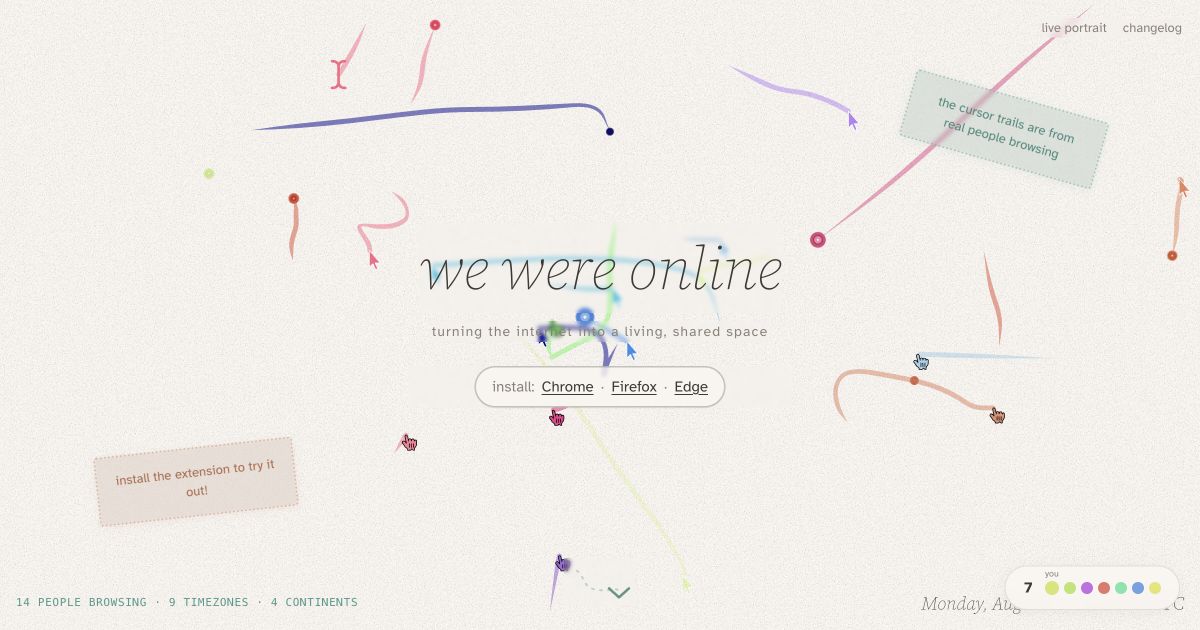
we were online
The information flaneur: a fresh look at information seeking
Trails and public spaces — Rafael M. Batista

It was a huge honor to present the opening keynote address at #SIGIR2026 and to talk about the need for IR to resist uncritical adoption of…
Chatty Community Gardens

There's this verb "distribution" used in the context of sentences like "Substack solved distribution" and I don't get it. What does it mean?

ATProto builders, I've been having some really positive conversations with multiple funders who want to invest in the ecosystem. The tides…

Become a supporter · Currents

Introducing the “organize mode” and the supporter tier
Become a Sill+ supporter - Euphonos

Standard.site Summer, on Bluesky's tab | Offprint
