

Disability Driven Development (DDD) is a practice that reimagines computing from a disabled perspective, challenging its seemingly seamless and stable hegemonic operations. It asks who is left out of creating (and joyfully using) digital technology, and how this can be changed. It is a practice by and for those who did not get to shape computing to meet their needs. It is a work related to crip technoscience, a practice of critique, alteration, and reinvention of our material-discursive world1. It is also heavily inspired by "fourth wave" womanist thinkers like EbonyJanice Moore, drawing on the notion of "a revolution that does not cost us our whole spirit, soul, and bodies."2 DDD was coined by Amelia Laumann to describe her work on SpoonStack 3.
Disability Driven Development
Disability Driven Development (DDD) is a practice that reimagines computing from a disabled perspective, challenging its seemingly seamless and stable hegemonic operations. It asks who is left out of creating (and joyfully using) digital technology, and how this can be changed. It is a practice by and for those who did not get to shape computing to meet their needs. It is a work related to crip technoscience, a practice of critique, alteration, and reinvention of our material-discursive world1. It is also heavily inspired by "fourth wave" womanist thinkers like EbonyJanice Moore, drawing on the notion of "a revolution that does not cost us our whole spirit, soul, and bodies."2 DDD was coined by Amelia Laumann to describe her work on SpoonStack 3.
Disability-Driven Development
Against Technoableism
When bioethicist and professor Ashley Shew became a self-described "hard-of-hearing chemobrained amputee with Crohn's disease and tinnitus," there was no returning to "normal." Suddenly well-meaning people called her an "inspiration" while grocery shopping or viewed her as a needy recipient of technological wizardry. Most disabled people don't want what the abled assume they want--nor are they generally asked. Almost everyone will experience disability at some point in their lives, yet the abled persistently frame disability as an individual's problem rather than a social one. In a warm, feisty voice and vibrant prose, Shew shows how we can create better narratives and more accessible futures by drawing from the insights of the cross-disability community. To forge a more equitable world, Shew argues that we must eliminate "technoableism"--the harmful belief that technology is a "solution" for disability; that the disabled simply await being "fixed" by technological wizardry; that making society more accessible and equitable is somehow a lesser priority. This badly needed introduction to disability expertise considers mobility devices, medical infrastructure, neurodivergence, and the crucial relationship between disability and race. The future, Shew points out, is surely disabled--whether through changing climate, new diseases, or even through space travel. It's time we looked closely at how we all think about disability technologies and learn to envision disabilities not as liabilities, but as skill sets enabling all of us to navigate a challenging world.
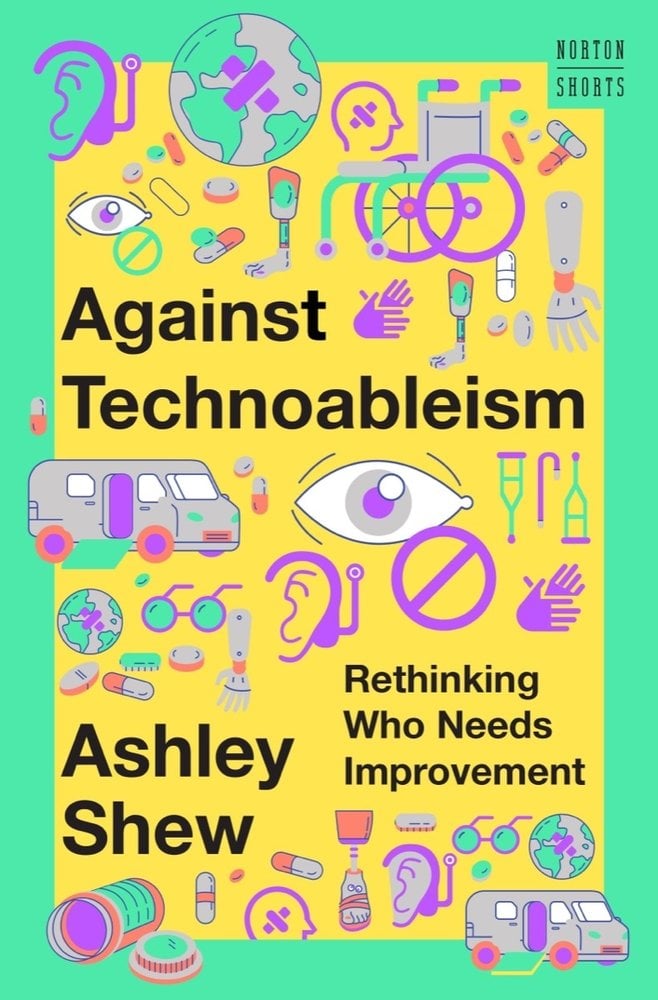
Disability Dongle
Disability Dongles are contemporary fairy tales that appeal to the abled imagination by presenting a heroic designer-protagonist whose prototype provides a techno-utopian (re)solution to the design problem. Disability Dongle rhetoric instills in students the value of a quick fix over structural change, thus preventing them from seeking out, participating in, and contributing to existing inquiry. By labeling these material-discursive phenomena—the designed artifacts and the discourse through which their meaning is constituted—we work to shift the focus from their misguided concern about our bodies to their under-analyzed intentions and ambitions.
Against Technoableism
One of BookRiot’s Ten Best Disability Books of the YearShortlisted for the Inc. Non-Obvious Book Awards“Wonderfully lucid.” —Andrew Leland, New York Times Book ReviewA manifesto exploding what we think we know about disability, and arguing that disabled people are the real experts when it comes to technology and disability., Against Technoableism, Rethinking Who Needs Improvement, Ashley Shew, 9781324076254
HCDE Distinguished Lecture with Laura Forlano | Designing Consequences: On Living Well with Machines
Crip Technoscience Manifesto
As disabled people engaged in disability community, activism, and scholarship, our collective experiences and histories have taught us that we are effective agents of world building and dismantling toward more socially just relations.The grounds for social justice and world remaking, however, are frictioned;technologies, architectures, and infrastructures are often designed and implemented without committing to disability as a difference that matters. This manifesto calls attention to the powerful, messy, non-innocent, contradictory, and nevertheless crucial work of what we name as “crip technoscience,” practices of critique, alteration, and reinvention of our material-discursive world. Disabled people are experts and designers of everyday life. But we also harness technoscience for political action, refusing to comply with demands to cure, fix, or eliminate disability. Attentive to the intersectional workings of power and privilege, we agitate against independence and productivity as requirements for existence. Instead, we center technoscientific activism and critical design practices that foster disability justice.
#LiberatingWebinars: Disability Justice & Crip Technoscience: Racism & Ableism in AI
Kyle Booten
Noöhacking1 is the title of my current research program. I use this term for ways that artists and everyday digital media users build and repurpose algorithmic tools in order to take care of their own minds/spirits, an especially challenging and important task amidst a digital milieu that seems designed to make us alienated, unintelligent, and miserable.
Social Model of Disability | The Paper Pilot
The Paper Pilot's digital garden of thoughts on philosophy, politics, and sociology
Challenging Ableism: A Critical Turn Toward Disability Justice in HCI
A reflection on our learnings from the CHI 2022 "Dreaming Disability Justice in HCI" workshop, and why we continue to call for disability justice, despite the limitations of how we practice it within academia and industry.
The "Disability Dongle": Why Silicon Valley Hates Me and you., Sightless Scribbles
A fabulously gay blind author.
Technoableism
Technoableism is a belief in the power of technology that considers the elimination of disability a good thing, something we should strive for. It’s a classic form of ableism—bias against disabled people, bias in favor of nondisabled ways of life. Technoableism is the use of technologies to reassert those biases, often under the guise of empowerment.

Does Doctorow's Enshittification Thesis Hold Up? Dwayne Monroe Responds
Amelia Wattenberger
I create things on the web, explore novel interfaces, turn data into meaning, and empower devs with AI.
Disability-driven Development

Disability-driven Development is a practice that reimagines computing from a disabled perspective.

The Dunning-Kruger effect in accessibility - Craig Abbott
Against Technoableism

Is Meta Using Disabled People to Promote Its Glasses?
Challenging Ableism: A Critical Turn Toward Disability Justice in HCI
The influence of artificial intelligence on individuals with disabilities

AI Doesn't Fix Accessible Systems. It Depends on Them. — Anna E. Cook