


Although many data scientists are eager to promote social justice, their efforts often fall short, and in some cases even exacerbate existing injustices. This gap between intentions and impacts follows from issues in how data scientists conceptualize their role in social justice efforts: they typically act as technicians, aiming to develop technical tools that will produce social justice. This default role generally results in depoliticized techno-fixes that fail to produce substantive changes. In this paper, we contribute “movement data science” as a framework to guide data scientists in taking on more productive and equitable roles in social justice efforts. Our framework is inspired by movement lawyering, a practice used by lawyers to situate themselves in grassroots social movements. Movement data science suggests that data scientists should ground their efforts to advance justice in sustained and solidaristic relationships with social movements. We contribute a process with four essential practices to help data scientists build these relationships and identify roles to play within specific social justice efforts. Movement data science does not provide a simple blueprint for data scientists to follow, but it can help them support social justice movements in substantive ways that go beyond attempting to solve injustices with technical tools.
Data Feminism
Today, data science is a form of power. It has been used to expose injustice, improve health outcomes, and topple governments. But it has also been used to d...

Democratizing Data
Democratizing Data builds a community-driven data ecosystem by identifying how datasets are used and reducing barriers to accessing high-quality public data. The initiative enhances the discoverability, usability, and relevance of data for researchers, policymakers, and stakeholder communities. A suite of tools and strategic partnerships supports this work by connecting users to the data, insights, and networks needed to inform decisions and generate impact.
A Polycentric Governance Lens on Data Infrastructures
Funding policies for data infrastructure promote open data sharing to drive positive social impact. However, concerns regarding the long-term management of data within and across distributed infrastructures can hinder data sharing. We draw upon the concept of polycentric governance to demonstrate how collaborative practices of data curation, in preparing and maintaining data for (future) sharing, provide a solid foundation for understanding data governance within data infrastructures. Based on a qualitative case study of a distributed ecological network, we investigate the conditions under which data are managed as a shared resource by local actors to ensure the long-term (re)usability of data. We contribute to CSCW by conceptualising data curation as a complex form of governance practice with multiple centres of decision-making, each of which operates with some degree of autonomy in data infrastructures. A polycentric governance lens on data infrastructures advances the CSCW conception of data curation as a collective governance practice that can cultivate a data democracy culture within and across organisations, empower individuals to be accountable for their data, and foster a mindset shift toward decentralised data governance.

Data Feminism
A new way of thinking about data science and data ethics that is informed by the ideas of intersectional feminism.

Feminist Data Manifest-No
1. We refuse to operate under the assumption that risk and harm associated with data practices can be bounded to mean the same thing for everyone, everywhere, at every time. We commit to acknowledging how historical and systemic patterns of violence and exploitation produce differential vulnerabilities for communities.
Professionalising Community Management Roles in Interdisciplinary Research Projects
In this article we discuss community management in interdisciplinary research teams, focusing on recognising and professionalising roles referred to here as the Research Community Managers (RCM). Drawing insights and examples from research and data science projects, we discuss how RCM roles address some of the researchâs most pressing challenges, from promoting best practices for open research and reproducibility to engaging diverse stakeholders in community-led research and ensuring fair recognition for their contributions. We offer a Community Maturation Indicator and share examples of projects from The Alan Turing Institute, the UK's national institute for data science and Artificial Intelligence (AI), where institutionally supported RCM roles were established. With the aim to integrate RCM expertise in teams involved in data science and AI research, we provide an RCM Skills and Competencies Framework. We also propose a roadmap for professionalising RCM roles by improving recognition and rewards, potential career paths and organisational support structures. To systematically sustain and progress these roles, we recommend institutional investment in establishing RCM teams that are empowered to prioritise collaboration, transparency and community-based approaches in interdisciplinary projects, such as in data science and AI. As a team, RCMs are well placed to connect disparate teams, initiatives and resources across the organisation, building more resilient research communities that can achieve greater innovation, improved project outcomes and a strongly connected ecosystem, with impacts extending beyond their narrow contexts.

Doing Data Science on the Shoulders of Giants: The Value of Open Source Software for the Data Science Community
Open source software is ubiquitous throughout data science, and enables the work of nearly every data scientist in some way or another. Open source projects, however, are disproportionately maintained by a small number of individuals, some of whom are institutionally supported, but many of whom do this maintenance on a purely volunteer basis. The health of the data science ecosystem depends on the support of open source projects, on an individual and institutional level.

Data Refusal from Below: A Framework for Understanding, Evaluating, and Envisioning Refusal as Design
Amidst calls for public accountability over large data-driven systems, feminist and indigenous scholars have developed refusal as a practice that challenges the authority of data collectors. However, because data affect so many aspects of daily life, it can be hard to see seemingly different refusal strategies as part of the same repertoire. Furthermore, conversations about refusal often happen from the standpoint of designers and policymakers rather than the people and communities most affected by data collection. In this article, we introduce a framework for data refusal from below —writing from the standpoint of people who refuse, rather than the institutions that seek their compliance. Because refusers work to reshape socio-technical systems, we argue that refusal is an act of design and that design-based frameworks and methods can contribute to refusal. We characterize refusal strategies across four constituent facets common to all refusal, whatever strategies are used: autonomy , or how refusal accounts for individual and collective interests; time , or whether refusal reacts to past harm or proactively prevents future harm; power , or the extent to which refusal makes change possible; and cost , or whether or not refusal can reduce or redistribute penalties experienced by refusers. We illustrate each facet by drawing on cases of people and collectives that have refused data systems. Together, the four facets of our framework are designed to help scholars and activists describe, evaluate, and imagine new forms of refusal.

Civic, Citizen and Grassroots Science: Towards a Transformative Scientific Research Model | Request PDF
Request PDF | On Jan 1, 2013, Jessica McCallum Breen and others published Civic, Citizen and Grassroots Science: Towards a Transformative Scientific Research Model | Find, read and cite all the research you need on ResearchGate

Can “Conscious Data Contribution” Help Users to Exert “Data Leverage” Against Technology Companies?
Tech users currently have limited ability to act on concerns regarding the negative societal impacts of large tech companies. However, recent work suggests that users can exert leverage using their role in the generation of valuable data, for instance by withholding their data contributions to intelligent technologies. We propose and evaluate a new means to exert this type of leverage against tech companies: "conscious data contribution" (CDC).
Citizen science in environmental and ecological sciences
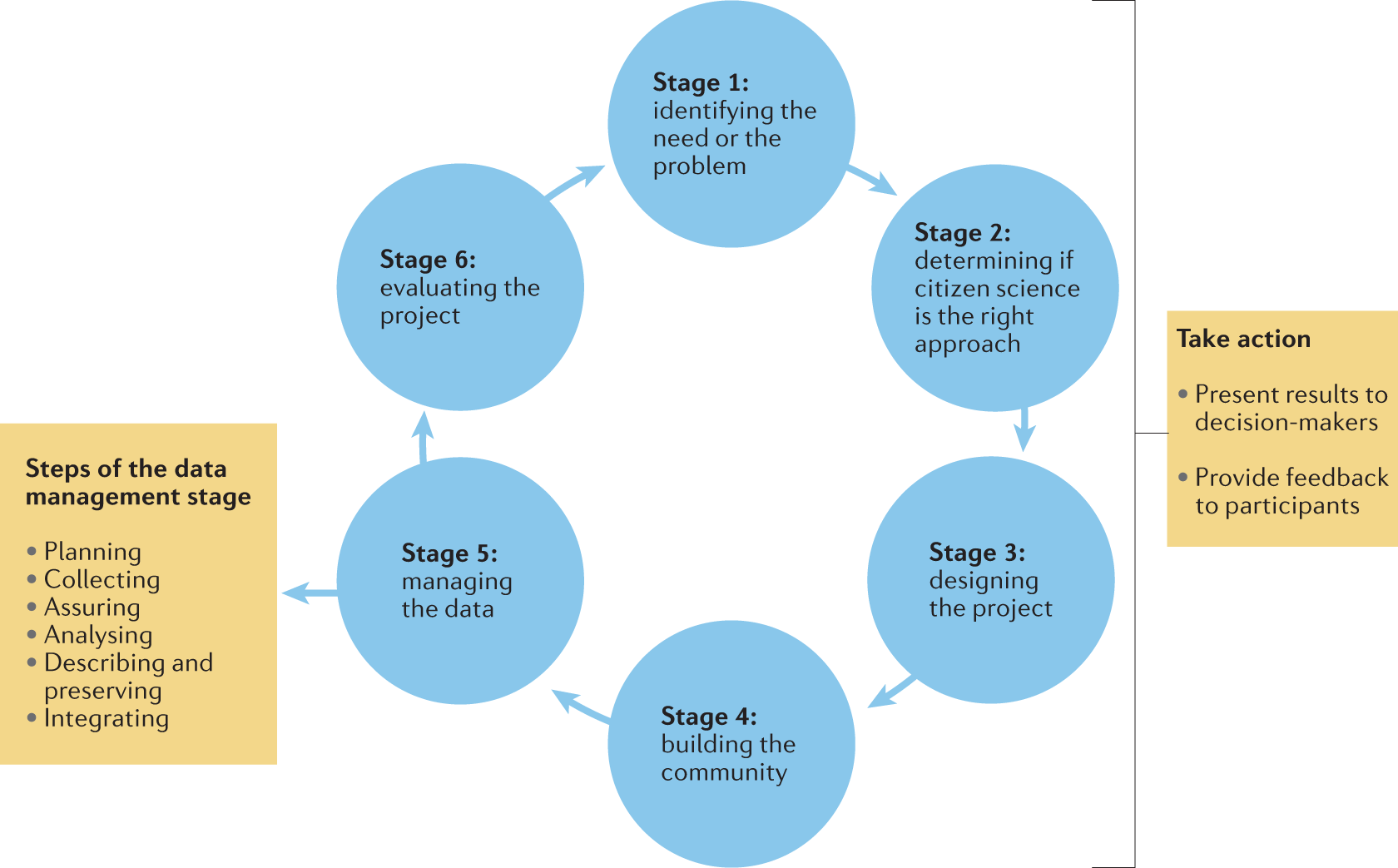
Citizen science is an increasingly acknowledged approach applied in many scientific domains, and particularly within the environmental and ecological sciences, in which non-professional participants contribute to data collection to advance scientific research. We present contributory citizen science as a valuable method to scientists and practitioners within the environmental and ecological sciences, focusing on the full life cycle of citizen science practice, from design to implementation, evaluation and data management. We highlight key issues in citizen science and how to address them, such as participant engagement and retention, data quality assurance and bias correction, as well as ethical considerations regarding data sharing. We also provide a range of examples to illustrate the diversity of applications, from biodiversity research and land cover assessment to forest health monitoring and marine pollution. The aspects of reproducibility and data sharing are considered, placing citizen science within an encompassing open science perspective. Finally, we discuss its limitations and challenges and present an outlook for the application of citizen science in multiple science domains.
Data Leverage: A Framework for Empowering the Public in its Relationship with Technology Companies
Many powerful computing technologies rely on implicit and explicit data contributions from the public. In this paper, we synthesize emerging research that seeks to better understand and help people action this data leverage. Drawing on prior work in areas including machine learning, human-computer interaction, and fairness and accountability in computing, we present a framework for understanding data leverage that highlights new opportunities to change technology company behavior related to privacy, economic inequality, content moderation and other areas of societal concern.
Better Deal for Data - Practical Data Governance for the Social Sector
Better Deal for Data - practical data governance for the social sector.
Broadening Access to Data Science Education in High School and Higher Education through Open Source Tools, Infrastructure, and Training
Equitable data science education requires a multifaceted approach, involving high school and higher education, community involvement, and accessible tools. A renewed investment in public digital infrastructure is needed to support these efforts. Nonprofits play a crucial role in supporting these efforts, and increased representation in leadership can enhance their impact. By addressing these disparities, we can ensure a more inclusive future in data science.
Linked Data is a Political Agenda
A Data Utopia for Science-of-Science
Here I want to briefly sketch out a vision for how to solve a key set of problems facing science-of-science researchers, using the relatively new idea of a ‘data trust.’ In my ideal wor…
