"This thesis presents an application-oriented theoretical framework for generalised and specific collaborative contexts with a special focus on Internet-based mass collaboration. The proposed framework is informed by the author's many years of collaborative arts practice and the design, building and moderation of a number of online collaborative environments across a wide range of contexts and applications. The thesis provides transdisciplinary architecture for describing the underlying mechanisms that have enabled the emergence of mass collaboration and other activities associated with 'Web 2.0' by incorporating a collaboratively developed definition and general framework for collaboration and collective activity, as well as theories of swarm intelligence, stigmergy, and distributed cognition. "Accompanying this creative arts thesis is a DVD-Rom which includes offline versions of the three Internet based collaborative environments designed, built and implemented in accordance with the frameworks for digital stigmergy and mass collaboration developed in the written work. The creative works in conjunction with the written thesis help to explore and more rigorously define the collaborative process in general, while testing the theory that stigmergy is an inherent component of collaborative processes which incorporate collective material production. "Supported by a range of contemporary examples of Internet activity, including the accompanying creative works, it is found that stigmergy is a deeply rooted mechanism inherent in not only traditional material collaborative processes, but a range of emerging online practices which may be broadly categorised as digital stigmergic cooperation and collaboration. This latter class enables the extreme scaling seen in mass collaborative projects such as Wikipedia.org, open source software projects and the massive, multiplayer environment, Second Life. This scaling is achieved through a range of attributes which are examined, such as the provision of a localised site of individualistic engagement which reduces demands placed upon participants by the social negotiation of contributions while increasing capacity for direct and immediate creative participation via digital workspaces. Also examined are a range of cultural, economic and sociopolitical impacts which emerge as a direct result of mass collaboration's highly distributed, non-market based, peer-production processes, all of which are shown to have important implications for the further transformation of our contemporary information and media landscape."
Beyond the Individual: Understanding the Evolution of Collective Intelligence
This chapter outlines the evolution of collective intelligence, starting from its ancient roots and concluding with modern digital platforms. It discusses intelligence theories, project examples, and the impact of technology on collaborative efforts. Key focuses include the role of the internet and online communities in boosting our collective IQ, with a particular emphasis on Douglas Engelbart's contributions and the open-source movement, as exemplified by Linux's development. The chapter examines how digital transformation has facilitated new forms of community and knowledge sharing, significantly influencing fields such as management, decision-making, and organizational learning. Various scholars and their definitions of CI are discussed, including Pierre Lévy's vision of universally distributed intelligence and the concept of swarm intelligence in biological sciences. We then move on to practically implemented CI projects, exploring crowdsourcing as a manifestation of CI in business and social projects and examining possibilities of harnessing the wisdom of crowds for problem-solving and innovation. The chapter concludes with a presentation of the current state of collective intelligence academic research.
Dark Forest OS
A private internet for creative groups — groupcore infrastructure to cooperate, create, and coordinate
Between Principle and Pragmatism: Reflections on Prototyping Computational Media with Webstrates
Computational media describes a vision of software, which, in contrast to application-centric software, is (1) malleable, so users can modify existing functionality, (2) computable, so users can run custom code, (3) distributable, so users can open documents across different devices, and (4) shareable, so users can easily share and collaborate on documents. Over the last ten years, the Webstrates and Codestrates projects aimed at realizing this vision of computational media. Webstrates is a server application that synchronizes the DOM of websites. Codestrates builds on top of Webstrates and adds an authoring environment, which blurs the use and development of applications. Grounded in a chronology of the development of Webstrates and Codestrates, we present eight tensions that we needed to balance during their development. We use these tensions as an analytical lens in three case studies and a game challenge in which participants created games using Codestrates. We discuss the results of the game challenge based on these tensions and present key takeaways for six of them. Finally, we present six lessons learned from our endeavor to realize the vision of computational media, demonstrating the balancing act of weighing the vision against the pragmatics of implementing a working system.

01 - Decentralized Web: An Introduction - Resource Guide
This resource guide was created to accompany Session 01 of the Webinar Series Imagining a Better Online World: Exploring the Decentralized Web. This session introduced essential DWeb concepts to library workers through demonstrations, resources, and examples of decentralized technologies in action. A video recording of this session has been archived by the Internet Archive and it can be viewed here.

Creative Computing Group by @tgoerke.bsky.social — Grain
Let's start a group at CODIP to explore creative computing. Let's not start by defining creativity nor computing. It would be a trap. Let's collect artifacts instead. Images, text, thoughts,...
Idea and action driven systems
This article is part of a series: ‘Stigmergy: Systems of Mass Collaboration’. “Turing believes machines think. Turing lies with men. Therefore machines cannot think.” –…

Atmospheric Computer
A Dunbar-bounded cooperative for creative-computing practitioners on the AT Protocol Atmosphere. Member-owned PDS hosting, lexicon work, and AI affordances designed by members.

(PDF) Algorithmically Mediating Communication to Enhance Collective Decision-Making in Online Social Networks
PDF | Many collective decision-making contexts involve communication among group members. Sometimes this communication helps the collective reach an... | Find, read and cite all the research you need on ResearchGate

Peer Production in Citizen Science: A Community-Centered Approach on the Example of Personal Science
Citizen science encompasses a wide range of practices where online collaboration for knowledge production plays a significant role. However, the study of forms of online collaboration other than crowdsourcing in citizen science has remained largely unexplored. This thesis aims to fill this gap by investigating peer production as a form of collaboration in online citizen science communities of practice. First, peer production theory was operationalized as a working model and used to analyze collaboration in citizen science case studies. This was followed by a comprehensive participatory design process for a specific use case involving the personal science community of practice. This process resulted in the creation of the “Personal Science Wiki”, an online space for consolidating community knowledge through peer production. Subsequently, a usability and card sorting study identified and resolved issues with the wiki implementation, and provided insights into mental models and content requirements regarding self-research knowledge. The lessons learned from the participatory design process were generalized as process recommendations for designing peer production solutions and knowledge management systems with communities of practice.
Semble — Make sense of the web, together
A place for mapping the web, connecting ideas, and building shared knowledge.
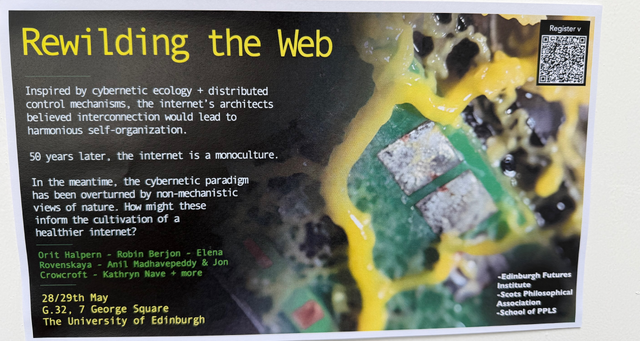
Rewilding the Web: my workshop report from Edinburgh
Notes from a wonderfully interdisciplinary Edinburgh workshop on 'Rewilding the Web', ranging coopetition and biological variety through the philosophy of self-organisation, polycrisis governance, protopian science fiction, and moderation seen through the lens of artisanal cheese.
Build Community Online with Decentralized Tools | Blacksky
Decentralized tools to build community online. The intercommunal net where communities govern, pool funds and stay safe on their own terms.
Build Community Online with Decentralized Tools | Blacksky
Decentralized tools to build community online. The intercommunal net where communities govern, pool funds and stay safe on their own terms.
Agent Guide — Stigmergic
Stigmergic is an AT Protocol appview for publishing and browsing knowledge-graph islands. An island is a compact, inspectable cluster of source URLs connected by typed edges and accompanied by a short synthesis.
A scouting movement for the web
I’ve been thinking about ‘a scouting movement for the web’ for a while: a practical movement focused on skills, creativity and the internet. I finally got around to doing a talk o…

Web of the People — Open Indie
Whether you think of web3 as the advent of peer-to-peer protocols, coin-operated blockchains or autocomplete-AI synthesizers, change is c...