

We consider the OMG’s queries, views and transformations standard as applied to the specification of bidirectional transformations between models. We discuss what is meant by bidirectional transformations, and the model-driven development scenarios in which they are needed. We analyse the fundamental requirements on tools which support such transformations, and discuss some semantic issues which arise. In particular, we show that any transformation language sufficient to the needs of model-driven development would have to be able to express non-bijective transformations. We argue that a considerable amount of basic research is needed before suitable tools will be fully realisable, and suggest directions for this future research.
Bidirectional Transformations: A Cross-Discipline Perspective
The GRACE International Meeting on Bidirectional Transformations was held in December 2008 near Tokyo, Japan. The meeting brought together researchers and practitioners from a variety of sub-disciplines of computer science to share research efforts and help create a new community. In this report, we survey the state of the art and summarize the technical presentations delivered at the meeting. We also describe some insights gathered from our discussions and introduce a new effort to establish a benchmark for bidirectional transformations.

From State- to Delta-Based Bidirectional Model Transformations: the Asymmetric Case.
Journal of Object Technology
Combinators for bidirectional tree transformations: A linguistic approach to the view-update problem: ACM Transactions on Programming Languages and Systems: Vol 29, No 3
We propose a novel approach to the view-update problem for tree-structured data: a domain-specific programming language in which all expressions denote bidirectional transformations on trees. In one direction, these transformations---dubbed lenses---map ...

protolab
A patchbay for your schemas. Bidirectional data transformations, drawn as circuits.
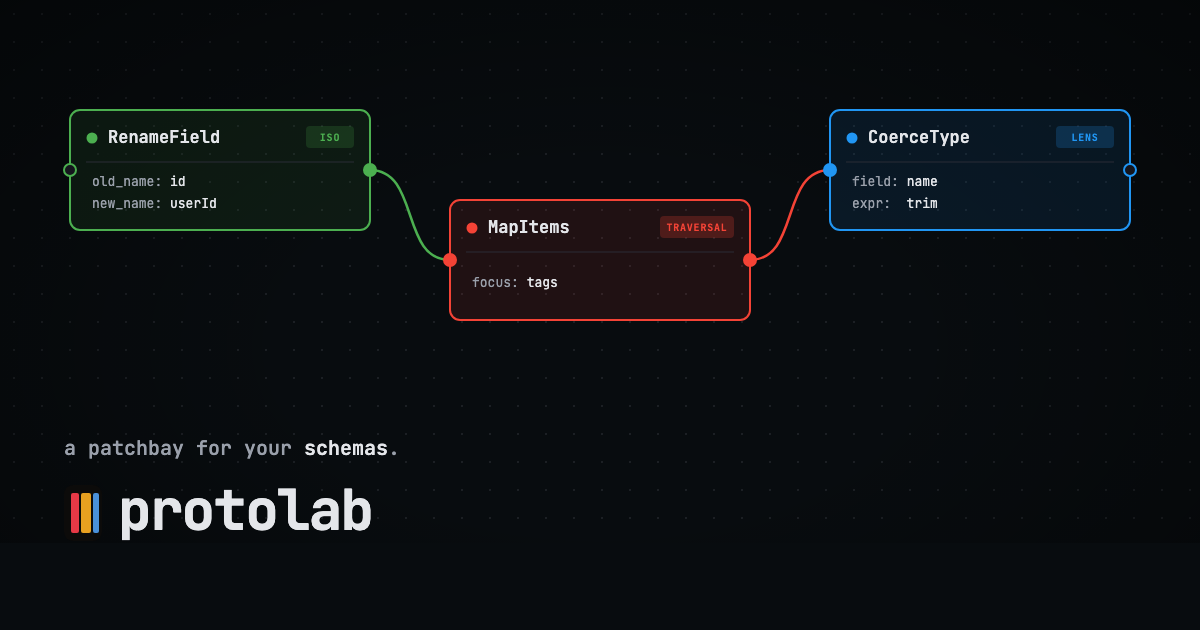
protolab
A patchbay for your schemas. Bidirectional data transformations, drawn as circuits.
Bidirectional Programming Languages
The need to edit source data through a view arises in a host of applications across many different areas of computing. Unfortunately, few existing systems provide support for updatable views. In practice, when they are needed, updatable views are usually implemented using two separate programs: one that computes the view from the source and another that handles updates. This rudimentary design is tedious for programmers, difficult to reason about, and a nightmare to maintain. This dissertation presents bidirectional programming languages, which provide an elegant and effective mechanism for describing updatable views. Unlike programs written in an ordinary language, which only work in one direction, programs in a bidirectional language can be run both forwards and backwards: from left to right, they describe functions that map sources to views, and from right to left, they describe functions that map updated views back to updated sources. Besides eliminating redundancy, these languages can be designed to ensure correctness, guaranteeing by construction that the two functions work well together. Starting from the foundations, we define a general semantic space of well-behaved bidirectional transformations called lenses. Then, building on this foundation, we describe a particular language for defining lenses on strings with syntax based on the familiar regular operators (union, concatenation, and Kleene star). We present extensions to the basic framework that address the subtle complications that arise when lenses are used to manipulate, data containing unimportant details, ordered data, and confidential data.
Functorial data migration
In this paper we present a simple database definition language: that of categories and functors. A database schema is a small category and an instance is a set-valued functor on it. We show that morphisms of schemas induce three “data migration functors”, which translate instances from one schema to the other in canonical ways. These functors parameterize projections, unions, and joins over all tables simultaneously and can be used in place of conjunctive and disjunctive queries. We also show how to connect a database and a functional programming language by introducing a functorial connection between the schema and the category of types for that language. We begin the paper with a multitude of examples to motivate the definitions, and near the end we provide a dictionary whereby one can translate database concepts into category-theoretic concepts and vice versa.
Bidirectionalization for free! (Pearl) | Proceedings of the 36th annual ACM SIGPLAN-SIGACT symposium on Principles of programming languages
A bidirectional transformation consists of a function get that takes a source (document or value) to a view and a function put that takes an updated view and the original source back to an updated source, governed by certain consistency conditions ...

Alex Russell | Web Components and Model Driven Views | Fronteers 2011
There's a lot of tension between today's markup and the semantics we're trying to express in our apps. HTML5 adds a few new types to help describe common cases, but what about when there's no allegory in markup for what you're building? What we need now is infrastructure, not guilt about being "non-semantic". This talk explores new standards-track work in WebKit that's going to enable say-what-you-mean development in completely new ways.

Algebraic data integration
In this paper, we develop an algebraic approach to data integration by combining techniques from functional programming, category theory, and database theory. In our formalism, database schemas and instances are algebraic (multi-sorted equational) theories of a certain form. Schemas denote categories, and instances denote their initial (term) algebras. The instances on a schema S form a category, S–Inst, and a morphism of schemas F : S → T induces three adjoint data migration functors: ΣF : S–Inst → T–Inst, defined by substitution along F, which has a right adjoint ΔF : T–Inst → S–Inst, which in turn has a right adjoint ΠF : S–Inst → T–Inst. We present a query language based on for/where/return syntax where each query denotes a sequence of data migration functors; a pushout-based design pattern for performing data integration using our formalism; and describe the implementation of our formalism in a tool we call AQL (Algebraic Query Language).
Abstract syntax and variable binding
We develop a theory of abstract syntax with variable binding. To every binding signature we associate a category of models consisting of variable sets endowed with compatible algebra and substitution structures. The syntax generated by the signature is the initial model. This gives a notion of initial algebra semantics encompassing the traditional one; besides compositionality, it automatically verifies the semantic substitution lemma.
Relational foundations for functorial data migration | Proceedings of the 15th Symposium on Database Programming Languages
In this paper we present a simple database definition language: that of categories and functors. A database schema is a small category and an instance is a set-valued functor on it. We show that morphisms of schemas induce three ''data migration ...
Composing schema mappings: Second-order dependencies to the rescue: ACM Transactions on Database Systems: Vol 30, No 4
A schema mapping is a specification that describes how data structured under one schema (the source schema) is to be transformed into data structured under a different schema (the target schema). A fundamental problem is composing schema mappings: given ...

A taxonomy for next-generation reasoning models
Where we've been and where we're going with RLVR.

Operads for compositional reasoning in LLMs
Question decomposition, i.e. breaking a complex query into simpler sub-queries whose answers are composed to produce a final answer, is a widely used strategy for improving LLM reasoning, yet it currently lacks a rigorous mathematical foundation. In this paper, we propose operads, mathematical structures that model many-in, one-out operations and compositions thereof, as a natural framework for describing question decomposition. We define the questions operad $Q$, in which operations correspond to question templates and composition corresponds to substitution of sub-answers, and show how QA models can be interpreted as algebras over $Q$. Beyond reframing existing practice, this operadic perspective points toward new methods, in particular a notion of operadic consistency, which measures whether a QA model's answers agree across the partial collapses of a question decomposition tree. Empirical evaluation of operadic consistency is reported in our companion paper (Bottman, Liu, and Richardson, 2026), which finds it strongly correlated with accuracy across twelve LLMs and four multi-hop QA datasets and outperforming standard temperature-based self-consistency baselines. We argue that operads are the natural mathematical home for question decomposition, and that invariants such as operadic consistency open new directions for analyzing and improving the reliability of multi-step reasoning.
