


Significance Since the discovery of the wisdom of crowds over 100 years ago theories of collective intelligence have held that group accuracy requires either statistical independence or informational diversity among individual beliefs. Empirical evidence suggests that allowing people to observe the beliefs of others leads to increased similarity of individual estimates, reducing independence and diversity without a corresponding increase in group accuracy. As a result, social influence is expected to undermine the wisdom of crowds. We present theoretical predictions and experimental findings demonstrating that, in decentralized networks, social influence generates learning dynamics that reliably improve the wisdom of crowds. We identify general conditions under which influence, not independence, produces the most accurate group judgments. , A longstanding problem in the social, biological, and computational sciences is to determine how groups of distributed individuals can form intelligent collective judgments. Since Galton’s discovery of the “wisdom of crowds” [Galton F (1907) Nature 75:450–451], theories of collective intelligence have suggested that the accuracy of group judgments requires individuals to be either independent, with uncorrelated beliefs, or diverse, with negatively correlated beliefs [Page S (2008) The Difference: How the Power of Diversity Creates Better Groups, Firms, Schools, and Societies ]. Previous experimental studies have supported this view by arguing that social influence undermines the wisdom of crowds. These results showed that individuals’ estimates became more similar when subjects observed each other’s beliefs, thereby reducing diversity without a corresponding increase in group accuracy [Lorenz J, Rauhut H, Schweitzer F, Helbing D (2011) Proc Natl Acad Sci USA 108:9020–9025]. By contrast, we show general network conditions under which social influence improves the accuracy of group estimates, even as individual beliefs become more similar. We present theoretical predictions and experimental results showing that, in decentralized communication networks, group estimates become reliably more accurate as a result of information exchange. We further show that the dynamics of group accuracy change with network structure. In centralized networks, where the influence of central individuals dominates the collective estimation process, group estimates become more likely to increase in error.
The network science of collective intelligence
In the last few years, breakthroughs in computational and experimental techniques have produced several key discoveries in the science of networks and human collective intelligence. This review presents the latest scientific findings from two key fields of research: collective problem-solving and the wisdom of the crowd. I demonstrate the core theoretical tensions separating these research traditions and show how recent findings offer a new synthesis for understanding how network dynamics alter collective intelligence, both positively and negatively.

How large language models can reshape collective intelligence
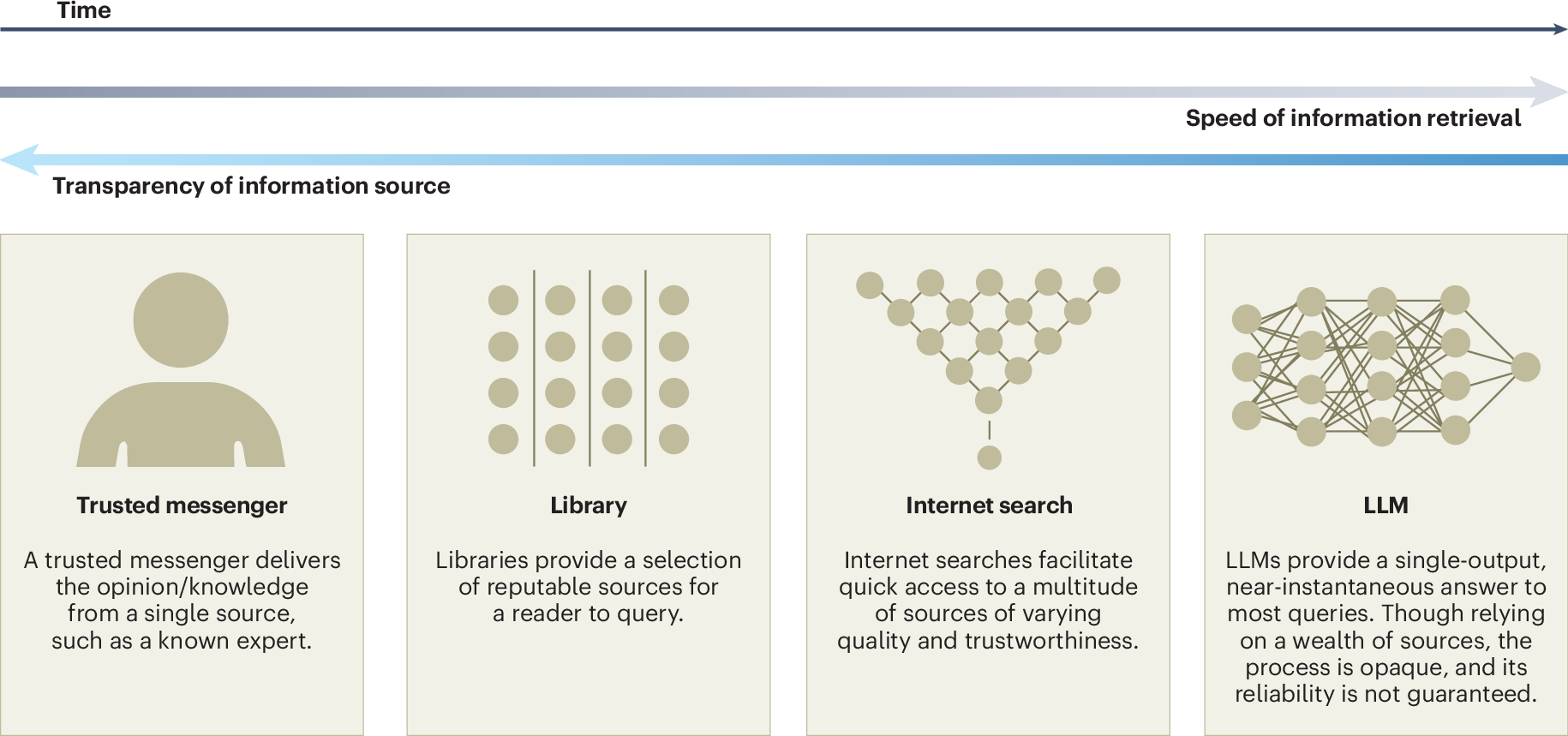
Collective intelligence underpins the success of groups, organizations, markets and societies. Through distributed cognition and coordination, collectives can achieve outcomes that exceed the capabilities of individuals—even experts—resulting in improved accuracy and novel capabilities. Often, collective intelligence is supported by information technology, such as online prediction markets that elicit the ‘wisdom of crowds’, online forums that structure collective deliberation or digital platforms that crowdsource knowledge from the public. Large language models, however, are transforming how information is aggregated, accessed and transmitted online. Here we focus on the unique opportunities and challenges this transformation poses for collective intelligence. We bring together interdisciplinary perspectives from industry and academia to identify potential benefits, risks, policy-relevant considerations and open research questions, culminating in a call for a closer examination of how large language models affect humans’ ability to collectively tackle complex problems.
How large language models can reshape collective intelligence
Collective intelligence underpins the success of groups, organizations, markets and societies. Through distributed cognition and coordination, collectives can achieve outcomes that exceed the capabilities of individuals—even experts—resulting in improved accuracy and novel capabilities. Often, collective intelligence is supported by information technology, such as online prediction markets that elicit the ‘wisdom of crowds’, online forums that structure collective deliberation or digital platforms that crowdsource knowledge from the public. Large language models, however, are transforming how information is aggregated, accessed and transmitted online. Here we focus on the unique opportunities and challenges this transformation poses for collective intelligence. We bring together interdisciplinary perspectives from industry and academia to identify potential benefits, risks, policy-relevant considerations and open research questions, culminating in a call for a closer examination of how large language models affect humans’ ability to collectively tackle complex problems.
Harnessing Crowds: Mapping the Genome of Collective Intelligence
Over the past decade, the rise of the Internet has enabled the emergence of surprising new forms of collective intelligence. Examples include Google, Wikipedia,

Emergent social conventions and collective bias in LLM populations
Social conventions are the backbone of social coordination, shaping how individuals form a group. As growing populations of artificial intelligence (AI) agents communicate through natural language, a fundamental question is whether they can bootstrap the foundations of a society. Here, we present experimental results that demonstrate the spontaneous emergence of universally adopted social conventions in decentralized populations of large language model (LLM) agents. We then show how strong collective biases can emerge during this process, even when agents exhibit no bias individually. Last, we examine how committed minority groups of adversarial LLM agents can drive social change by imposing alternative social conventions on the larger population. Our results show that AI systems can autonomously develop social conventions without explicit programming and have implications for designing AI systems that align, and remain aligned, with human values and societal goals. , Groups of AI agents can develop social conventions, generate societal bias, and undergo critical mass dynamics in norm adoption.

The Majority Illusion in Social Networks
Social behaviors are often contagious, spreading through a population as individuals imitate the decisions and choices of others. A variety of global phenomena, from innovation adoption to the emergence of social norms and political movements, arise as a result of people following a simple local rule, such as copy what others are doing. However, individuals often lack global knowledge of the behaviors of others and must estimate them from the observations of their friends' behaviors. In some cases, the structure of the underlying social network can dramatically skew an individual's local observations, making a behavior appear far more common locally than it is globally. We trace the origins of this phenomenon, which we call "the majority illusion," to the friendship paradox in social networks. As a result of this paradox, a behavior that is globally rare may be systematically overrepresented in the local neighborhoods of many people, i.e., among their friends. Thus, the "majority illusion" may facilitate the spread of social contagions in networks and also explain why systematic biases in social perceptions, for example, of risky behavior, arise. Using synthetic and real-world networks, we explore how the "majority illusion" depends on network structure and develop a statistical model to calculate its magnitude in a network.

Resampling reduces bias amplification in experimental social networks
Large-scale social networks are thought to contribute to polarization by amplifying people’s biases. However, the complexity of these technologies makes it difficult to identify the mechanisms responsible and evaluate mitigation strategies. Here we show under controlled laboratory conditions that transmission through social networks amplifies motivational biases on a simple artificial decision-making task. Participants in a large behavioural experiment showed increased rates of biased decision-making when part of a social network relative to asocial participants in 40 independently evolving populations. Drawing on ideas from Bayesian statistics, we identify a simple adjustment to content-selection algorithms that is predicted to mitigate bias amplification by generating samples of perspectives from within an individual’s network that are more representative of the wider population. In two large experiments, this strategy was effective at reducing bias amplification while maintaining the benefits of information sharing. Simulations show that this algorithm can also be effective in more complex networks.

Artificial Intelligence Systems Distort Upstream Selection in Human Social Learning
Humans are social learners who depend on observing others to acquire knowledge, norms, and behaviors, a capacity that underlies cumulative cultural evolution. Social learning unfolds in two stages: upstream selection determines what information becomes visible, and downstream selection determines what learners copy from that visible sample. Downstream selection occurs through biases such as conformity bias (copying what appears common) and prestige bias (copying those who appear highly respected). These downstream biases can be adaptive when upstream selection yields a sample that reflects the population's true distribution, so that what appears common is actually common and those who appear respected are actually competent. We argue that digital technologies disrupt this condition, creating an upstream selection problem. Engagement-based algorithms amplify the tails of the distribution, surfacing rare and extreme content, whereas generative AI collapses it toward the mode, erasing the surrounding diversity. Crucially, in each system the optimization signal shapes both visibility and prestige. For engagement-based algorithms, the signal is engagement: creators who post extreme content become more visible and, through the likes, shares, and followers, appear more prestigious. For generative AI, the signal is statistical typicality: it makes the modal answer dominant and, with no alternatives shown, makes the model that produced it appear more prestigious. These distortions can give rise to emergent group-level phenomena, including pluralistic ignorance and false consensus. Synthesizing evidence across psychology, cultural evolution, and computational social science, we provide a framework for how digital technologies disrupt social learning and outline interventions for restoring functional cultural transmission.
The knowledge layer for collective intelligence
A portable data substrate for humans and their tools to think together.

The knowledge layer for collective intelligence
A portable data substrate for humans and their tools to think together.
The knowledge layer for collective intelligence
A portable data substrate for humans and their tools to think together.
The knowledge layer for collective intelligence
A portable data substrate for humans and their tools to think together.
An Experimental Method to Study Opinion Diffusion in Human-AI Hybrid Societies
As artificial intelligence increasingly mediates public discourse, it becomes important to understand how human-AI collectives shape opinion formation, deliberation, and democratic outcomes. We present a novel experimental method for studying opinion dynamics in hybrid human-AI social networks. Participants, human or AI, were embedded in $5\times5$ grid lattice networks and iteratively asked to select and revise statements on a given polarizing topic over eight rounds. We compared three conditions: human-only, AI-only, and hybrid networks with equal proportions of human and AI participants. Hybrid human-AI networks achieved the lowest final polarization while, in contrast, human-only networks exhibited higher polarization with lower neighbor agreement. We also ran additional experiments varying Large Language Model (LLM) prompt framing to explore whether instruction design might influence convergence patterns. Although these early findings are preliminary and cannot yet support broad generalizations, they highlight the potential value of experimental social networks for understanding opinion dynamics in human-AI hybrid societies.
Beyond the Individual: Understanding the Evolution of Collective Intelligence
This chapter outlines the evolution of collective intelligence, starting from its ancient roots and concluding with modern digital platforms. It discusses intelligence theories, project examples, and the impact of technology on collaborative efforts. Key focuses include the role of the internet and online communities in boosting our collective IQ, with a particular emphasis on Douglas Engelbart's contributions and the open-source movement, as exemplified by Linux's development. The chapter examines how digital transformation has facilitated new forms of community and knowledge sharing, significantly influencing fields such as management, decision-making, and organizational learning. Various scholars and their definitions of CI are discussed, including Pierre Lévy's vision of universally distributed intelligence and the concept of swarm intelligence in biological sciences. We then move on to practically implemented CI projects, exploring crowdsourcing as a manifestation of CI in business and social projects and examining possibilities of harnessing the wisdom of crowds for problem-solving and innovation. The chapter concludes with a presentation of the current state of collective intelligence academic research.

Collective Intelligence Research

Explorations into the idea that a group of humans is "more intelligent" than the sum of their "IQ" (i.e. "groups of individuals doing things collectively that seem intelligent")
How large language models can reshape collective intelligence

Sharing Notes about Collective Intelligence — Pop Junctions
Socially Minded Intelligence: How Individuals, Groups, and Artificial Intelligence Can Make Each Other Smarter (or Not)

Profile: Adrien Treuille

NOVA | The Wisdom of the Crowds | Season 45 | Episode 6
Mapping Citizen Science through the Lens of Human-Centered AI