

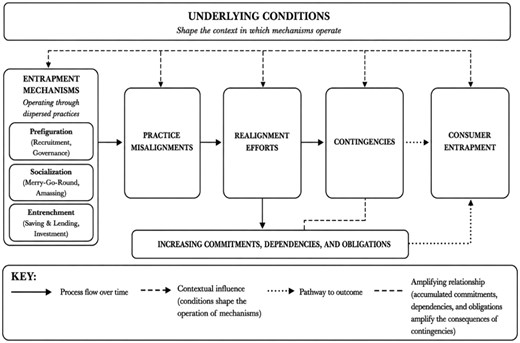
Abstract Why do consumers sometimes remain trapped in the very practices and communities that once helped them? Consumer practice research has largely emphasized the enabling outcomes of sustained practice participation, with less attention given to how those same practices can become entrapping. This article explores how consumer entrapment emerges within interconnected collective practices. Drawing on an ethnographic study of Chama, a community-based savings and support group in Kenya, it integrates practice theory with Hodder’s theory of entanglement. The study identifies three mechanisms (prefiguration, socialization, and entrenchment) through which participation generates commitments, dependencies, and obligations that produce recurring practice misalignments. Consumers continually work to realign these misalignments, yet under specific conditions, these efforts reproduce the contingencies that sustain participation while progressively deepening entrapment. The findings reveal a central tension: efforts to restore practice alignment can sustain what consumers value while simultaneously reproducing the interdependencies through which consumer entrapment emerges.
Citizen involvement in research on technological innovations for health, care or well-being: a scoping review
Citizen science can be a powerful approach to foster the successful implementation of technological innovations in health, care or well-being. Involving experience experts as co-researchers or co-designers of technological innovations facilitates mutual learning, community building, and empowerment. By utilizing the expert knowledge of the intended users, innovations have a better chance to get adopted and solve complex health-related problems. As citizen science is still a relatively new practice for health and well-being, little is known about effective methods and guidelines for successful collaboration. This scoping review aims to provide insight in (1) the levels of citizen involvement in current research on technological innovations for health, care or well-being, (2) the used participatory methodologies, and (3) lesson’s learned by the researchers., A scoping review was conducted and reported in accordance with the PRISMA-ScR guidelines. The search was performed in SCOPUS in January 2021 and included peer-reviewed journal and conference papers published between 2016 and 2020. The final selection (N = 83) was limited to empirical studies that had a clear focus on technological innovations for health, care or well-being and involved citizens at the level of collaboration or higher. Our results show a growing interest in citizens science as an inclusive research approach. Citizens are predominantly involved in the design phase of innovations and less in the preparation, data-analyses or reporting phase. Eight records had citizens in the lead in one of the research phases., Researcher use different terms to describe their methodological approach including participatory design, co-design, community based participatory research, co-creation, public and patient involvement, partcipatory action research, user-centred design and citizen science. Our selection of cases shows that succesful citizen science projects develop a structural and longitudinal partnership with their collaborators, use a situated and adaptive research approach, and have researchers that are willing to abandon traditional power dynamics and engage in a mutual learning experience.

A model for nesting connected groups with communities of practice
In the new edition of my book, Building Successful Communities of Practice, I share insights into community size and interactions. I've been using this theory with clients to create nested layers that include communities of practice that serve as a model for their organisation.

Volunteering and Civic Action: Boundaries Blurring, Boundaries Redrawn
The aim of this introduction to the special issue is to call into question the presumed conceptual divide between volunteering and civic action and suggest an analytical tool and four perspectives that bring to light the varying meanings of popular engagement. Volunteering and civic action are laden with different moral meanings, are associated with different theoretical approaches and, just as important, have been assigned different roles in society. This conceptual divide is reflected in the academic debate. Only rarely, however, has the academic debate explored and discussed how the meaning of volunteering and civic action has changed historically. Therefore, we argue for a contextual and relational interpretation of the different forms of popular engagement instead of the application of essentialist definitions of volunteering and civic action. In order to examine the variety of popular engagement without being caught up in pre-made or taken-for-granted conceptualisations of volunteering and civic action as two separate forms of popular engagement, we propose approaching variations of popular engagement with respect to two criteria: first, to what degree popular engagement is enacted in institutionalised spheres of politics or in social public spheres and, second, to what degree actions of popular engagement are controversial or operating in line with what is widely agreed upon and dominant in public opinion. Moreover, we argue that history, discourses, politics and a relational approach are four crucial perspectives in order to reveal the varying meanings of popular engagement.
A Day in the Life of an Ensh*ttificator
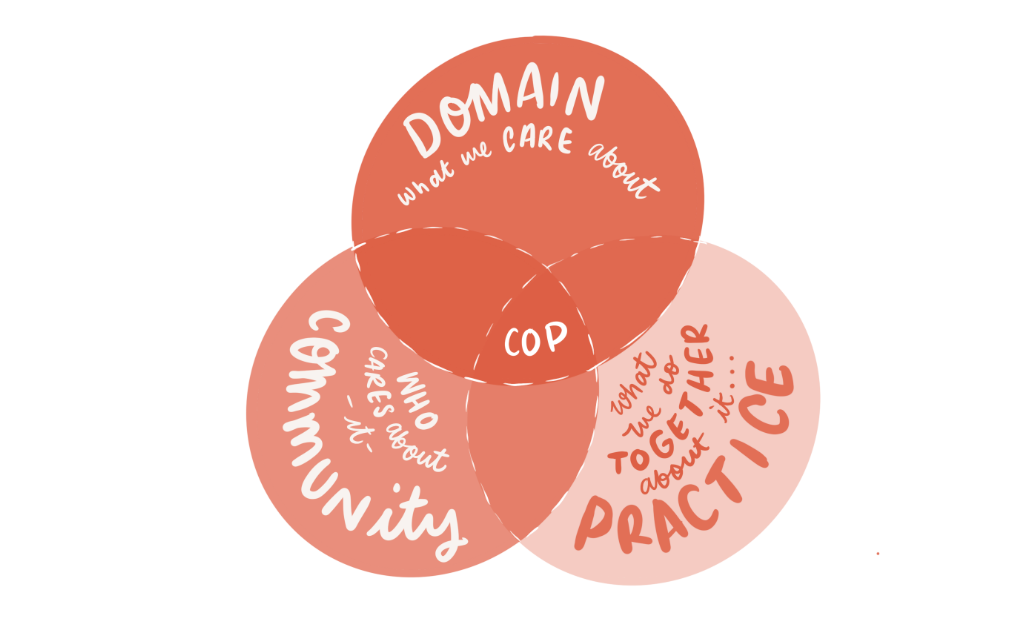
Wait… whats a Community of Practice?
“Learning is not merely the acquisition of knowledge by individuals. It is a process of social participation.” A slightly bastardised…
Civic Action
Commonly, researchers have looked for civic life in a distinct sector in which they assume that voluntary associations will cultivate special skills and virtues. Gathering together many challenges to this approach, and using ethnographic cases of housing advocacy and youth civic engagement projects, the authors reconceptualize “the civic” as civic action and show how patterned scene styles shape it. Doing so reveals patterns of action in complex organizations that may span institutional sectors. The authors show how researchers can locate scene styles, and with an extensive literature review, they portray several common styles and suggest that different civic styles often lead to different outcomes.
How social norms emerge: The interindividual actor–critic.
Tightwads and spendthrifts: An interdisciplinary review
Consumers rely on a “pain of paying” to help deter their spending. While this is beneficial for some consumers, others experience levels of pain that create problems. “Tightwads” experience too much pain when considering spending and therefore spend less than they would ideally like to spend. By contrast, “spendthrifts” experience too little pain and therefore spend more than they would ideally like to spend. Neither are happy with how they handle money. In the decade since the tightwad‐spendthrift construct was introduced, much has been learned about what it is and is not (e.g., frugality, greed), what contextual factors are likely to reduce its importance, how it plays a role within romantic relationships, and when it might first emerge in childhood. This paper reviews the wide range of interdisciplinary research relevant to the tightwad‐spendthrift construct and proposes several directions for new research.

Community-driven informal adult environmental learning: Using theory as a lens to identify steps toward concientización
This article examines community-driven adult environmental learning in a volunteer watershed stewards program. We look for evidence of elements that portray steps toward “concientización”—the proce...

Metanorms generate stable yet adaptable normative social order in a politically decentralized society
Abstract Norms are essential for social stability but can hinder adaptability in changing environments. Yet human societies have found ways to modify existing norms or create new ones in response to novel challenges. This paper proposes a framework for understanding adaptive norm evolution. First, drawing on a theory of legal order, we posit that societies balance normative stability and adaptability through metanorms—rules that govern the process by which norms are interpreted, changed and enforced. Second, we test this idea in the context of customary dispute resolution by elders among the Turkana, a pastoralist society in Kenya. Based on vignette experiments with 369 participants, we found that community members were significantly more willing to enforce decisions when elders aligned their conduct with metanorms. Elders are constrained in their ability to alter long-standing customs, but by following metanorms, they can create new rules for novel situations. These findings support our proposed mechanism: in the absence of centralized authority, metanorms governing normative institutions allow for adaptive norm change while preserving cultural continuity. We conclude by suggesting that group-level selection acts on cultural variation in metanorms, shaping the evolvability of normative systems and enabling societies to sustain adaptive legal order without coercive centralized power. This article is part of the theme issue ‘Transforming cultural evolution research and its application to global futures’.
DIY Infrastructure Building for Power – Esther Han Beol Jang
Reimagining Ourselves at the End of Our World: Kinship, Interconnection, and Spirituality in the Metacrisis - The Great Simplification
Over the past decade, the world has become increasingly chaotic and uncertain – and so, too, has our cultural vision for the future. While the events we face now may feel unprecedented, they are rooted in much deeper patterns, which humanity has been playing out for millennia. If we take the time to understand past trends, we can also employ practices and philosophies that might counteract them – such as focusing on kinship, intimacy, and resilience – to help pave the way for a better future. How might we nurture the foundations of a different kind of society, even while the end of our current civilization plays out around us?

Differences Between Tight and Loose Cultures: A 33-Nation Study
The differences across cultures in the enforcement of conformity may reflect their specific histories. , With data from 33 nations, we illustrate the differences between cultures that are tight (have many strong norms and a low tolerance of deviant behavior) versus loose (have weak social norms and a high tolerance of deviant behavior). Tightness-looseness is part of a complex, loosely integrated multilevel system that comprises distal ecological and historical threats (e.g., high population density, resource scarcity, a history of territorial conflict, and disease and environmental threats), broad versus narrow socialization in societal institutions (e.g., autocracy, media regulations), the strength of everyday recurring situations, and micro-level psychological affordances (e.g., prevention self-guides, high regulatory strength, need for structure). This research advances knowledge that can foster cross-cultural understanding in a world of increasing global interdependence and has implications for modeling cultural change.
Embers of society: Firelight talk among the Ju/’hoansi Bushmen
Much attention has been focused on control of fire in human evolution and the impact of cooking on anatomy, social, and residential arrangements. However, little is known about what transpired when firelight extended the day, creating effective time for social activities that did not conflict with productive time for subsistence activities. Comparison of 174 day and nighttime conversations among the Ju/’hoan (!Kung) Bushmen of southern Africa, supplemented by 68 translated texts, suggests that day talk centers on economic matters and gossip to regulate social relations. Night activities steer away from tensions of the day to singing, dancing, religious ceremonies, and enthralling stories, often about known people. Such stories describe the workings of entire institutions in a small-scale society with little formal teaching. Night talk plays an important role in evoking higher orders of theory of mind via the imagination, conveying attributes of people in broad networks (virtual communities), and transmitting the “big picture” of cultural institutions that generate regularity of behavior, cooperation, and trust at the regional level. Findings from the Ju/’hoan are compared with other hunter-gatherer societies and related to the widespread human use of firelight for intimate conversation and our appetite for evening stories. The question is raised as to what happens when economically unproductive firelit time is turned to productive time by artificial lighting.

Design Justice: Community-Led Practices to Build the Worlds We Need
An exploration of how design might be led by marginalized communities, dismantle structural inequality, and advance collective liberation and ecological su
The Matrix of Convivial Technology – Assessing technologies for degrowth
This article introduces the notion of convivial technology as a conceptual framework for technologies suitable for degrowth societies. This paper is inspired by Ivan Illich's notion of convivial tools but reconsiders it in the light of current practices and discussions. Looking for a definition of convivial technologies it uses qualitative empirical research conducted with degrowth-oriented groups developing or adapting grassroots technologies like Open Source cargo bikes or composting toilets in Germany. The basic ethical values and design criteria that guide these different groups in relation to technology are summed up into five dimensions: relatedness, adaptability, accessibility, bio-interaction and appropriateness. These dimensions can be correlated with the four life-cycle levels material, production, use and infrastructure to form the Matrix for Convivial Technology (MCT). The MCT is a 20-field schema that can be filled in. Experiences with the tool in different fields are presented. The MCT is itself a convivial tool as it allows for degrowth-oriented groups to self-assess their work and products in a qualitative, context-sensitive and independent way. It is a normative schema that fosters discussion concerning degrowth technologies in contexts of political education. And it is a research method as it helps collecting data about underlying ethical assumptions and aspirations of individuals and groups engaged in developing technology.