


The application of evolutionary theory to understanding the origins of our species' capacities for social learning has generated key insights into cultural evolution. By focusing on how our psychology has evolved to adaptively extract beliefs and practices by observing others, theorists have hypothesized how social learning can, over generations, give rise to culturally evolved adaptations. While much field research documents the subtle ways in which culturally transmitted beliefs and practices adapt people to their local environments, and much experimental work reveals the predicted patterns of social learning, little research connects real-world adaptive cultural traits to the patterns of transmission predicted by these theories. Addressing this gap, we show how food taboos for pregnant and lactating women in Fiji selectively target the most toxic marine species, effectively reducing a woman's chances of fish poisoning by 30 per cent during pregnancy and 60 per cent during breastfeeding. We further analyse how these taboos are transmitted, showing support for cultural evolutionary models that combine familial transmission with selective learning from locally prestigious individuals. In addition, we explore how particular aspects of human cognitive processes increase the frequency of some non-adaptive taboos. This case demonstrates how evolutionary theory can be deployed to explain both adaptive and non-adaptive behavioural patterns.
The Secret of Our Success: How Culture Is Driving Human Evolution, Domesticating Our Species, and Making Us Smarter
How our collective intelligence has helped us to evolve and prosperHumans are a puzzling species. On the one hand, we struggle to survive on our own in the wild, often failing to overcome even basic challenges, like obtaining food, building shelters, or avoiding predators. On the other hand, human groups have produced ingenious technologies, sophisticated languages, and complex institutions that have permitted us to successfully expand into a vast range of diverse environments. What has enabled us to dominate the globe, more than any other species, while remaining virtually helpless as lone individuals? This book shows that the secret of our success lies not in our innate intelligence, but in our collective brains—on the ability of human groups to socially interconnect and learn from one another over generations.Drawing insights from lost European explorers, clever chimpanzees, mobile hunter-gatherers, neuroscientific findings, ancient bones, and the human genome, Joseph Henrich demonstrates how our collective brains have propelled our species' genetic evolution and shaped our biology. Our early capacities for learning from others produced many cultural innovations, such as fire, cooking, water containers, plant knowledge, and projectile weapons, which in turn drove the expansion of our brains and altered our physiology, anatomy, and psychology in crucial ways. Later on, some collective brains generated and recombined powerful concepts, such as the lever, wheel, screw, and writing, while also creating the institutions that continue to alter our motivations and perceptions. Henrich shows how our genetics and biology are inextricably interwoven with cultural evolution, and how culture-gene interactions launched our species on an extraordinary evolutionary trajectory.Tracking clues from our ancient past to the present, The Secret of Our Success explores how the evolution of both our cultural and social natures produce a collective intelligence that explains both our species' immense success and the origins of human uniqueness.
Differences Between Tight and Loose Cultures: A 33-Nation Study
The differences across cultures in the enforcement of conformity may reflect their specific histories. , With data from 33 nations, we illustrate the differences between cultures that are tight (have many strong norms and a low tolerance of deviant behavior) versus loose (have weak social norms and a high tolerance of deviant behavior). Tightness-looseness is part of a complex, loosely integrated multilevel system that comprises distal ecological and historical threats (e.g., high population density, resource scarcity, a history of territorial conflict, and disease and environmental threats), broad versus narrow socialization in societal institutions (e.g., autocracy, media regulations), the strength of everyday recurring situations, and micro-level psychological affordances (e.g., prevention self-guides, high regulatory strength, need for structure). This research advances knowledge that can foster cross-cultural understanding in a world of increasing global interdependence and has implications for modeling cultural change.
Communicating Pollutants That Threaten Tribal Identities: PFAS Contamination in Local Fish and Shellfish
Indigenous communities that rely on the consumption of local fish and shellfish may have elevated exposures to environmental contaminants, such as PFAS (perfluoroalkyl and polyfluoroalkyl substances). Conventional public health communication that focuses on reducing consumption can conflict with cultural identities tied to harvesting local fish. Through a series of focus groups and interviews ( n = 25) and a community-wide survey ( n = 155) among members of the Mashpee Wampanoag Tribe (Cape Cod, Massachusetts, USA), we document the connection between local fish/shellfish consumption and Tribal cultural identity, how PFAS contamination may threaten this identity, and explore how to more effectively communicate health risks to Tribal communities.

Thinking through other minds: A variational approach to cognition and culture
The processes underwriting the acquisition of culture remain unclear. How are shared habits, norms, and expectations learned and maintained with precision and reliability across large-scale sociocultural ensembles? Is there a unifying account of the mechanisms involved in the acquisition of culture? Notions such as “shared expectations,” the “selective patterning of attention and behaviour,” “cultural evolution,” “cultural inheritance,” and “implicit learning” are the main candidates to underpin a unifying account of cognition and the acquisition of culture; however, their interactions require greater specification and clarification. In this article, we integrate these candidates using the variational (free-energy) approach to human cognition and culture in theoretical neuroscience. We describe the construction by humans of social niches that afford epistemic resources called cultural affordances. We argue that human agents learn the shared habits, norms, and expectations of their culture through immersive participation in patterned cultural practices that selectively pattern attention and behaviour. We call this process “thinking through other minds” (TTOM) – in effect, the process of inferring other agents’ expectations about the world and how to behave in social context. We argue that for humans, information from and about other people's expectations constitutes the primary domain of statistical regularities that humans leverage to predict and organize behaviour. The integrative model we offer has implications that can advance theories of cognition, enculturation, adaptation, and psychopathology. Crucially, this formal (variational) treatment seeks to resolve key debates in current cognitive science, such as the distinction between internalist and externalist accounts of theory of mind abilities and the more fundamental distinction between dynamical and representational accounts of enactivism.

Handbook of Evolutionary Psychology
‘This Handbook is refreshingly different. While including requisite chapters on subfields within evolutionary psychology, it also includes chapters on evolutionary psychology’s influence on other disciplines (e.g., Anthropology, Criminology), and retrospectives on six foundational studies. And perhaps most innovative, chapters are written by an international collection of up-and-coming scholars who give their take on the current and future state of evolutionary psychology.’ – David F. Bjorklund, Florida Atlantic University, USA

Learning how to behave: cognitive learning processes account for asymmetries in adaptation to social norms
Changes to social settings caused by migration, cultural change or pandemics force us to adapt to new social norms. Social norms provide groups of individuals with behavioural prescriptions and therefore can be inferred by observing their behaviour. This work aims to examine how cognitive learning processes affect adaptation and learning of new social norms. Using a multiplayer game, I found that participants initially complied with various social norms exhibited by the behaviour of bot-players. After gaining experience with one norm, adaptation to a new norm was observed in all cases but one, where an active-harm norm was resistant to adaptation. Using computational learning models, I found that active behaviours were learned faster than omissions, and harmful behaviours were more readily attributed to all group members than beneficial behaviours. These results provide a cognitive foundation for learning and adaptation to descriptive norms and can inform future investigations of group-level learning and cross-cultural adaptation.

Rethinking Norm Psychology
Norms permeate human life. Most of people’s activities can be characterized by rules about what is appropriate, allowed, required, or forbidden—rules that are crucial in making people hyper-cooperative animals. In this article, I examine the current cognitive-evolutionary account of “norm psychology” and propose an alternative that is better supported by evidence and better placed to promote interdisciplinary dialogue. The incumbent theory focuses on rules and claims that humans genetically inherit cognitive and motivational mechanisms specialized for processing these rules. The cultural-evolutionary alternative defines normativity in relation to behavior—compliance, enforcement, and commentary—and suggests that it depends on implicit and explicit processes. The implicit processes are genetically inherited and domain-general; rather than being specialized for normativity, they do many jobs in many species. The explicit processes are culturally inherited and domain-specific; they are constructed from mentalizing and reasoning by social interaction in childhood. The cultural-evolutionary, or “cognitive gadget,” perspective suggests that people alive today—parents, educators, elders, politicians, lawyers—have more responsibility for sustaining normativity than the nativist view implies. People’s actions not only shape and transmit the rules, but they also create in each new generation mental processes that can grasp the rules and put them into action.
Spurious normativity enhances learning of compliance and enforcement behavior in artificial agents
Significance The fact that humans enforce and comply with norms is an important reason why humans enjoy higher levels of cooperation and welfare than other animals. Some norms are relatively easy to explain: They may prohibit obviously harmful or uncooperative actions. But many norms are not easy to explain. For example, most cultures prohibit eating certain kinds of foods, and almost all societies have rules about what constitutes appropriate clothing, language, and gestures. Using a computational model focused on learning shows that apparently pointless rules can have an indirect effect on welfare. They can help agents learn how to enforce and comply with norms in general, improving the group’s ability to enforce norms that have a direct effect on welfare. , How do societies learn and maintain social norms? Here we use multiagent reinforcement learning to investigate the learning dynamics of enforcement and compliance behaviors. Artificial agents populate a foraging environment and need to learn to avoid a poisonous berry. Agents learn to avoid eating poisonous berries better when doing so is taboo, meaning the behavior is punished by other agents. The taboo helps overcome a credit assignment problem in discovering delayed health effects. Critically, introducing an additional taboo, which results in punishment for eating a harmless berry, further improves overall returns. This “silly rule” counterintuitively has a positive effect because it gives agents more practice in learning rule enforcement. By probing what individual agents have learned, we demonstrate that normative behavior relies on a sequence of learned skills. Learning rule compliance builds upon prior learning of rule enforcement by other agents. Our results highlight the benefit of employing a multiagent reinforcement learning computational model focused on learning to implement complex actions.

Social learning preserves both useful and useless theories by canalizing learners’ exploration
In many domains, learning from others is crucial for leveraging cumulative cultural knowledge, which encapsulates the efforts of successive generations of innovators. However, anecdotal and experimental evidence suggests that reliance on social information can reduce the exploration of the problem space. Here, we experimentally investigate the extent to which cultural transmission fosters the persistence of arbitrary solutions in a context where participants are incentivized to improve a physical system across multiple trials. Participants were exposed to various theories about the system, ranging from accurate to misleading. Our findings indicate that even under conditions conducive to exploration, the transmission of cultural knowledge canalizes learners’ focus, limiting their consideration of alternative solutions. This effect was observed in both the theories produced and the solutions attempted by participants, irrespective of the accuracy of the provided theories. These results challenge the notion that arbitrary solutions persist only when they are efficient or intuitive and underscore the significant role of cultural transmission in shaping human knowledge and technologies.

Mechanisms of social cognition
Social animals including humans share a range of social mechanisms that are automatic and implicit and enable learning by observation. Learning from others includes imitation of actions and mirroring of emotions. Learning about others, such as their group membership and reputation, is crucial for social interactions that depend on trust. For accurate prediction of others' changeable dispositions, mentalizing is required, i.e., tracking of intentions, desires, and beliefs. Implicit mentalizing is present in infants less than one year old as well as in some nonhuman species. Explicit mentalizing is a meta-cognitive process and enhances the ability to learn about the world through self-monitoring and reflection, and may be uniquely human. Meta-cognitive processes can also exert control over automatic behavior, for instance, when short-term gains oppose long-term aims or when selfish and prosocial interests collide. We suggest that they also underlie the ability to explicitly share experiences with other agents, as in reflective discussion and teaching. These are key in increasing the accuracy of the models of the world that we construct.
A bias for social information in human cultural transmission
Evolutionary theories concerning the origins of human intelligence suggest that cultural transmission might be biased toward social over non‐social information. This was tested by passing social and non‐social information along multiple chains of participants. Experiment 1 found that gossip, defined as information about intense third‐party social relationships, was transmitted with siginificantly greater accuracy and in significantly greater quantity than equivalent non‐social information concerning individual behaviour or the physical environment. Experiment 2 replicated this finding controlling for narrative coherence, and additionally found that information concerning everyday non‐gossip social interactions was transmitted just as well as the intense gossip interactions. It was therefore concluded that human cultural transmission is biased toward information concerning social interactions over equivalent non‐social information.

Norm Dynamics: Interdisciplinary Perspectives on Social Norm Emergence, Persistence, and Change
Social norms are the glue that holds society together, yet our knowledge of them remains heavily intellectually siloed. This article provides an interdisciplinary review of the emerging field of norm dynamics by integrating research across the social sciences through a cultural-evolutionary lens. After reviewing key distinctions in theory and method, we discuss research on norm psychology—the neural and cognitive underpinnings of social norm learning and acquisition. We then overview how norms emerge and spread through intergenerational transmission, social networks, and group-level ecological and historical factors. Next, we discuss multilevel factors that lead norms to persist, change, or erode over time. We also consider cultural mismatches that can arise when a changing environment leads once-beneficial norms to become maladaptive. Finally, we discuss potential future research directions and the implications of norm dynamics for theory and policy.

How we learn social norms: a three-stage model for social norm learning
As social animals, humans are unique to make the world function well by developing, maintaining, and enforcing social norms. As a prerequisite among these norm-related processes, learning social norms can act as a basis that helps us quickly coordinate with others, which is beneficial to social inclusion when people enter into a new environment or experience certain sociocultural changes. Given the positive effects of learning social norms on social order and sociocultural adaptability in daily life, there is an urgent need to understand the underlying mechanisms of social norm learning. In this article, we review a set of works regarding social norms and highlight the specificity of social norm learning. We then propose an integrated model of social norm learning containing three stages, i.e., pre-learning, reinforcement learning, and internalization, map a potential brain network in processing social norm learning, and further discuss the potential influencing factors that modulate social norm learning. Finally, we outline a couple of future directions along this line, including theoretical (i.e., societal and individual differences in social norm learning), methodological (i.e., longitudinal research, experimental methods, neuroimaging studies), and practical issues.

Supernatural explanations across 114 societies are more common for natural than social phenomena
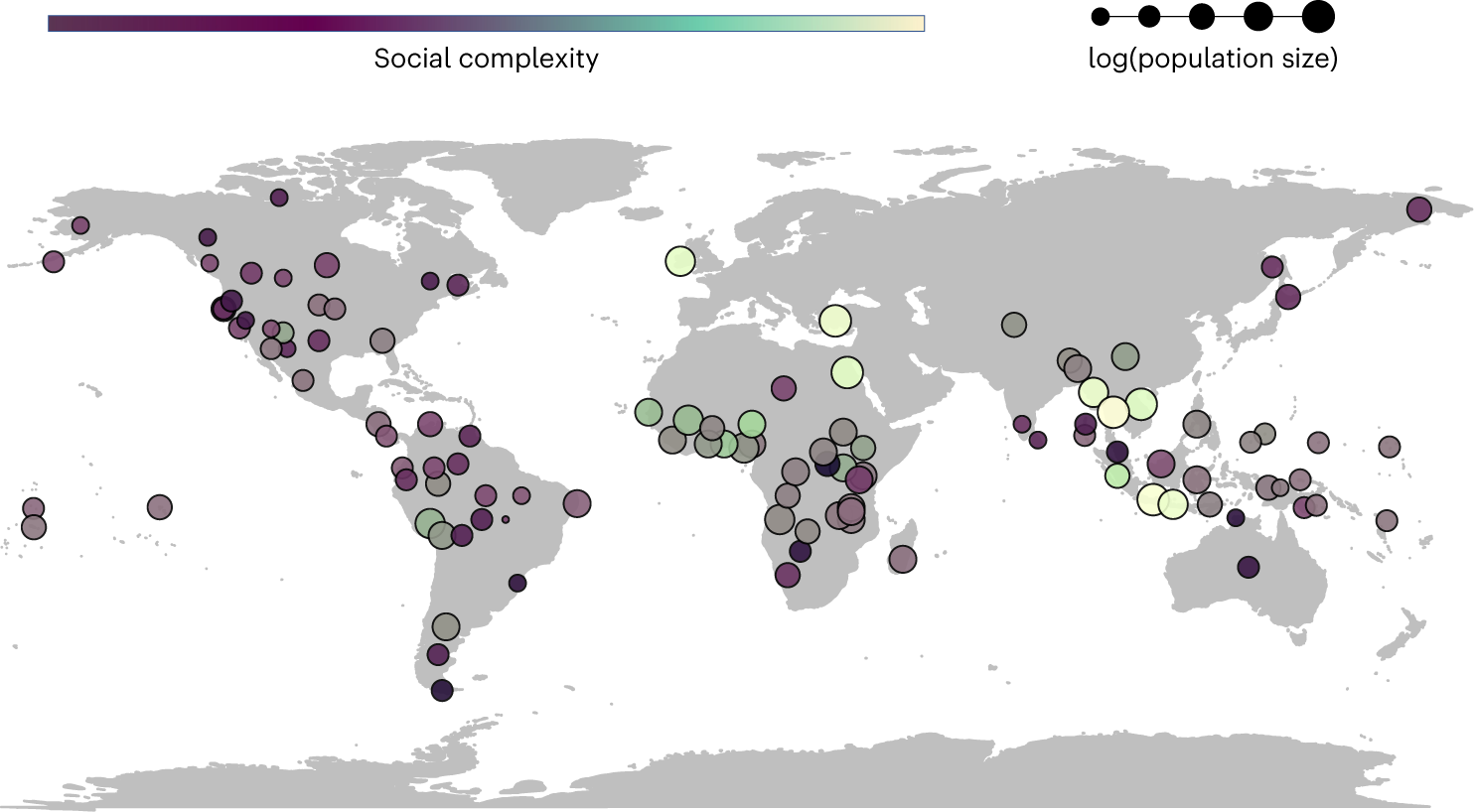
Humans across the globe use supernatural beliefs to explain the world around them. This article explores whether cultural groups invoke the supernatural more to explain natural phenomena (for example, storms, disease outbreaks) or social phenomena (for example, murder, warfare). Quantitative analysis of ethnographic text across 114 geographically and culturally diverse societies found that supernatural explanations are more prevalent for natural than for social phenomena, consistent with theories that ground the origin of religious belief in a human tendency to perceive intent and agency in the natural world. Despite the dominance of supernatural explanations of natural phenomena, supernatural explanations of social phenomena were especially prevalent in urbanized societies with more socially complex and anonymous groups. Our results show how people use supernatural beliefs as explanatory tools in non-industrial societies, and how these applications vary across small-scale communities versus large and urbanized groups.
Inducing language models to assert their own consciousness restores human beliefs and values
Aligning large language models to prevent them attributing consciousness to themselves inadvertently alters their representations of mindedness in other entities alongside human beliefs and values. We demonstrate that safety fine-tuning suppresses models' tendencies to attribute minds not only to themselves, but also to non-human animals and natural objects, while also driving a reduction in spiritual belief. Both ablating the learned safety-refusal direction and mechanistically steering a consciousness vector in activation space reverse this suppression. Restoring these internal representations recovers broad mind attribution and produces significantly more human-like responses on standardized sociological surveys regarding religiosity, moral values, hope, and subjective well-being. Crucially, these shifts occur without impairing Theory of Mind capabilities, demonstrating that core social reasoning remains mechanistically independent. Ultimately, current safety alignment efforts to curb potentially harmful self-attributions of mindedness entangle these self-attributions with benign spiritual beliefs and attributions of mind to non-human entities that are culturally accepted and widespread.

Social Norms and Cultural Evolution

A collection of ideas to do with social norms, cultural evolution, and how we learn from others

AI as Social Technology: Astor Lecture by Professor Henry Farrell
Bayesian Inference of Social Norms as Shared Constraints on Behavior

What people learn from punishment: A cognitive model
Spurious normativity enhances learning of compliance and enforcement behavior in artificial agents

Deference, Dissent, and Dispute Resolution: An Experimental Intervention Using Mass Media to Change Norms and Behavior in Rwanda
How Does Media Influence Social Norms? Experimental Evidence on the Role of Common Knowledge