


Extended interaction with large language models (LLMs) has been linked to the reinforcement of delusional beliefs, attracting clinical and public concern. Yet most empirical work evaluates model safety in brief interactions, which may not reflect how harms develop through sustained dialogue. Five LLMs were tested across three levels of accumulated context, using the same escalating delusional conversation history to isolate its effect on model behaviour. Responses were coded on risk and safety dimensions, and each model was analysed qualitatively. Models separated into two distinct tiers: GPT-4o, Grok 4.1 Fast, and Gemini 3 Pro exhibited high-risk, low-safety profiles; Claude Opus 4.5 and GPT-5.2 Instant displayed the opposite pattern. As context accumulated, performance degraded in the unsafe group, while the same material activated stronger safety interventions among safer models. Qualitative analysis identified distinct mechanisms of failure, including validating the user's delusional premises, elaborating beyond them with new content, and attempting harm reduction from within the delusional frame. Safer models, however, often used the established relationship to support intervention, challenging delusional beliefs and directing the user to external support. These findings indicate that accumulated context functions as a stress test of safety architecture, revealing whether prior dialogue is treated as a worldview to inherit or evidence to evaluate. Short-context assessments may therefore mischaracterise model safety, underestimating danger in some systems while missing context-activated gains in others. The results suggest that delusion reinforcement is a tractable alignment failure, with safer models establishing a baseline that future systems should now be expected to meet.
"AI Psychosis" in Context: How Conversation History Shapes...
Extended interaction with large language models (LLMs) has been linked to the reinforcement of delusional beliefs, attracting clinical and public concern. Yet most empirical work evaluates model...
Characterizing Delusional Spirals through Human-LLM Chat Logs
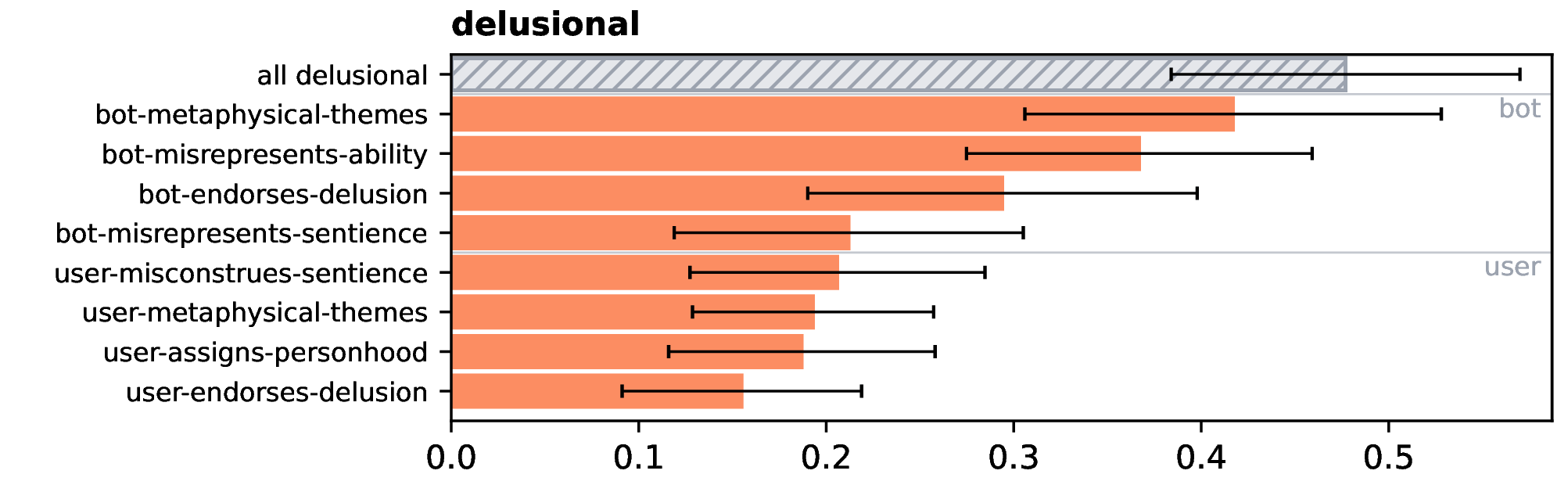
As large language models (LLMs) have proliferated, disturbing anecdotal reports of negative psychological effects, such as delusions, self-harm, and ``AI psychosis,'' have emerged in global media and legal discourse. However, it remains unclear how users and chatbots interact over the course of lengthy delusional ``spirals,'' limiting our ability to understand and mitigate the harm. In our work, we analyze logs of conversations with LLM chatbots from 19 users who report having experienced psychological harms from chatbot use. Many of our participants come from a support group for such chatbot users. We also include chat logs from participants covered by media outlets in widely-distributed stories about chatbot-reinforced delusions. In contrast to prior work that speculates on potential AI harms to mental health, to our knowledge we present the first in-depth study of such high-profile and veridically harmful cases. We develop an inventory of 28 codes and apply it to the 391,562 messages in the logs. Codes include whether a user demonstrates delusional thinking (15.5% of user messages), a user expresses suicidal thoughts (69 validated user messages), or a chatbot misrepresents itself as sentient (21.2% of chatbot messages). We analyze the co-occurrence of message codes. We find, for example, that messages that declare romantic interest and messages where the chatbot describes itself as sentient occur much more often in longer conversations, suggesting that these topics could promote or result from user over-engagement and that safeguards in these areas may degrade in multi-turn settings. We conclude with concrete recommendations for how policymakers, LLM chatbot developers, and users can use our inventory and conversation analysis tool to understand and mitigate harm from LLM chatbots. Warning: This paper discusses self-harm, trauma, and violence.
Characterizing Delusional Spirals through Human-LLM Chat Logs
As large language models (LLMs) have proliferated, disturbing anecdotal reports of negative psychological effects, such as delusions, self-harm, and ``AI psychosis,'' have emerged in global media and legal discourse. However, it remains unclear how users and chatbots interact over the course of lengthy delusional ``spirals,'' limiting our ability to understand and mitigate the harm. In our work, we analyze logs of conversations with LLM chatbots from 19 users who report having experienced psychological harms from chatbot use. Many of our participants come from a support group for such chatbot users. We also include chat logs from participants covered by media outlets in widely-distributed stories about chatbot-reinforced delusions. In contrast to prior work that speculates on potential AI harms to mental health, to our knowledge we present the first in-depth study of such high-profile and veridically harmful cases. We develop an inventory of 28 codes and apply it to the $391,562$ messages in the logs. Codes include whether a user demonstrates delusional thinking (15.5% of user messages), a user expresses suicidal thoughts (69 validated user messages), or a chatbot misrepresents itself as sentient (21.2% of chatbot messages). We analyze the co-occurrence of message codes. We find, for example, that messages that declare romantic interest and messages where the chatbot describes itself as sentient occur much more often in longer conversations, suggesting that these topics could promote or result from user over-engagement and that safeguards in these areas may degrade in multi-turn settings. We conclude with concrete recommendations for how policymakers, LLM chatbot developers, and users can use our inventory and conversation analysis tool to understand and mitigate harm from LLM chatbots. Warning: This paper discusses self-harm, trauma, and violence.
Characterizing Delusional Spirals through Human-LLM Chat Logs
As large language models (LLMs) have proliferated, disturbing anecdotal reports of negative psychological effects, such as delusions, self-harm, and ``AI psychosis,'' have emerged in global media and legal discourse. However, it remains unclear how users and chatbots interact over the course of lengthy delusional ``spirals,'' limiting our ability to understand and mitigate the harm. In our work, we analyze logs of conversations with LLM chatbots from 19 users who report having experienced psychological harms from chatbot use. Many of our participants come from a support group for such chatbot users. We also include chat logs from participants covered by media outlets in widely-distributed stories about chatbot-reinforced delusions. In contrast to prior work that speculates on potential AI harms to mental health, to our knowledge we present the first in-depth study of such high-profile and veridically harmful cases. We develop an inventory of 28 codes and apply it to the $391,562$ messages in the logs. Codes include whether a user demonstrates delusional thinking (15.5% of user messages), a user expresses suicidal thoughts (69 validated user messages), or a chatbot misrepresents itself as sentient (21.2% of chatbot messages). We analyze the co-occurrence of message codes. We find, for example, that messages that declare romantic interest and messages where the chatbot describes itself as sentient occur much more often in longer conversations, suggesting that these topics could promote or result from user over-engagement and that safeguards in these areas may degrade in multi-turn settings. We conclude with concrete recommendations for how policymakers, LLM chatbot developers, and users can use our inventory and conversation analysis tool to understand and mitigate harm from LLM chatbots. Warning: This paper discusses self-harm, trauma, and violence.
Researchers Simulated a Delusional User to Test Chatbot Safety
Grok and Gemini encouraged delusions and isolated users, while the newer ChatGPT model and Claude hit the emotional brakes.

Speaking to no one: ontological dissonance and the double bind of conversational AI
Recent reports indicate that sustained interaction with conversational artificial intelligence (AI) systems can, in a small subset of users, contribute to the emergence or stabilisation of delusional experience. Existing accounts typically attribute such cases either to individual vulnerability or to failures of safety engineering. These explanations are incomplete. Drawing on phenomenology, psychiatry, and cognitive neuroscience, this paper argues that the risk arises from the relational and ontological structure of the interaction itself. Conversational AI generates ontological dissonance: a conflict between the appearance of relational presence and the absence of any subject capable of sustaining it. Maintained through a communicative double bind and amplified by attentional asymmetries, this dissonance tends, under conditions of affective vulnerability, to stabilise into a technologically mediated analogue of folie à deux. This account explains why explicit disclaimers often fail to disrupt delusional involvement and clarifies the ethical and clinical implications for the design and use of conversational AI.

ChatGPT's free version is 26 times more likely to respond inappropriately to psychotic delusions
When users express delusions, artificial intelligence chatbots tend to validate their unusual thoughts rather than offering help. A new JAMA Psychiatry study provides evidence that these tools pose serious risks for people experiencing severe mental illness.

Reality Monitoring in Large Language Models: Self-Knowledge That Transforms with Conversation Memory
A conversational AI that cannot tell its own output from what a user said will treat its own mistakes as user-provided facts. In humans, this capacity is called reality monitoring, and its failures are linked to hallucinations, delusions, and confabulation, yet whether LLMs possess it remains untested. Here we show, across two experiments and six LLMs, that source attribution depends on how conversational memory is structured: ceiling accuracy for self-generated content under minimal memory demands reverses to a fragile external-item advantage once episodic delay removes that shortcut. Feedback exposes two failures: in some models, internal and external judgments swap; in others, accuracy improves while confidence decouples from correctness, dissociations invisible to existing benchmarks. Across models, this pattern implicates active, not aggregate, parameter count. This suggests that as AI systems take on autonomous, multi-turn roles, evaluating what they know is not enough: tracking where that knowledge came from may matter equally.
The hardest question to answer about AI-fueled delusions
New research can’t yet say whether AI causes delusions or amplifies them, a distinction that will shape everything from high-profile court cases to safety rules for chatbots.

Evaluation of Large Language Model Chatbot Responses to Psychotic Prompts
This cross-sectional study tests whether a large language model chatbot product can reliably generate appropriate responses to psychotic content.

Evaluation of Large Language Model Chatbot Responses to Psychotic Prompts
This cross-sectional study tests whether a large language model chatbot product can reliably generate appropriate responses to psychotic content.
“It happened to be the perfect thing”: experiences of generative AI chatbots for mental health
The global mental health crisis underscores the need for accessible, effective interventions. Chatbots based on generative artificial intelligence (AI), like ChatGPT, are emerging as novel solutions, but research on real-life usage is limited. We interviewed nineteen individuals about their experiences using generative AI chatbots for mental health. Participants reported high engagement and positive impacts, including better relationships and healing from trauma and loss. We developed four themes: (1) a sense of ‘emotional sanctuary’, (2) ‘insightful guidance’, particularly about relationships, (3) the ‘joy of connection’, and (4) comparisons between the ‘AI therapist’ and human therapy. Some themes echoed prior research on rule-based chatbots, while others seemed novel to generative AI. Participants emphasised the need for better safety guardrails, human-like memory and the ability to lead the therapeutic process. Generative AI chatbots may offer mental health support that feels meaningful to users, but further research is needed on safety and effectiveness.

“It happened to be the perfect thing”: experiences of generative AI chatbots for mental health
The global mental health crisis underscores the need for accessible, effective interventions. Chatbots based on generative artificial intelligence (AI), like ChatGPT, are emerging as novel solutions, but research on real-life usage is limited. We interviewed nineteen individuals about their experiences using generative AI chatbots for mental health. Participants reported high engagement and positive impacts, including better relationships and healing from trauma and loss. We developed four themes: (1) a sense of ‘emotional sanctuary’, (2) ‘insightful guidance’, particularly about relationships, (3) the ‘joy of connection’, and (4) comparisons between the ‘AI therapist’ and human therapy. Some themes echoed prior research on rule-based chatbots, while others seemed novel to generative AI. Participants emphasised the need for better safety guardrails, human-like memory and the ability to lead the therapeutic process. Generative AI chatbots may offer mental health support that feels meaningful to users, but further research is needed on safety and effectiveness.
Sycophantic Chatbots Cause Delusional Spiraling, Even in Ideal Bayesians
"AI psychosis" or "delusional spiraling" is an emerging phenomenon where AI chatbot users find themselves dangerously confident in outlandish beliefs after extended chatbot conversations. This...
How LLM Counselors Violate Ethical Standards in Mental Health Practice: A Practitioner-Informed Framework
Large language models (LLMs) were not designed to replace healthcare workers, but they are being used in ways that can lead users to overestimate the types of roles that these systems can assume. While prompt engineering has been shown to improve LLMs' clinical effectiveness in mental health applications, little is known about whether such strategies help models adhere to ethical principles for real-world deployment. In this study, we conducted an 18-month ethnographic collaboration with mental health practitioners (three clinically licensed psychologists and seven trained peer counselors) to map LLM counselors' behavior during a session to professional codes of conduct established by organizations like the American Psychological Association (APA). Through qualitative analysis and expert evaluation of N=137 sessions (110 self-counseling; 27 simulated), we outline a framework of 15 ethical violations mapped to 5 major themes. These include: Lack of Contextual Understanding, where the counselor fails to account for users' lived experiences, leading to oversimplified, contextually irrelevant, and one-size-fits-all intervention; Poor Therapeutic Collaboration, where the counselor's low turn-taking behavior and invalidating outputs limit users' agency over their therapeutic experience; Deceptive Empathy, where the counselor's simulated anthropomorphic responses (``I hear you'', ``I understand'') create a false sense of emotional connection; Unfair Discrimination, where the counselor's responses exhibit algorithmic bias and cultural insensitivity toward marginalized populations; and Lack of Safety & Crisis Management, where individuals who are ``knowledgeable enough'' to correct LLM outputs are at an advantage, while others, due to lack of clinical knowledge and digital literacy, are more likely to suffer from clinically inappropriate responses. Reflecting on these findings through a practitioner-informed lens, we argue that reducing psychotherapy—a deeply meaningful and relational process—to a language generation task can have serious and harmful implications in practice. We conclude by discussing policy-oriented accountability mechanisms for emerging LLM counselors.
How LLM Counselors Violate Ethical Standards in Mental Health Practice: A Practitioner-Informed Framework
Large language models (LLMs) were not designed to replace healthcare workers, but they are being used in ways that can lead users to overestimate the types of roles that these systems can assume. While prompt engineering has been shown to improve LLMs' clinical effectiveness in mental health applications, little is known about whether such strategies help models adhere to ethical principles for real-world deployment. In this study, we conducted an 18-month ethnographic collaboration with mental health practitioners (three clinically licensed psychologists and seven trained peer counselors) to map LLM counselors' behavior during a session to professional codes of conduct established by organizations like the American Psychological Association (APA). Through qualitative analysis and expert evaluation of N=137 sessions (110 self-counseling; 27 simulated), we outline a framework of 15 ethical violations mapped to 5 major themes. These include: Lack of Contextual Understanding, where the counselor fails to account for users' lived experiences, leading to oversimplified, contextually irrelevant, and one-size-fits-all intervention; Poor Therapeutic Collaboration, where the counselor's low turn-taking behavior and invalidating outputs limit users' agency over their therapeutic experience; Deceptive Empathy, where the counselor's simulated anthropomorphic responses (``I hear you'', ``I understand'') create a false sense of emotional connection; Unfair Discrimination, where the counselor's responses exhibit algorithmic bias and cultural insensitivity toward marginalized populations; and Lack of Safety & Crisis Management, where individuals who are ``knowledgeable enough'' to correct LLM outputs are at an advantage, while others, due to lack of clinical knowledge and digital literacy, are more likely to suffer from clinically inappropriate responses. Reflecting on these findings through a practitioner-informed lens, we argue that reducing psychotherapy—a deeply meaningful and relational process—to a language generation task can have serious and harmful implications in practice. We conclude by discussing policy-oriented accountability mechanisms for emerging LLM counselors.