

Shaping sustainable public finances that drive full employment, prosperity, and shared growth.
Public & Social Investments | Windfall Policy Atlas
How should governments allocate resources to maintain economic stability and ensure broad access to essential services during the AI transition?

Money & Macro
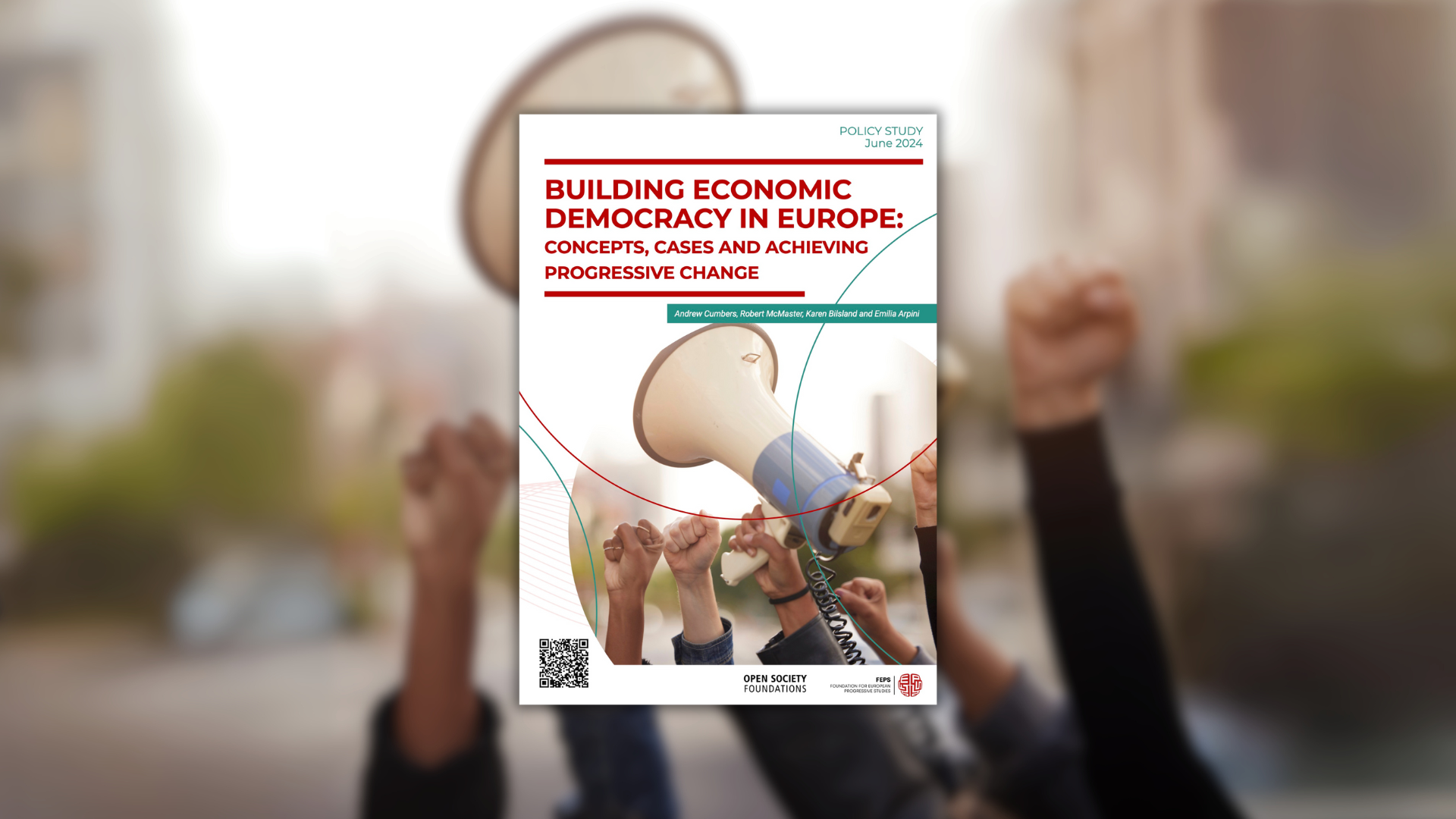
Building Economic Democracy in Europe - Foundation for European Progressive Studies
Concepts, Cases and Achieving Progressive Change
Wealth Capture Policies | Windfall Policy Atlas
What mechanisms can ensure AI-driven productivity gains are captured for the public benefit?
Scaling sustainable social networks in the public interest | Heinrich Böll Stiftung | Brussels office - European Union
This policy paper identifies five key challenges for scaling a public-interest social web: infrastructure, governance, funding, attractiveness, and public mandate. It outlines a roadmap for overcoming these challenges and building the Open Social Web Alliance into a relevant force within months — starting in Germany.
L'écologie sacrifiée sur l'autel des règles budgétaires européennes
La discussion budgétaire, focalisée sur la réduction de la dette, ne répond pas aux besoins d’investissements urgents pour la transition écologique et sociale.…

The PEPPER V Report - Kelso Institute Europe
This Report provides an overview of the development of employee financial participation, i.e., employee share ownership and profit sharing, across the EU-27, the United Kingdom, and the United States of America as of January 2024. Against the background of the policy development of the past 35 years, it highlights the growth of financial participation over the last decade using the most recent cross-country data available, i.e., the 2021 CRANET Survey, the 2019 European Company Survey and the 2015 European Working Conditions Survey, which also show its potential positive impact on employment and productivity.
Work, Justice, and Collective Capital Institutions: Revisiting Rudolf Meidner and the Case for <span style="font-variant:small-caps;">Wage‐Earner</span> Funds
ABSTRACT This article makes the case for a specific variety of what we call Collective Capital Institutions (CCIs), by returning to the idea of Wage‐Earner Funds (WEFs) – a 1970s Swedish policy proposal designed gradually to shift ownership and control over parts of the economy to democratically controlled institutions. We identify two attractive rationales in favour of such a scheme and argue that both can fruitfully be transposed to the current worldwide economic situation. The egalitarian rationale is that WEFs could help in the pursuit of equality by giving a wider set of people a stake in collectively owned companies and a right to their profits. The democratic rationale is that WEFs redistribute not only these profits, but also the power over economic decisions made within companies. We then contrast such schemes for collective capital ownership with the similar but much more privatised proposals set out in, for instance, John Rawls's idea of a ‘property‐owning democracy’. We argue that CCIs ultimately are more likely to contribute to the development of the ‘sense of justice’ within society that is needed for a stable just society. We conclude that CCIs deserve a great deal more exploration in academic and political discussions of egalitarian economic systems.

Post-growth: the science of wellbeing within planetary boundaries
There are increasing concerns that continued economic growth in high-income countries might not be environmentally sustainable, socially beneficial, or economically achievable. In this Review, we explore the rapidly advancing field of post-growth research, which has evolved in response to these concerns. The central idea of post-growth is to replace the goal of increasing GDP with the goal of improving human wellbeing within planetary boundaries. Key advances discussed in this Review include: the development of ecological macroeconomic models that test policies for managing without growth; understanding and reducing the growth dependencies that tie social welfare to increasing GDP in the current economy; and characterising the policies and provisioning systems that would allow resource use to be reduced while improving human wellbeing.

Exocapitalism: economies with absolutely no limits
There is a touch of destiny with this one. We have real…

Funding the Commons | Public Goods Funding
We convene researchers, builders, and institutions to develop the funding mechanisms, governance systems, and coordination tools that public goods need in an age of AI.

Fiscal stagnation
Public debt-to-GDP ratios have climbed to historic highs in most advanced economies. This column studies the connection between productivity growth, fiscal policy, and public debt. Using a theoretical model, it argues that a feedback loop is possible between fiscal policy and growth. Large primary surpluses are associated with fiscal distortions which depress investment and productivity growth, and lead to further pressure on public debt-to-GDP ratios. A fall into fiscal stagnation can result from hysteresis effects or pessimistic animal spirits. Meanwhile, exiting fiscal stagnation requires large policy interventions that reduce the public debt-to-GDP ratio, such as credible pro-growth strategies.

Beyond GDP: Measuring and Valuing What Really Matters
Rethinking the UN’s “beyond GDP” agenda and the case for putting wealth at the centre
Home - Schumacher Center for a New Economics
Our mission is to envision a just and regenerative economy; apply the concepts locally; then share the results for broad replication. Programs Library Lectures & Publications The Decentralism File Community Land Trust Local Currencies Reinventing The Commons All Programs eNewsletters All News “Since there is now increasing evidence of environmental deterioration, particularly in … Continued

The Portfolio Ideal Worker: Insecurity and Inequality in the New Economy
This output contributes to the following UN Sustainable Development Goals (SDGs)
Supporting AT Proto development with money and infrastructure should be a no-brainer for EU industrial policy. In fact, given the need for alternatives to US-owned platforms, comparative advantage, and infinite downstream benefits, few areas offer a bigger bang for your industrial policy buck.

Eurosky Sebastian
2 days ago I had the opportunity to participate in the European Commission‘s workshop on the future of social networks in Europe, together with researchers, entrepreneurs, policymakers, investors and civil society representatives.
