

"Why do you jackasses use these inferior linguistic vehicles when we have something here that’s so precious, so elegant, which gives me so ...
A folksonomy of lexicons - Chris's Corner
On the design and intent of different lexicons
On Language and Humanity: In Conversation With Noam Chomsky
The father of modern linguistics is still opening up new kinds of questions and topics for inquiry.

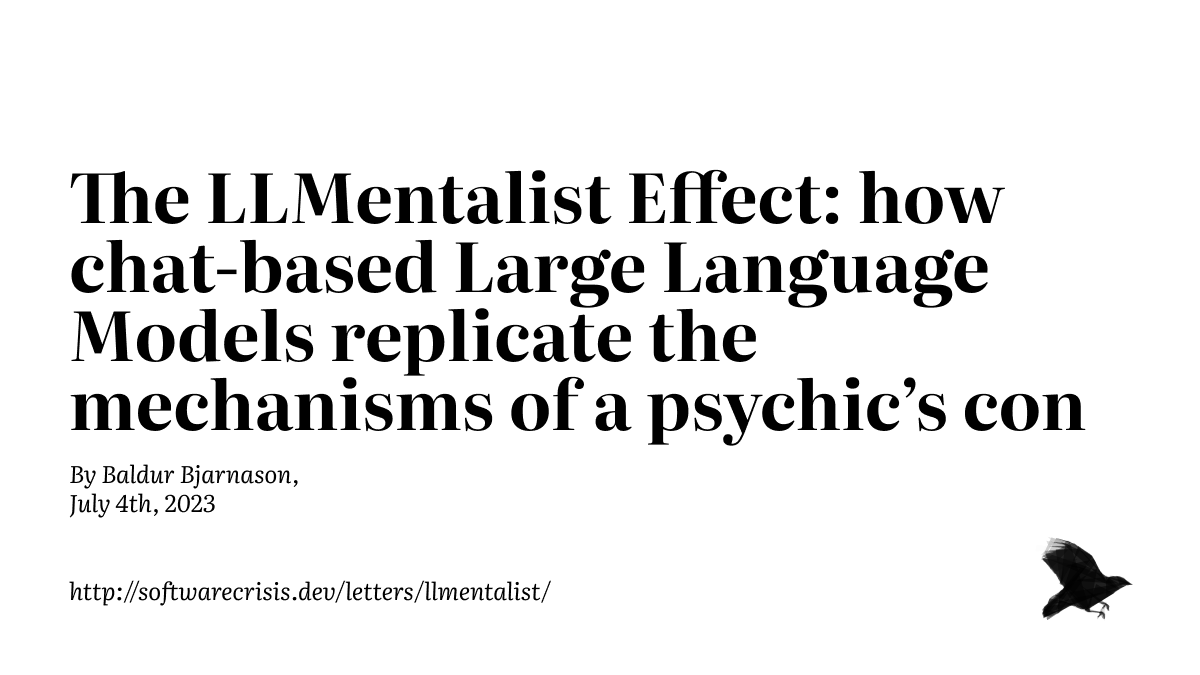
The LLMentalist Effect: how chat-based Large Language Models rep…
The new era of tech seems to be built on superstitious behaviour
Why mental metaphors do not help us understand chatbot mistakes
The function of chatbots like OpenAI’s ChatGPT is based on detecting probabilistic patterns in the training data. This makes them vulnerable to generating factual mistakes in their outputs. Recently, it has become commonplace in philosophical, scientific, and popular discourses to capture such mistakes by metaphors that draw on discourses about the human mind. The two most popular metaphors at present are hallucinating and bullshitting. In this paper, we review, discuss, and criticise these mental metaphors. By applying conceptual metaphor theory, we provide numerous reasons why they do not succeed in providing us with a better understanding of factual chatbot mistakes. We conclude by calling for justifications of the epistemic feasibility and fruitfulness of the metaphors at issue. Furthermore, we raise the question what would be lost if we stopped trying to capture factual chatbot mistakes by mental metaphors.
Deconstructing the algorithmic sublime
This special theme contextualizes, examines, and ultimately works to dispel the feelings of “sublime”—of awe and terror that overrides rational thought—that much of the contemporary public discourse on algorithms encourages. Employing critical, reflexive, and ethnographic techniques, these authors show that while algorithms can take on a multiplicity of different cultural meanings, they ultimately remain closely connected to the people who define and deploy them, and the institutions and power relations in which they are embedded. Building on a conversation we began at the Algorithms in Culture conference at U.C. Berkeley in December 2016, we collectively study algorithms as culture (Seaver, this special theme), fetish (Thomas et al.), imaginary (Christin), bureaucratic logic (Caplan and boyd), method of governance (Coletta and Kitchin; Lee; Geiger), mode of inquiry (Baumer), and mode of power (Kubler). [Box: see text]

"I've got an idea!" On pluralism and resisting deskilling
A ramble around plural knowledges, data and AI, inspired by the wisdom from friends and colleagues in Nairobi and watching The Pitt. Plus! a random picture of an elephant

Mirages: On Anthropomorphism in Dialogue Systems
Automated dialogue or conversational systems are anthropomorphised by developers and personified by users. While a degree of anthropomorphism may be inevitable due to the choice of medium, conscious and unconscious design choices can guide users to personify such systems to varying degrees. Encouraging users to relate to automated systems as if they were human can lead to high risk scenarios caused by over-reliance on their outputs. As a result, natural language processing researchers have investigated the factors that induce personification and develop resources to mitigate such effects. However, these efforts are fragmented, and many aspects of anthropomorphism have yet to be explored. In this paper, we discuss the linguistic factors that contribute to the anthropomorphism of dialogue systems and the harms that can arise, including reinforcing gender stereotypes and notions of acceptable language. We recommend that future efforts towards developing dialogue systems take particular care in their design, development, release, and description; and attend to the many linguistic cues that can elicit personification by users.

The Grid: A Lecture on Cybotron and Techno-Vernacular Expressionism by DeForrest Brown, Jr.


community.lexicon.collections proposal - Chris's Corner
The working explainer for a lexicons about heterogeneous collections.
The homogenizing effect of large language models on human expression and thought
AbstractCognitive diversity, reflected in variations of language, perspective, and reasoning, is essential to creativity and collective intelligence. This diversity is rich and grounded in culture, history, and individual experience. Yet, as large language models (LLMs) become deeply embedded in people's lives, they risk standardizing language and reasoning. We synthesize evidence across linguistics, psychology, cognitive science, and computer science to show how LLMs reflect and reinforce dominant styles while marginalizing alternative voices and reasoning strategies. We examine how their design and widespread use contribute to this effect by mirroring patterns in their training data and amplifying convergence as all people increasingly rely on the same models across contexts. Unchecked, this homogenization risks flattening the cognitive landscapes that drive collective intelligence and adaptability.


Maite Taboada
Maite Taboada. Professor. Department of Linguistics, Simon Fraser University. Research: discourse analysis, computational linguistics
#IC2S2 keynote Gasper Begus giving a fascinating talk about analyzing languages spoken by whales @ic2s2.bsky.social
Notation as a Tool of Thought

Notation is not a way of writing thoughts down — it is a technology that determines which thoughts are available to be had. Starting from Iverson's 1979 Turing Award lecture, this collection gathers the argument's ancestors, elaborations, and its opponents: Nielsen and Matuschak on media as cognitive infrastructure, Bret Victor's case against symbol manipulation, and empirical work on representation as a cognitive tool. Open to contributions.
The Technological Turn in Mathematics
J Notation as a Tool of Thought

Prof. Judy Fan: Cognitive Tools for Making the Invisible Visible
Media for Thinking the Unthinkable
Kill Math
Using spaced repetition systems to see through a piece of mathematics
