In a 1990 paper, “Entrepreneurship: Productive, Unproductive, and Destructive,” late economist William Baumol argued that not all entrepreneurs are equal: there are both “productive” and “unproductive” endeavors. Most people think of all entrepreneurship to be what Baumol referred to as the “productive” kind, where the companies that founders launch commercialize something new or better, benefiting society and themselves in the process. Baumol was worried, however, by a very different sort of entrepreneur, the “unproductive” ones who exploit special relationships with the government to construct regulatory moats, secure public spending for their own benefit, or bend specific rules to their will — in the process, stifling competition to create advantage for their firms. Two recent trends indicate that this may be happening in the U.S. today: rising profits, especially those earned by the largest businesses in the economy, and suggestive evidence of an increase in efforts to shape the rules of the game. Baumol may have been ahead of his time. If the U.S. is going to tackle its many problems, we are going to have to find ways to encourage would-be entrepreneurs to start innovative, productive businesses, rather than dedicating their efforts to co-opting government in order to secure economic advantage.
annotations: William Baumol : un entrepreneuriat réellement productif
Blog de sciences économiques et sociales de Martin Anota. Traductions, revues de presse.
Entrepreneuring for a Post-Growth Economy: From Sustainable to Post-Growth Entrepreneurship
Earth's critical planetary boundaries are being exceeded and current economic development models are failing to provide adequate societal benefits. Urgent

Too much of a good thing
Profits are too high. America needs a giant dose of competition

The Everywhere Millionaire: Who Is Really Rich in America and How They Got There
From two leading economists comes a groundbreaking new portrait of the hidden fortunes of Main Street business owners—ordinary Americans who built extraordinary wealth and are quietly rewriting the rules of money and power. Most people think the path to great wealth runs through Wall Street or Silicon Valley. We’re told you must be a Zuckerberg, a Musk, or a Jamie Dimon to get rich. But this story is wrong. Drawing on unprecedented data from a decade of research and vivid real-life stories of entrepreneurs—from a self-made hot-dog stand billionaire to the heirs of an auto dealer—Zidar and Zwick reveal a surprising truth: prosperity is more attainable, more widely distributed, and closer to home than we imagine. A multitude of Americans have built staggering fortunes by running often unglamorous businesses far from the spotlight. A quiet revolution in the business world—the rise of “pass-through” firms like S-corporations and partnerships—supercharged this wealth, channeling vast income directly to business owners rather than traditional corporations.Part economic detective story, part roadmap to riches, this book reveals: —The Hidden 1%: They might be a local beer distributor, a dentist with a regional network of practices, a commercial HVAC contractor with trucks around town, or a restaurateur who keeps opening new locations. For every public company CEO, more than a thousand private business owners each have transformational wealth.— The Blueprint for Wealth: Zidar and Zwick describe where Main Street Millionaires come from, how they grew rich, and how much money they make. Their stories suggest the American Dream is not dead and many paths to prosperity remain open today. — Power Brokers: Armed with their fortunes, Main Street Millionaires wield power in city halls, statehouses, and Washington, often bending policy to protect what they’ve built. They are both growing the economic pie and grabbing bigger slices for themselves.The Everywhere Millionaire celebrates the stories of entrepreneurs who seized opportunities while asking hard questions about how concentrated wealth and power shape society. It is an essential guide to seeing the economy as it really is and recognizing the surprising paths to prosperity—and influence—everywhere.
12 Things I Learned from Chris Dixon about Startups | Andreessen Horowitz
#1 “If everyone loves your idea, I might be worried that it’s not forward thinking enough.” Anyone thinking about starting a business should be searching for mispriced opportunities. While markets are mostly efficient in eliminating opportunities for extraordinary profit, there are always areas of an economy in which there are significant uncertainty. These areas are...

How To Be Successful
I’ve observed thousands of founders and thought a lot about what it takes to make a huge amount of money or to create something important. Usually, people start off wanting the former and end up...
Nearly half as many people are launching businesses as 20 years ago
According to a study conducted by BDC in collaboration with the Université de Montréal, not enough people are starting businesses to replace those closing their doors

Ignorance got a bad rap
One of the best skills to develop as an entrepreneur? Ignorance. I think a lot of folks are spending way too much energy trying to know it all. They’re trying to be over-informed. Soaking up every …

You Weren't Meant to Have a Boss
March 2008, rev. June 2008Technology tends to separate normal from natural. Our bodies weren't designed to eat the foods that people in rich countries eat, or to get so little exercise. There may be a similar problem with the way we work: a normal job may be as bad for us intellectually as white flour or sugar is for us physically.I began to suspect this after spending several years working with startup founders. I've now worked with over 200 of them, and I've noticed a definite difference between programmers working on their own startups and those working for large organizations. I wouldn't say founders seem happier, necessarily; starting a startup can be very stressful. Maybe the best way to put it is to say that they're happier in the sense that your body is happier during a long run than sitting on a sofa eating doughnuts.Though they're statistically abnormal, startup founders seem to be working in a way that's more natural for humans.I was in Africa last year and saw a lot of animals in the wild that I'd only seen in zoos before. It was remarkable how different they seemed. Particularly lions. Lions in the wild seem about ten times more alive. They're like different animals. I suspect that working for oneself feels better to humans in much the same way that living in the wild must feel better to a wide-ranging predator like a lion. Life in a zoo is easier, but it isn't the life they were designed for. TreesWhat's so unnatural about working for a big company? The root of the problem is that humans weren't meant to work in such large groups.Another thing you notice when you see animals in the wild is that each species thrives in groups of a certain size. A herd of impalas might have 100 adults; baboons maybe 20; lions rarely 10. Humans also seem designed to work in groups, and what I've read about hunter-gatherers accords with research on organizations and my own experience to suggest roughly what the ideal size is: groups of 8 work well; by 20 they're getting hard to manage; and a group of 50 is really unwieldy. [1] Whatever the upper limit is, we are clearly not meant to work in groups of several hundred. And yet—for reasons having more to do with technology than human nature—a great many people work for companies with hundreds or thousands of employees.Companies know groups that large wouldn't work, so they divide themselves into units small enough to work together. But to coordinate these they have to introduce something new: bosses.These smaller groups are always arranged in a tree structure. Your boss is the point where your group attaches to the tree. But when you use this trick for dividing a large group into smaller ones, something strange happens that I've never heard anyone mention explicitly. In the group one level up from yours, your boss represents your entire group. A group of 10 managers is not merely a group of 10 people working together in the usual way. It's really a group of groups. Which means for a group of 10 managers to work together as if they were simply a group of 10 individuals, the group working for each manager would have to work as if they were a single person—the workers and manager would each share only one person's worth of freedom between them.In practice a group of people are never able to act as if they were one person. But in a large organization divided into groups in this way, the pressure is always in that direction. Each group tries its best to work as if it were the small group of individuals that humans were designed to work in. That was the point of creating it. And when you propagate that constraint, the result is that each person gets freedom of action in inverse proportion to the size of the entire tree. [2]Anyone who's worked for a large organization has felt this. You can feel the difference between working for a company with 100 employees and one with 10,000, even if your group has only 10 people. Corn SyrupA group of 10 people within a large organization is a kind of fake tribe. The number of people you interact with is about right. But something is missing: individual initiative. Tribes of hunter-gatherers have much more freedom. The leaders have a little more power than other members of the tribe, but they don't generally tell them what to do and when the way a boss can.It's not your boss's fault. The real problem is that in the group above you in the hierarchy, your entire group is one virtual person. Your boss is just the way that constraint is imparted to you.So working in a group of 10 people within a large organization feels both right and wrong at the same time. On the surface it feels like the kind of group you're meant to work in, but something major is missing. A job at a big company is like high fructose corn syrup: it has some of the qualities of things you're meant to like, but is disastrously lacking in others.Indeed, food is an excellent metaphor to explain what's wrong with the usual sort of job.For example, working for a big company is the default thing to do, at least for programmers. How bad could it be? Well, food shows that pretty clearly. If you were dropped at a random point in America today, nearly all the food around you would be bad for you. Humans were not designed to eat white flour, refined sugar, high fructose corn syrup, and hydrogenated vegetable oil. And yet if you analyzed the contents of the average grocery store you'd probably find these four ingredients accounted for most of the calories. "Normal" food is terribly bad for you. The only people who eat what humans were actually designed to eat are a few Birkenstock-wearing weirdos in Berkeley.If "normal" food is so bad for us, why is it so common? There are two main reasons. One is that it has more immediate appeal. You may feel lousy an hour after eating that pizza, but eating the first couple bites feels great. The other is economies of scale. Producing junk food scales; producing fresh vegetables doesn't. Which means (a) junk food can be very cheap, and (b) it's worth spending a lot to market it.If people have to choose between something that's cheap, heavily marketed, and appealing in the short term, and something that's expensive, obscure, and appealing in the long term, which do you think most will choose?It's the same with work. The average MIT graduate wants to work at Google or Microsoft, because it's a recognized brand, it's safe, and they'll get paid a good salary right away. It's the job equivalent of the pizza they had for lunch. The drawbacks will only become apparent later, and then only in a vague sense of malaise.And founders and early employees of startups, meanwhile, are like the Birkenstock-wearing weirdos of Berkeley: though a tiny minority of the population, they're the ones living as humans are meant to. In an artificial world, only extremists live naturally. ProgrammersThe restrictiveness of big company jobs is particularly hard on programmers, because the essence of programming is to build new things. Sales people make much the same pitches every day; support people answer much the same questions; but once you've written a piece of code you don't need to write it again. So a programmer working as programmers are meant to is always making new things. And when you're part of an organization whose structure gives each person freedom in inverse proportion to the size of the tree, you're going to face resistance when you do something new.This seems an inevitable consequence of bigness. It's true even in the smartest companies. I was talking recently to a founder who considered starting a startup right out of college, but went to work for Google instead because he thought he'd learn more there. He didn't learn as much as he expected. Programmers learn by doing, and most of the things he wanted to do, he couldn't—sometimes because the company wouldn't let him, but often because the company's code wouldn't let him. Between the drag of legacy code, the overhead of doing development in such a large organization, and the restrictions imposed by interfaces owned by other groups, he could only try a fraction of the things he would have liked to. He said he has learned much more in his own startup, despite the fact that he has to do all the company's errands as well as programming, because at least when he's programming he can do whatever he wants.An obstacle downstream propagates upstream. If you're not allowed to implement new ideas, you stop having them. And vice versa: when you can do whatever you want, you have more ideas about what to do. So working for yourself makes your brain more powerful in the same way a low-restriction exhaust system makes an engine more powerful.Working for yourself doesn't have to mean starting a startup, of course. But a programmer deciding between a regular job at a big company and their own startup is probably going to learn more doing the startup.You can adjust the amount of freedom you get by scaling the size of company you work for. If you start the company, you'll have the most freedom. If you become one of the first 10 employees you'll have almost as much freedom as the founders. Even a company with 100 people will feel different from one with 1000.Working for a small company doesn't ensure freedom. The tree structure of large organizations sets an upper bound on freedom, not a lower bound. The head of a small company may still choose to be a tyrant. The point is that a large organization is compelled by its structure to be one. ConsequencesThat has real consequences for both organizations and individuals. One is that companies will inevitably slow down as they grow larger, no matter how hard they try to keep their startup mojo. It's a consequence of the tree structure that every large organization is forced to adopt.Or rather, a large organization could only avoid slowing down if they avoided tree structure. And since human nature limits the size of group that can work together, the only way I can imagine for larger groups to avoid tree structure would be to have no structure: to have each group actually be independent, and to work together the way components of a market economy do.That might be worth exploring. I suspect there are already some highly partitionable businesses that lean this way. But I don't know any technology companies that have done it.There is one thing companies can do short of structuring themselves as sponges: they can stay small. If I'm right, then it really pays to keep a company as small as it can be at every stage. Particularly a technology company. Which means it's doubly important to hire the best people. Mediocre hires hurt you twice: they get less done, but they also make you big, because you need more of them to solve a given problem.For individuals the upshot is the same: aim small. It will always suck to work for large organizations, and the larger the organization, the more it will suck.In an essay I wrote a couple years ago I advised graduating seniors to work for a couple years for another company before starting their own. I'd modify that now. Work for another company if you want to, but only for a small one, and if you want to start your own startup, go ahead.The reason I suggested college graduates not start startups immediately was that I felt most would fail. And they will. But ambitious programmers are better off doing their own thing and failing than going to work at a big company. Certainly they'll learn more. They might even be better off financially. A lot of people in their early twenties get into debt, because their expenses grow even faster than the salary that seemed so high when they left school. At least if you start a startup and fail your net worth will be zero rather than negative. [3]We've now funded so many different types of founders that we have enough data to see patterns, and there seems to be no benefit from working for a big company. The people who've worked for a few years do seem better than the ones straight out of college, but only because they're that much older.The people who come to us from big companies often seem kind of conservative. It's hard to say how much is because big companies made them that way, and how much is the natural conservatism that made them work for the big companies in the first place. But certainly a large part of it is learned. I know because I've seen it burn off.Having seen that happen so many times is one of the things that convinces me that working for oneself, or at least for a small group, is the natural way for programmers to live. Founders arriving at Y Combinator often have the downtrodden air of refugees. Three months later they're transformed: they have so much more confidence that they seem as if they've grown several inches taller. [4] Strange as this sounds, they seem both more worried and happier at the same time. Which is exactly how I'd describe the way lions seem in the wild.Watching employees get transformed into founders makes it clear that the difference between the two is due mostly to environment—and in particular that the environment in big companies is toxic to programmers. In the first couple weeks of working on their own startup they seem to come to life, because finally they're working the way people are meant to.Notes[1] When I talk about humans being meant or designed to live a certain way, I mean by evolution.[2] It's not only the leaves who suffer. The constraint propagates up as well as down. So managers are constrained too; instead of just doing things, they have to act through subordinates.[3] Do not finance your startup with credit cards. Financing a startup with debt is usually a stupid move, and credit card debt stupidest of all. Credit card debt is a bad idea, period. It is a trap set by evil companies for the desperate and the foolish.[4] The founders we fund used to be younger (initially we encouraged undergrads to apply), and the first couple times I saw this I used to wonder if they were actually getting physically taller.Thanks to Trevor Blackwell, Ross Boucher, Aaron Iba, Abby Kirigin, Ivan Kirigin, Jessica Livingston, and Robert Morris for reading drafts of this.
Why it's nice to compete against a large, profitable company
Competing against big firms? Their revenue streams are their Achilles heel. Learn how smaller startups have a shot.
Entrepreneurship and attention deficit/hyperactivity disorder: a large-scale study involving the clinical condition of ADHD
A growing conversation has emerged linking ostensibly dark or pathological individual-level characteristics to entrepreneurship. Attention deficit/hyperactivity disorder (ADHD) is among the most central and emblematic. Recent studies have made great strides—articulating the theoretical relevance of ADHD-type behavior in entrepreneurship and suggesting a positive link consistent with narratives in the popular press. However, quantitative studies have yet to empirically examine ADHD in line with its theoretical roots and definition—as a clinical disorder. The present paper contributes by providing a theoretically–empirically aligned test of the connection between the condition of ADHD and entrepreneurial intention and action. Based on a large-scale data collection effort (N = 9869) and cross-sectional methodology, the results find a positive connection between clinical ADHD and entrepreneurial intentions as well as entrepreneurial action. This grounds prior research on ADHD and entrepreneurship, indicating that individuals with ADHD are indeed more likely to not just espouse entrepreneurial intentions, but also to initiate business venturing. Considering the design, it suggests a self-selection toward entrepreneurship in individuals with ADHD (before potentially being a choice of last resort).
Has America Wasted Its Wealth?
On Modern Philanthropy, And Why We Don't Have A Modern Florence

The rise of the "successful" unsustainable company
We're funding too many unsustainable companies.
Denizen / Post-Growth Economics (Deep Dive)
Rather than money accumulating into fewer private hands, not-for-profit businesses loop their profits back into the economy. Rather than money going into someone’s bank account, it comes back into the system. This is not the same as a non-profit, which may not have a business model. These are businesses that make a profit but do not extract that capital but rather circulate it
ADHD and Entrepreneurship: Unlocking the Potential of Those Who Break the Mold
Having symptoms related to the hyperactive-impulsive presentation of ADHD can spur innovativeness, proactiveness and risk-taking.

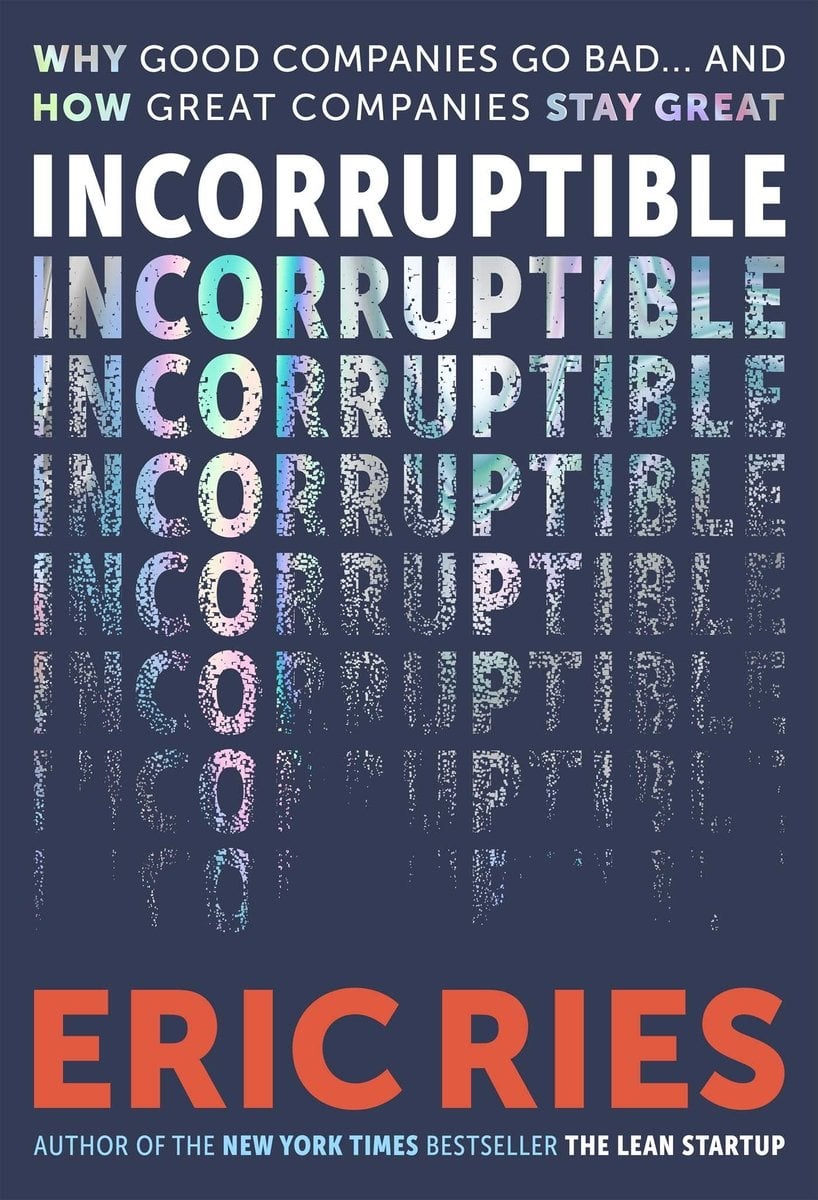
Incorruptible
Instant New York Times Bestseller "Incorruptible by Eric Ries is the best and most important business book of the year." —Dan Heath, NYT Bestselling Author & Podcast Host of "What It's Like To Be..." A Thinkers50 Best New Management Book | A Next Big Idea Club Must-Read From Eric Ries, creator of The Lean Startup, comes a bold and urgently needed rethink of how organizations are built—and why success itself so often turns companies against the people and principles that made them worth building in the first place. For decades, we've explained corporate corruption as a problem of bad actors, moral weakness, or isolated scandals. But that story doesn't match reality. Again and again, companies founded with strong ideals drift toward short-term thinking, extractive behavior, and mission abandonment—often despite the best intentions of the people inside them. Incorruptible argues that this failure is not primarily ethical. It is structural. As organizations grow, the systems that govern them—ownership, incentives, charters, accountability, and decision-making—quietly reshape behavior. When those systems are poorly designed, even principled leaders are pushed toward outcomes they never wanted. Success itself becomes a form of financial gravity, bending companies away from their original purpose. Drawing on two decades of work with founders, CEOs, investors, and institution builders, Ries shows how these failures arise predictably—and how they can be prevented. He reframes corporate governance not as bureaucracy or compliance, but as a creative and strategic act at the heart of building enduring, mission-controlled companies. At a moment when trust in business is eroding, Incorruptible offers a clear-eyed diagnosis and a practical blueprint for change. Success alone will not protect what matters most. Only incorruptible design can. Get more information and bonus materials at incorruptible.co.