


Existential musings over algorithmic design with creative programming legend Dan Tapper.
Creative Computing Group by @tgoerke.bsky.social — Grain
Let's start a group at CODIP to explore creative computing. Let's not start by defining creativity nor computing. It would be a trap. Let's collect artifacts instead. Images, text, thoughts,...
Rabrg/artificial-life
A simple (300 lines of code) reproduction of Computational Life: How Well-formed, Self-replicating Programs Emerge from Simple Interaction
AI experienced through AI co-created tools
AI co-created tools and social spaces as a new medium

The Myth of the Instant Cake Mix
How to think about creative tooling in the new world of generative AI

The Art of Code - Dylan Beattie
Beyond Slop
Visions for humane creative AI tools based on craft, process, and emergence.
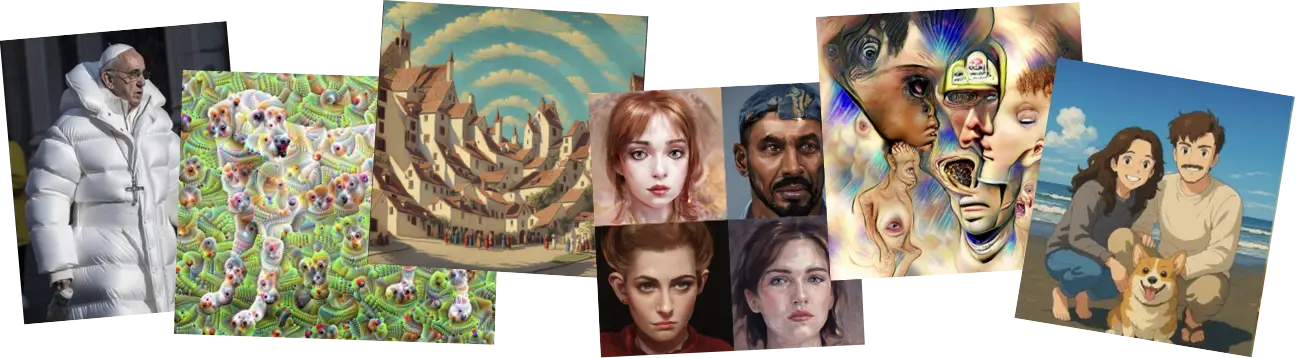
Co-Creation: Systems Thinking Beyond the Machine
Complexity thinking is all the rage — in the arts and sciences. Yet, there are two different strands of thinking about complexity, which are often confounded. The first comes from cybernetics, focussing on control in complex situations. The second is ecological, aiming at sustainable participation in a reality beyond control. Their difference rests on a fundamental distinction: is complexity rooted in feedback regulation or collective co-creation? While feedback remains mechanistic, co-creation generates new spaces of possibilities. We need it to understand life and its evolution. And it empowers us to rewrite our future, to escape our mechanistic cage without abandoning scientific rigor. In this paper, we illustrate how we implement these powerful yet abstract principles through our artistic and philosophical practice.
Emergence: the connected lives of ants, brains, cities and software
In the tradition of Being Digital and The Tipping Point…

Deconstructing the algorithmic sublime
This special theme contextualizes, examines, and ultimately works to dispel the feelings of “sublime”—of awe and terror that overrides rational thought—that much of the contemporary public discourse on algorithms encourages. Employing critical, reflexive, and ethnographic techniques, these authors show that while algorithms can take on a multiplicity of different cultural meanings, they ultimately remain closely connected to the people who define and deploy them, and the institutions and power relations in which they are embedded. Building on a conversation we began at the Algorithms in Culture conference at U.C. Berkeley in December 2016, we collectively study algorithms as culture (Seaver, this special theme), fetish (Thomas et al.), imaginary (Christin), bureaucratic logic (Caplan and boyd), method of governance (Coletta and Kitchin; Lee; Geiger), mode of inquiry (Baumer), and mode of power (Kubler). [Box: see text]

The Programmer Identity Crisis ❈ Simon Højberg ❈ Principal Frontend Engineer
On AI, Creativity, and Craft

Convivial Computing Salon #6: Convivial design heuristics for software systems
Combinatorial Creativity
Combinatorial creativity recombines existing ideas to spark novel, valuable innovations in cognition, AI, and design.
Programming as Theory Building: Why Senior Developers Are More Valuable Than Ever
Peter Naur's 1985 theory of programming explains why experience matters more in the age of AI-generated code
Revisiting creative behaviour as an epistemic process: lessons from 12 computational artists and designers | Proceedings of the 35th Australian Computer-Human Interaction Conference
As part of the Digital Library's transition to Open Access, new features for researchers are available in the Premium Edition. Click here to learn more.

Digital Art Enters the Museum Age — Social Software
We explore code and systems as a medium for creating new forms of art. We consider "software" in an expanded sense, examining the ways that we are programmed by technology around us and the ways we can write software to make change in the world.
Algorithm Mediated Experiences

On the effects of algorithms on everyday experiences

Generative Ethics: How AI Model Choice Shapes Social and Financial Performance

Political Sorting Can Drive AI Models Apart Through User Feedback

Network dynamics of social influence in the wisdom of crowds

Biased AI writing assistants shift users’ attitudes on societal issues

Generative AI enhances individual creativity but reduces the collective diversity of novel content

How Heavily Are PhD Students Offloading Their Scientific Writing to AI? Evidence from US STEM PhD Dissertations