

Hunome gives organisations a way to deliberate collectively and build the deliberative intelligence their decisions rest on: what their people work out together, held in a form they can act on.
Decision-making software for groups and organizations
Make important decisions together without endless meetings. Loomio keeps discussion, voting, outcomes, and the reasoning behind them in one clear place.

Role differentiation as ignition of a collective information...
Informational active matter shows how measurement-informed decisions produce collective order, so far in systems that reach consensus. We design collective information engines structured by...

The knowledge layer for collective intelligence
A portable data substrate for humans and their tools to think together.

The knowledge layer for collective intelligence
A portable data substrate for humans and their tools to think together.
The knowledge layer for collective intelligence
A portable data substrate for humans and their tools to think together.
Order Out of Chaos: Patterns of Organization for Writing on the Job
The meaning of what you write isn’t only the the words. The sequence of information, the categories you use, the emphasis you imply through your hierarchy—all of these decisions have a huge i…

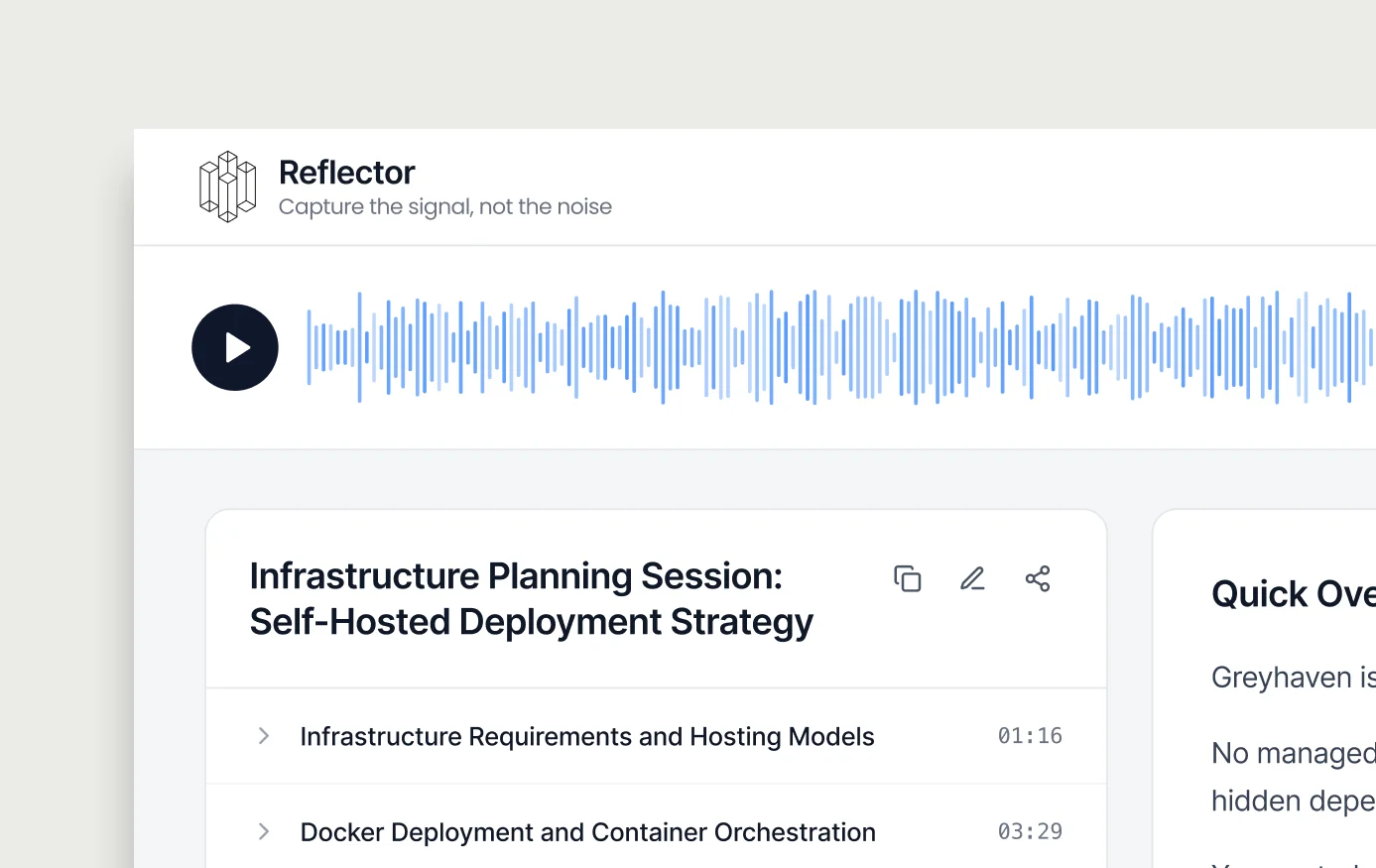
Reflector: Infrastructure for Meetings, by Greyhaven
Most organizations run on meetings. Strategy gets debated there. Decisions get made there. Context lives there. And yet...
In Pursuit of Ideal Data: Epistemic Enchantment and the Unintended Consequences of Datafying for Artificial Intelligence
The increasing datafication of work has become a pervasive theme within organizations, particularly with the rise of artificial intelligence (AI) technologies that rely on data and machine learning to generate insights and decisions. Prior research has shown that datafication practices aimed at administrative control and accountability can transform organizations in profound and often unintended ways. Our research moves beyond investigating datafication for administrative purposes to explore how it unfolds when actors intend to extract knowledge through AI predictive modeling. Drawing on a three-year ethnography of a human resources (HR) department introducing AI for candidate screening, we find that datafication expanded far beyond the technology’s initially envisioned scope. We explain this scope expansion by introducing the concept of epistemic enchantment : a collective process through which organizational members become captivated and mobilized by AI’s promise to generate predictive, objective, and continuously improving insights from data, while overlooking the costs and risks involved. Our study reveals how datafication practices can expand endlessly as organizational members, enchanted by AI’s epistemic promises, pursue the notion of ideal data as an ever-desired but never reachable goal.

'Generative CI' through Collective Response Systems
How can many people (who may disagree) come together to answer a question or make a decision? "Collective response systems" are a type of generative collective intelligence (CI) facilitation...
One year on: The momentum behind Jigsaw’s Sensemaking AI
How our suite of AI tools is helping public leaders bridge the gap between individual voices and concrete policy decisions

Toward a theory of network gatekeeping: A framework for exploring information control
Abstract Gatekeeping theories have been a popular heuristic for describing information control for years, but none have attained a full theoretical status in the context of networks. This article aims to propose a theory of network gatekeeping comprised of two components: identification and salience . Network gatekeeping identification lays out vocabulary and naming foundations through the identification of gatekeepers, gatekeeping, and gatekeeping mechanisms. Network gatekeeping salience , which is built on the bases of the network identification theory, utilizes this infrastructure to understand relationships among gatekeepers and between gatekeepers and gated, the entity subjected to a gatekeeping process. Network gatekeeping salience 1 Salience refers to the degree to which gatekeepers give priority to competing gated claims. proposes identifying gated and their salience to gatekeepers by four attributes: (a) their political power in relation to the gatekeeper, (b) their information production ability , (c) their relationship with the gatekeeper, and (d) their alternatives in the context of gatekeeping.

Meet the people who use Notion to plan their whole lives
The workplace tool’s appeal extends far beyond organizing work projects. Many users find it’s just as useful for managing their free time.

Managing scientific knowledge for policy on the ATmosphere - Mathew's newsletter
Two types of Atmosphere toolkit are needed if ATScience is to help scientists do science and better communicate it to other audiences: one serving the researchers and their teams, the other focused on aggregation and synthesis.
Testing Deliberative Technologies to Identify Optimal Use | Toda Peace Institute
Deliberative technologies are software tools that help create large-scale dialogue among participants. This article outlines the experience of testing four of these tools—Crowdsmart, Pol.is, Talk to the City, and Deliberation.io—with a group of student volunteers to understand their function and effectiveness, and to identify digital facilitation strategies. The paper concludes with recommendations to make deliberative […]

Organizing

Governance, collaboration, how to work together without being awful.
AI for mass deliberation and bridge-building

How AI (LLMs, bridging-based ranking, Polis) is used to involve many people in deliberation and synthesize common-ground statements: Israeli-Palestinian peacebuilding, Taiwan's vTaiwan/Polis, and the Habermas Machine.
Conflict Systems
Spaces as Layers - Nick's Blog
web.archive.org
Axioms for Organizers by Fred Ross, Sr. | Fred Ross, Sr.
The Tyranny of Stuctureless
cdn.fastly.steamstatic.com
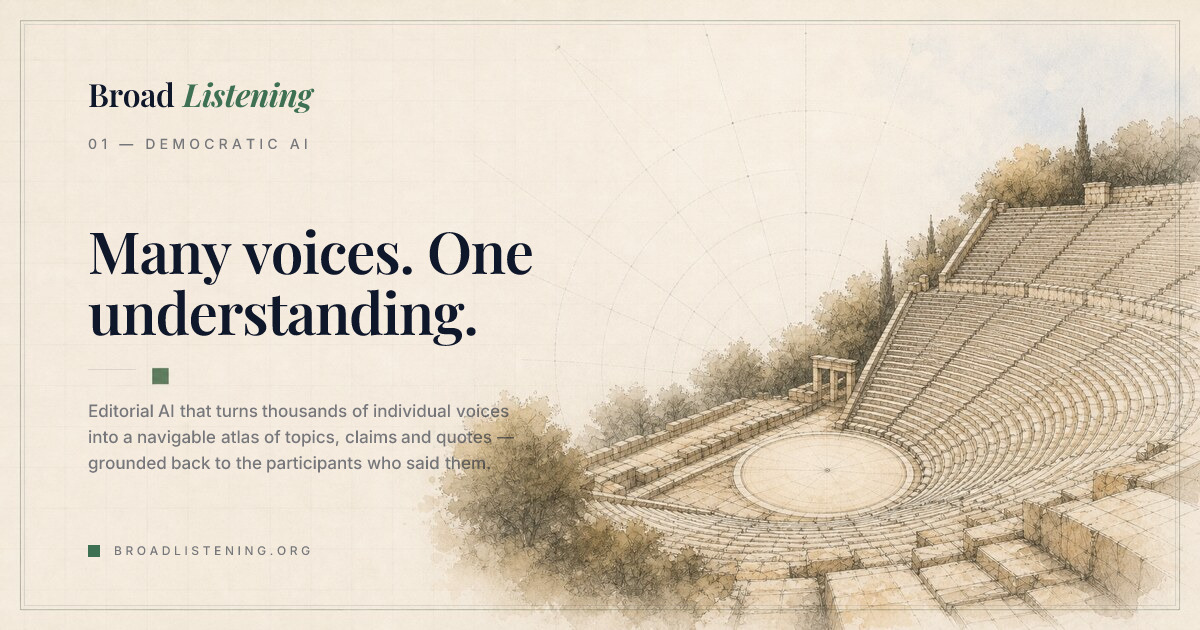
Broad Listening · Democratic AI for sensemaking

The Free Expression Evaluation

Generative AI for Pro-Democracy Platforms · From Novel Chemicals to Opera

The levers of political persuasion with conversational artificial intelligence
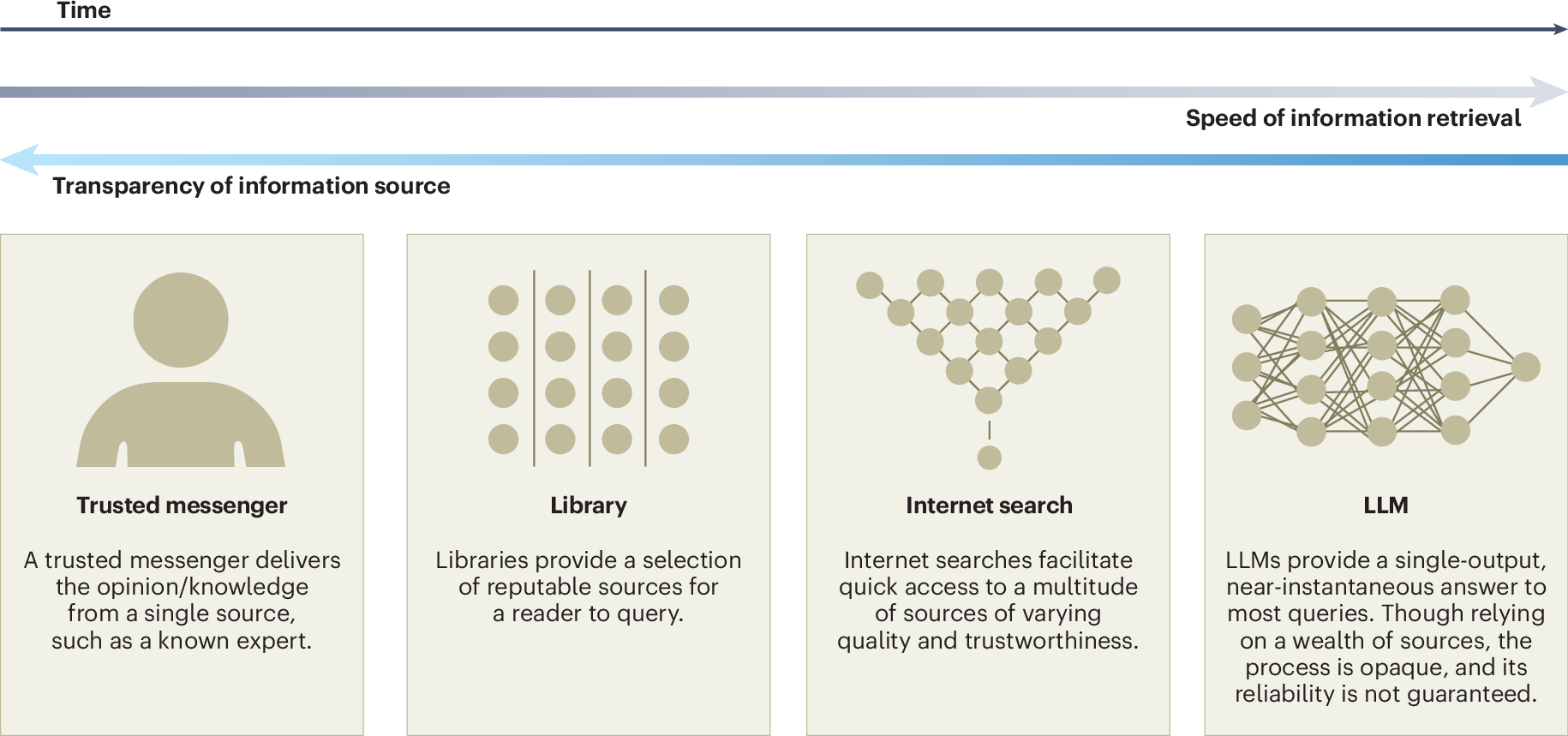
How large language models can reshape collective intelligence

Democracy as a Scaled Collective Intelligence Process: Points of Vulnerability and Augmentation