

The central premise of Intertwingler is that the computer is underutilized as an expressive medium. That may seem wild at first to say, but if you look around, you can find copious examples of the computer as a tool for preparing media, or as a vehicle for transporting or rendering media, but the actual content of the media in question would work just as well as if it had been made a hundred years ago:
» How Jordan Mechner Made a Different Sort of Interactive Movie (or, The Virtues of Restraint) The Digital Antiquarian
One can learn much about the state of computer gaming in any given period by looking to the metaphors its practitioners are embracing. In the early 1980s, when interfaces were entirely textual and graphics crude or nonexistent, text adventures like those of Infocom were heralded as the vanguard of a new interactive literature destined to augment or entirely supersede non-interactive books. That idea peaked with the mid-decade bookware boom, when just about every entertainment-software publisher (and a few traditional book publishers) were rushing to sign established authors and books to interactive projects. It then proceeded to collapse just as quickly under the weight of its own self-importance when the games proved less compelling and the public less interested than anticipated.
Calm Technology
Bits flowing through the wires of a computer network are ordinarily invisible. But a radically new tool shows those bits through motion, sound, and even touch. It communicates both light and heavy network traffic. Its output is so beautifully integrated with human information processing that one does not even need to be looking at it or near it to take advantage of its peripheral clues. It takes no space on your existing computer screen, and in fact does not use or contain a computer at all. It uses no software, only a few dollars in hardware, and can be shared by many people at the same time. It is called the "Dangling String".
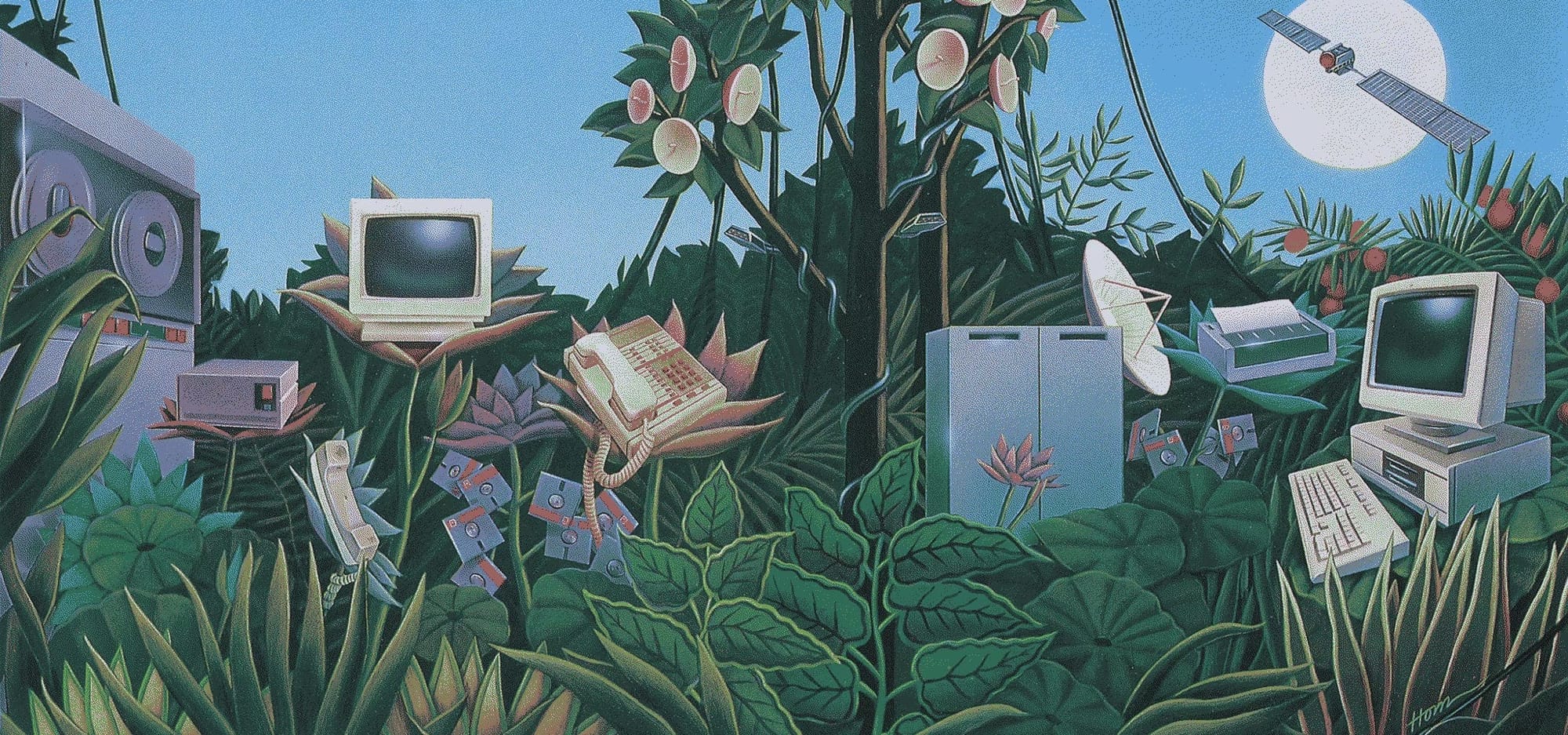
Computer Plant Life
"Thе Commodore РЕТ offers you а safe passage through the primeval swamр of computerization," says the ad copy accompanying this uncredited illustration in a June 1981 issue of Personal Computer World: That image and ad copy offers a perfect example of how most retro tech illustration works: Visualize the hell
Substrates conference series - Substrates 2026
An increasing number of researchers see their work as interactive authoring tools or software substrates for interactive computational media. By talking about “authoring tools”, we remove the divide between programmers and users; “software substrates” let us look beyond conventional programming languages and systems; and “interactive computational media” promises a more malleable and adaptable notion of tools for thought we are striving for. This workshop aims to bring together a wide range of perspectives on these matters.
The Computer for the 21st Century
Specialized elements of hardware and software, connected by wires, radio waves and infrared, will be so ubiquitous that no one will notice their presence


under the hood
This week I’ve been thinking about what it’s like for a new generation to make things with computers. When we were talking in Berlin, Luce made a point that...
The education of a computer
Our interfaces have lost their senses
We programmed them by punching cards, plugging in wires, and flipping switches. Programmers walked among banks of switches and cables, physically choreographing their logic. Being on a computer used to be a full-body experience.
how do you a call a person who is interacting with digital media ?
We use tools from computer science, media design, and digital art to study massive cultural data sets. Directed by Dr. Lev Manovich.
<i>Webstrates</i>: Shareable Dynamic Media
Shareable Dynamic Media is our vision for an interactive computing environment that blurs the distinction between documents and applications, characterized by three key properties: malleability, so that users can appropriate and repurpose media in ...

Digital Art Enters the Museum Age — Social Software
We explore code and systems as a medium for creating new forms of art. We consider "software" in an expanded sense, examining the ways that we are programmed by technology around us and the ways we can write software to make change in the world.
The idea of a "tech industry" has always relied on "computer" being a special kind of medium, akin to alchemy. And if tech demands to be king, AI hype has now elevated LLMs to a king of kings. But the solipsism has hit a dead end. The only way forward is to recognize that computers are not special.

LLMs are just normal technology. But tech is just a normal medium.
productpicnic.beehiiv.comScience in the Digital Era

How does scientific research adapt to digital media and automated information processing? What are the opportunities, what are the risks?
Leibniz book
Konrad Hinsen's blog
Konrad Hinsen's blog
Konrad Hinsen's blog
Konrad Hinsen's blog
Konrad Hinsen's blog
