


<p>Would you believe that there is a conspiracy theory about the way we tune musical instruments? And that this theory even involves the Nazis, chakras, and whatnot? No? Then sit down and enjoy
How the brain perceives rhythm
MIT neuroscientists have found that people are biased toward hearing and producing rhythms composed of simple integer ratios. This holds true for musicians and non-musicians living in the United States, as well as members of a Bolivian tribe who have little exposure to Western music.

Queen's Brian May Says Artificial Intelligence Could Have a 'Massively Scary' Impact on Music and Beyond
"I think we might look back on 2023 as the last year when humans really dominated the music scene," Queen co-founder Brian May recently told 'Guitar Player'

How 9/11 Made Everyone a Conspiracy Theorist
Crackpot theories were once the stuff of shortwave radio, but September 11 unleashed the Age of Alex Jones.

Music Chat: Classical Music's Ten Dirtiest Secrets
Does Developing a Belief in One Conspiracy Theory Lead a Person to be More Likely to Believe in Others?
ABSTRACT The monological belief system model suggests that—for at least a subset of people—developing a belief in one conspiracy theory will cause them to be more likely to believe in others. This model has been influential in the literature, but its core causal hypothesis has never been credibly tested. We therefore tested it in two longitudinal studies. Study 1 used a sample from New Zealand and Australia ( N = 498), with 7 monthly waves. Study 2 (preregistered) used a sample from New Zealand, Australia and the United Kingdom ( N = 978), with 13 monthly waves. We applied random intercept cross‐lagged panel models, permitting a credible causal identification strategy, albeit we cannot rule out time‐varying confounds. We find that increased belief in a conspiracy theory at one wave did (on average) predict increased belief in other conspiracies at the next wave, although the estimated coefficients were small.

An A.I. Songwriting Experiment: Humans Against the Machine
Five humans convened for a weekend to create new music from scratch. Could they do better than A.I.? Could you even tell the difference?


Solar Symphony: Listening to the Sun's hidden "music"
What sound can teach us about our Sun? In this episode, we explore how NASA scientists translate electromagnetic waves from the Sun into sound, and even music. Through this process, researchers are gradually unlocking the Sun's secrets, from the steady \"hum\" of the star's rotation, to the way that solar winds \"play\" the Earth's magnetosphere like a harp. This story comes from the podcast NASA's Curious Universe, and features Host and Astrophysicist Padi Boyd, Sonification Specialist Robert Alexander and Heliophysicist Mike Hartinger. Explore the all new Defacto Sound website, and click the Contact Form to get in touch.If you know what this week's mystery sound is, tell us at mystery.20k.org.Follow Dallas on Instagram, TikTok, YouTube and LinkedIn.Join our community on Reddit and follow us on Facebook.Subscribe to NASA's Curious Universe wherever you get your podcasts.Get 50% off your first meal box plus free shipping at factormeals.com/factorpodcast.Get an exclusive 60% discount on Incogni and a 30-day money-back guarantee at incogni.com/20k.Claim your $75 sponsored job credit at indeed.com/hertz.Download the CFO's Guide to AI and Machine Learning at netsuite.com/20k.Learn more about your ad choices. Visit megaphone.fm/adchoices
ABOUT
NYC experimental live music calendar • noise, improv, jazz, new music, avant-electronics, weirdos • performance against corporate interests!

The Conspiracy Theory About Wayfair Is Spreading Quickly Among Lifestyle Influencers On Instagram
The theory plays into the bigger QAnon conspiracy theory, which baselessly claims that the world is controlled by a secret cabal of pedophiles that President Trump is actively fighting against.

Great. Now Even Your Headphones Can Spy on You
Israeli researchers show that even if you're paranoid enough to remove your computer's microphone, malware can convert your headphones into spy bugs.


tofubeats - 陰謀論 (CONSPIRACY THEORY) / Director's Cut

AI & Music - developments & perspectives

Perspectives, developments, & news re: AI & music

Owners of Elvis Presley’s Music Sue Anthropic for Copyright Infringement

YouTube Music adds new labels for AI music
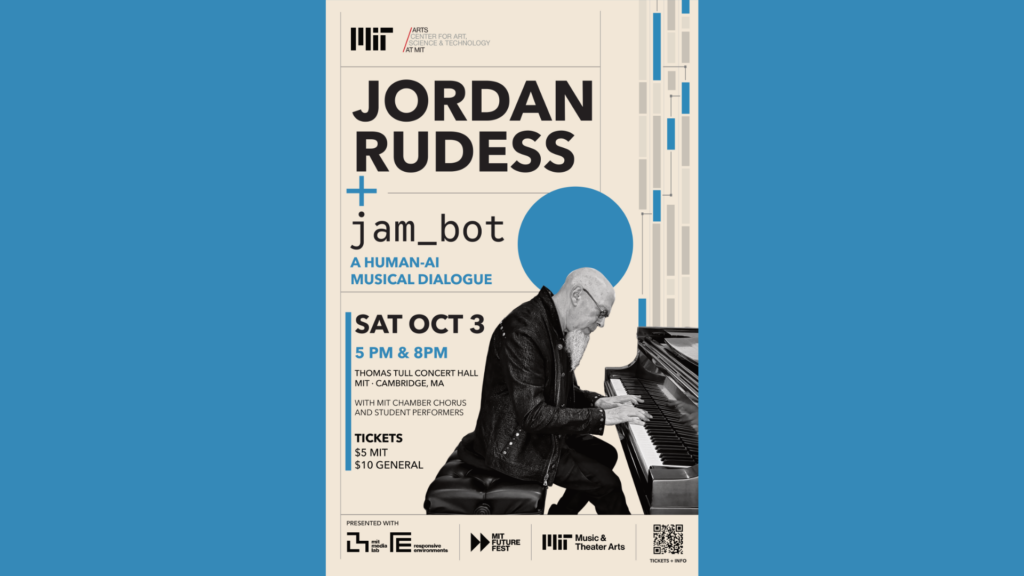
Jordan Rudess + jam_bot at MIT October 3

Jordan Rudess and MIT’s jam_bot: A New Era of Human-AI Musical Collaboration

Artificial Intelligence in Music Classrooms: PK-12 Educators’ Practices, Concerns, and Confidence

“It frustrates me to hear people bashing something that's so amazing”: Todd Edwards is optimistic about AI in music production