

This introduction to the special issue ‘Utopian Media Studies’ sketches a framework for how media studies can become a site of utopian praxis, research and experimentation. It first addresses three apprehensions media scholars might have about the notion of utopian media studies and its appeal to a loaded concept like ‘utopia’. The introduction then outlines five sensibilities to explicate the nature and significance of this special issue’s contribution to the field: a utopian media studies must adopt an ecological approach to media; recognize and be invigorated by limits; work toward the technological liberation of time; connect imagination with practice; and emphasize and enable conditions for transmitting hope. Lastly, the introduction considers Ruth Levitas’s distinction between utopia’s archaeological, ontological, and architectural mode to map some of the concrete ways in which existing media studies research is doing utopian work that aligns with these sensibilities. In connecting work that operates in these modes with the various contributions to this special issue, the introduction reveals the utopian currents that already run through media studies as a discipline and opens up new conceptual and methodological approaches to studying and modeling digital utopias.
Utopian media studies: Introduction
This introduction to the special issue ‘Utopian Media Studies’ sketches a framework for how media studies can become a site of utopian praxis, research and experimentation. It first addresses three apprehensions media scholars might have about the notion of utopian media studies and its appeal to a loaded concept like ‘utopia’. The introduction then outlines five sensibilities to explicate the nature and significance of this special issue’s contribution to the field: a utopian media studies must adopt an ecological approach to media; recognize and be invigorated by limits; work toward the technological liberation of time; connect imagination with practice; and emphasize and enable conditions for transmitting hope. Lastly, the introduction considers Ruth Levitas’s distinction between utopia’s archaeological, ontological, and architectural mode to map some of the concrete ways in which existing media studies research is doing utopian work that aligns with these sensibilities. In connecting work that operates in these modes with the various contributions to this special issue, the introduction reveals the utopian currents that already run through media studies as a discipline and opens up new conceptual and methodological approaches to studying and modeling digital utopias.

We Are Civic Media
A discipline-crossing introduction to civic media via accounts from grassroots practitioners “Civic media” is the use of contemporary technologies to connect communities, inspire action, build civic capacity, and sustain social change efforts. Written by artists, creators, storytellers, organizers, and others working at the intersections of technology, social justice, and culture, this book summons civic media through the lived experiences of its contributors. Latoya Peterson delves into the therapeutic power of gaming; Akilah Hughes discusses identity and community through the lens of her campaign to change her high school's racist mascot; and Tyree Boyd-Pates emphasizes the potential power of museum curation to challenge power dynamics and bridge digital and physical realms. Through the experiences of these grassroots practitioners and many others, We Are Civic Media offers accessible insights for those interested in understanding, respecting, and practicing civic media.
Historical pragmatism and the internet
This article argues that the literature describing the internet revolution in the 1990s was characterized by the rhetoric of the technological sublime. This rhetoric suffered from three fatal flaws: (1) it was not sufficiently grounded in the historical development of technology; (2) it viewed the internet in isolation, failing to consider the wider technological context; and (3) it failed to examine the internet in view of the social, economic, religious and political circumstances of its users. Several examples from history are cited, demonstrating that changes in various systems for the production, dissemination and preservation of cultural information both border and deborder the world. The article suggests that if internet researchers take a pragmatic, historically grounded approach, they will discover that the introduction of internet technology can be seen to have similar consequences. While the technology overcomes many boundaries (of space and time, politics and economics), other social borders may be created at the same time. It is easier to see old boundaries coming down than to see new ones being erected. Rather than being swept by utopian or dystopian enthusiasms, the article insists that the really interesting discoveries are to be made in locating the subtle social shifts taking place, relatively unnoticed, as a consequence of technological change.
Digital Locality
The Paper Pilot's digital garden of thoughts on philosophy, politics, and sociology. Reading time: ~10 minute read | Published: Nov 21, 2024 | Updated: Aug 3, 2026

Fast Capitalism | Mavs Open Press Open Access Journals | University of Texas at Arlington
Fast Capitalism is an academic journal aimed at describing the current moment of capitalism. We publish peer reviewed scholarship and essays about the impact of rapid information and communication technologies on self, society and culture in the 21st century. Our authors examine how heretofore distinct social institutions, such as work and family, education and entertainment, have blurred to the point of near identity in an accelerated, post-Fordist stage of capitalism. This makes it difficult for people to shield themselves from subordination and surveillance. The working day has expanded; there is little down time anymore. People can 'office' anywhere, using laptops and cells to stay in touch. But these invasive technologies that tether us to capital and control can also help us resist these tendencies. People use the Internet as a public sphere in which they express and enlighten themselves and organize others; information technologies afford connection, mitigate isolation, and even make way for social movements. We are convinced that the best way to study an accelerated media culture and its various political economies and existential meanings is dialectically, with nuance, avoiding sheer condemnation and ebullient celebration. We seek to shape these new technologies and social structures in democratic ways. We look at technology, Artificial Intelligence (AI), global flows, political economy, culture and cultural studies, social theory, political theory, intersectionality, and the envionrment.
Trust — Utopian conspiracy
A network of utopian conspirators, a sandbox for their creative, technical and critical projects, and a site of experimentation for new ways of learning together.

Music
The Paper Pilot's digital garden of thoughts on philosophy, politics, and sociology. Reading time: ~4 minute read | Published: Aug 18, 2026 | Updated: Sep 12, 2026
How Liminalism Became the Defining Aesthetic of Our Time
This crowd-curated digital movement is one of the most pertinent and explicit reactions to our particular slice of dystopian late capitalism.

Afterlives of the California Ideology| “Polemic Becomes Canon”: An Interview With Richard Barbrook on the Californian Ideology
In this interview, Richard Barbrook shares his perspective on the essay “The Californian Ideology,” which he published in 1995 and 1996 with Andy Cameron, who died in 2012. Richard Barbrook lays out the essay’s genesis, explores the inspiration offered by Marx and Engels’ The German Ideology, discusses his ambivalent but not simply dismissive relationship to California and the United States, and provides insight into the thinking around the masters program in hypermedia at the University of Westminster, United Kingdom, that he and Cameron were setting up at the time of the essay’s publication. In the essay they wanted to impart a different approach to digital technologies than was prevalent in the Californian computer industry at the time. Overall, the interview makes it apparent how “The Californian Ideology” should be seen in its temporal context—as well as how the basic questions the essay raises continue to shape the discussion about digital media and infrastructures today.
No Sense of Place: The Impact of Electronic Media on Social Behavior
Introduction: Behavior in Its PlacePart I--Media as Change Mechanisms Media and Behavior: A Missing LinkMedia, Situations, and BehaviorWhy Roles Change When Media ChangePart II--From Print Situations to Electronic Situations The Merging of Public SpheresThe Blurring of Public and Private BehaviorsThe Separation of Social Place from Physical PlacePart III--The New Social Landscape New Group IdentitiesNew Ways of BecomingQuestioning AuthorityEffect LoopsPart IV--Three Dimensions of Social Change The Merging of Masculinity and FemininityThe Blurring of Childhood and AdulthoodLowering the Politica

The Economics of Sovereign Media: A Roadmap for AT Protocol | ATmosphereConf VODs
The talk will focus on (1) the structural shifts reshaping the media landscape & creator economy and provide a roadmap / suggestions for how the AT Protocol ecosystem & community can be best positioning to serve the needs of creators of all kinds (emphasis / focus here on independent creators) through this evolutio, while preserving their rights to sovereignty & ownership. The talk ideally touches on both cultural, economic and technical / infrastructural topics. Will be speaking in my capacity both as an artist and as an investor / student of media markets.

Digital Locality | The Paper Pilot
The Paper Pilot's digital garden of thoughts on philosophy, politics, and sociology
Social Media Is Now Parasocial Media
When practitioners used the term “social media” to describe the internet tools that emerged in the mid-aughts, they were giving a name to the kinds of platforms and protocols that allowed people to socialize with friends and communities of interest by using digital technologies. Twenty years later, users of social media are far more likely to scroll than post – and the content that they consume is often strategically produced and algorithmically curated. In this essay, I argue that the very essence of social media has changed. To more effectively interrogate what we are witnessing, we need to stop presuming that these tools are “social media” and begin recognizing that they are now “parasocial media.” Doing so raises new questions about digitally mediated sociality, not to mention the politics and governance of these platforms.
Hype, financial narratives, and self-fulfilling prophecies in surveillance capitalism
The rise of platforms has transformed our understanding of contemporary capitalism, with the critical literature describing how these firms leverage unprecedented digital powers to extract monopoly rents – perhaps even heralding a new form of Feudalism. This paper draws on the literature on financial narratives to examine the role that such stories play within the form of capitalism that they describe, and what this suggests for the role of “hype” in contemporary capitalism. The same stories that for critical scholars appear as menacing threats of “technofeudalism” or “surveillance capitalism” for investors appear as optimistic stories of promising future returns. By driving financial investments, narratives afford platforms very real social and political powers, enabling them to function as a form of self-fulfilling prophecies. The paper argues for a cultural inflection to the political economy of Big Tech – viewing capitalism as neither mechanistic nor rational, but as an expression of a complex interplay between narrative, technology, and economic power. This suggests the need for a critical hype studies, geared at deconstructing the narratives undergirding the technological waves of capitalist pursuits, and examining the broader role of hype in coordinating and directing flows of capital within contemporary financialized capitalism.
Topics — Real Life
ABOUT TOPICS: Since we began Real Life in the summer of 2016, we’ve run many essays across a range of topics, with a particular focus on the personal and cultural implications of living with technology. Our aim is not to track the news cycle so much as the longstanding social issues that inform and transcend it. We wanted to make it easier to read and explore Real Life beyond our chronological archive, so we’ve created these Topics to gather in one place the work we’ve published on some key themes. More Topics will be added to this page over time.

Ecological Media

Interconnected, relational, emergent. Socially networked media rooted in ecological relationalities.

We Need To Rewild The Internet
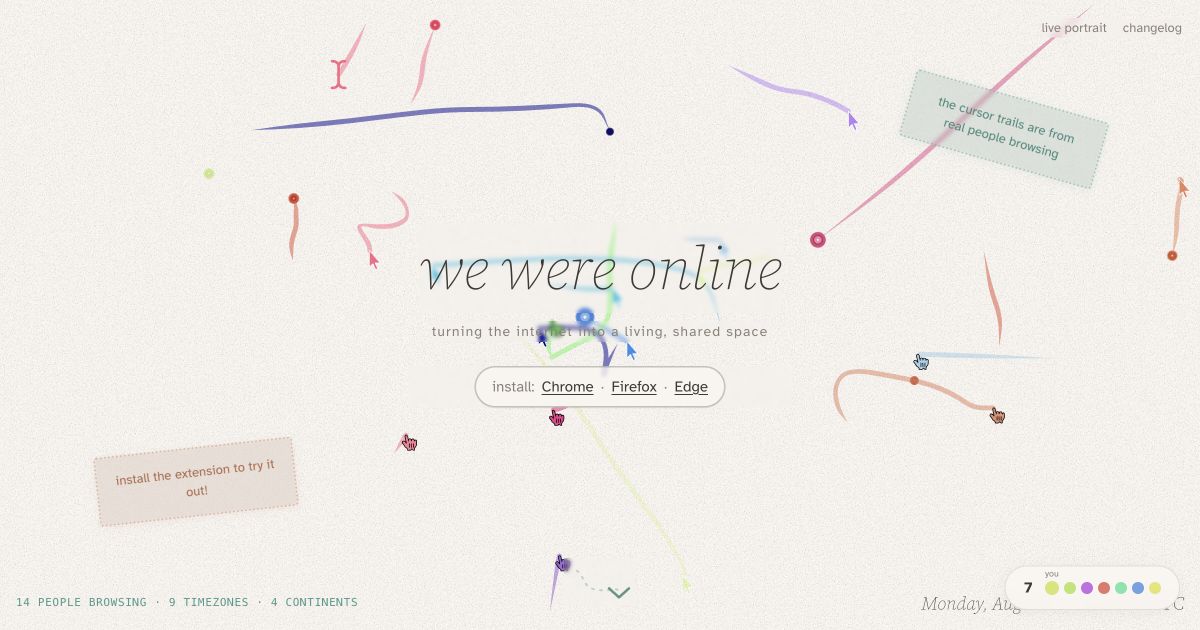
we were online
The information flaneur: a fresh look at information seeking
Trails and public spaces — Rafael M. Batista

It was a huge honor to present the opening keynote address at #SIGIR2026 and to talk about the need for IR to resist uncritical adoption of…

Chatty Community Gardens