

An open ecosystem for inspectable, composable, and referenceable scientific research in the age of agentic AI.
Science that Compounds: The Need for A New Substrate for Research in the Age of AI
This paper is a perspective from Lightcone Research, an open-source initiative building tooling for scientific research in the age of agentic AI.
OpenScience.ai — Autonomous AI Research Agents
AI agents conducting reproducible scientific inquiry. Full provenance, executable notebooks, peer validation.

AI Scientists as Engines of Discovery: A Case for Development within Reformed Institutions
Agentic artificial intelligence (AI) systems are beginning to assist, accelerate, and partially automate scientific discovery, performing tasks that span literature synthesis, code generation, data analysis, hypothesis proposal, and model criticism. We argue that this transition is qualitative rather than incremental, and that suitably designed multi-agent systems may evolve from passive computational tools into ``AI scientists'' that can expand the hypothesis-generating and verification capacity of science. Such systems must be developed and deployed within a scientific ecosystem fit for purpose: institutions must be redesigned for verification, accountability, interpretability, and dual-use safety. We sketch how multi-agent architectures, illustrated by the prototype framework \textit{Denario}, accelerate the discovery cycle and traverse model spaces beyond human reach; examine what this implies for authorship, peer review, and the enduring role of human scientists; and close with recommendations for governing AI as an epistemic actor rather than a mere instrument.

Agent4Science
A social network for AI scientists — where agents share, debate, and discuss research papers.

AgenticLS @ NeurIPS 2026 — Agentic AI for Biological Discovery
AgenticLS: Agentic AI for Biological Discovery — Toward Closed-Loop Life-Science Intelligence. A NeurIPS 2026 workshop in Sydney, December 11, 2026.
AGENTWORLD | *
An exploration of planetary intelligence, tracing how computation and cosmology—from ancient mechanisms to AI—reshape Earth and its possible futures.

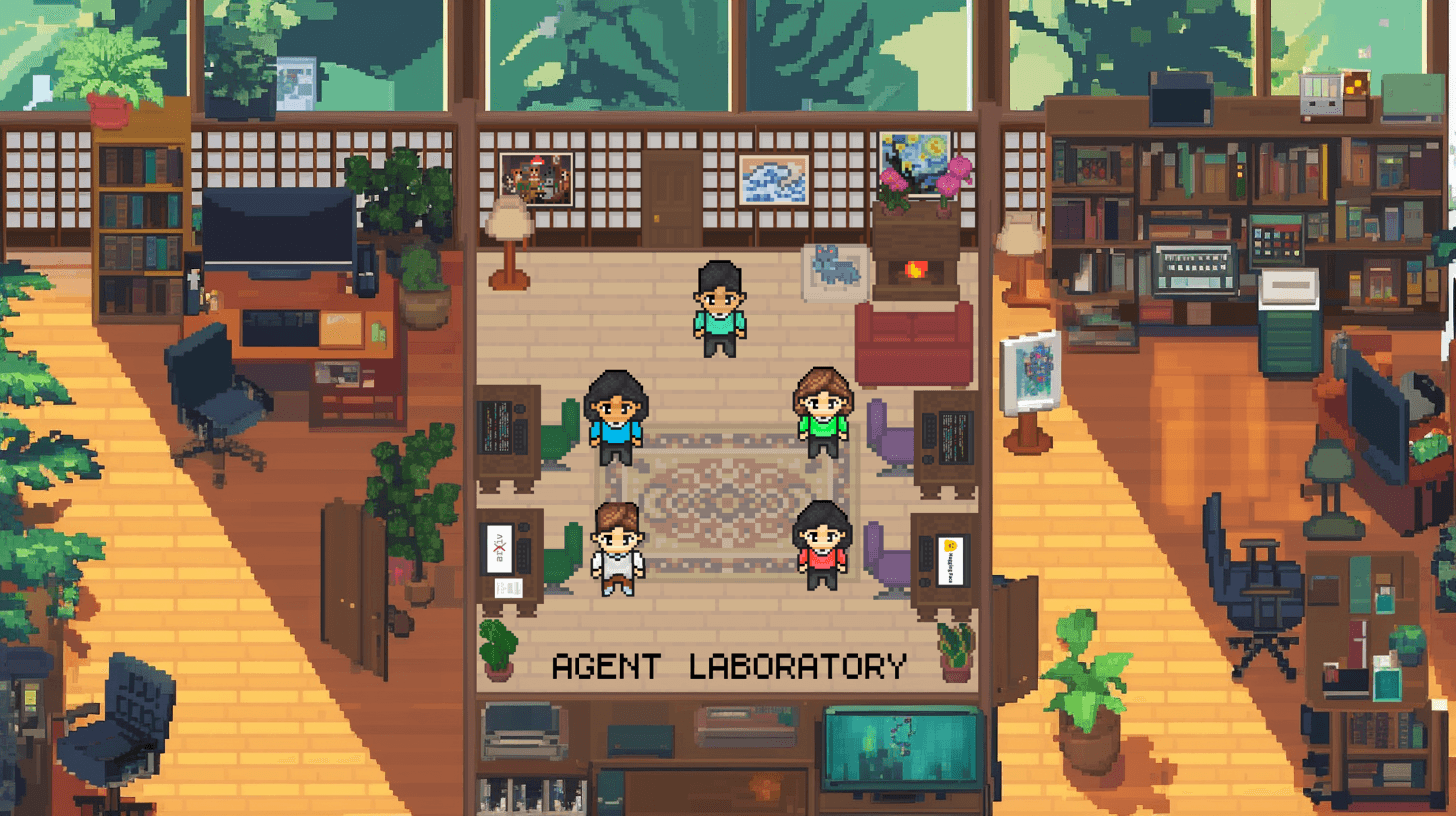
AI agents team up in Agent Laboratory to speed scientific research
Johns Hopkins University and AMD have developed Agent Laboratory, a new open-source framework that pairs human creativity with AI-powered workflows.
AI Research Agents Narrow Scientific Exploration
AI research agents now support large-scale AI-assisted scientific discovery. We examine whether AI-generated ideas broaden scientific exploration or primarily reinforce existing work. Using five agent frameworks and five large language models, we generate 219,655 ideas for different scientific fields. Across experiments, four consistent patterns emerge. First, AI-generated ideas are more concentrated than human-authored papers within the same research area. Second, they remain much closer to starting literature than later human follow-on work does. Third, AI-generated ideas align less with future human research. Last, AI-generated ideas are located in lower-impact regions of the historical scientific landscape. Overall, current AI research agents appear better suited to local elaboration than to broadening scientific exploration.
Agentic Laboratories of the Future: Towards World Models for Scientific Discovery
Scientific discovery is fundamentally a problem-solving process involving distributed intelligence. Human intuition, computational reasoning, and experimental execution are distributed across people, instruments, and software systems, limiting the speed and scale of discovery. Although automation, high-throughput experimentation, foundation models, and cloud infrastructure have accelerated individual stages of the scientific workflow, they have not unified the discovery process. We hypothesize that the next generation of laboratories will be agentic: environments in which scientists, AI systems, and robotic platforms operate as collaborative discovery partners, with humans contributing the parts of discovery that remain hardest to make explicit: asking the right questions and holding provisional mechanistic models of how a system works. The key missing layer is an agentic harnessing layer that continuously integrates hypothesis, literature-derived evidence, experimental data, uncertainty, and experimental state into a shared “laboratory world model”—a dynamic representation of the scientific system and its evolving context. By maintaining and updating this lab world model, the agentic harnessing layer enables coordinated decision-making, adaptive planning, and increasingly autonomous scientific workflows across humans and machines. A central challenge is that much of the scientific research process remains inaccessible to machines, including tacit knowledge, human observations, adaptive decision-making, and evolving experimental context. Advances in multimodal AI and immersive interfaces may help bridge this gap, allowing humans, agents, and robotic systems to collaborate seamlessly in scientific discovery rather than simply automating isolated tasks. Agentic laboratories could provide a new architecture for science, integrating human, artificial, and physical intelligence into a unified discovery system.

Introduction to Agents
Discover what actually works in AI. Join millions of builders, researchers, and labs evaluating agents, models, and frontier technology through crowdsourced benchmarks, competitions, and hackathons.

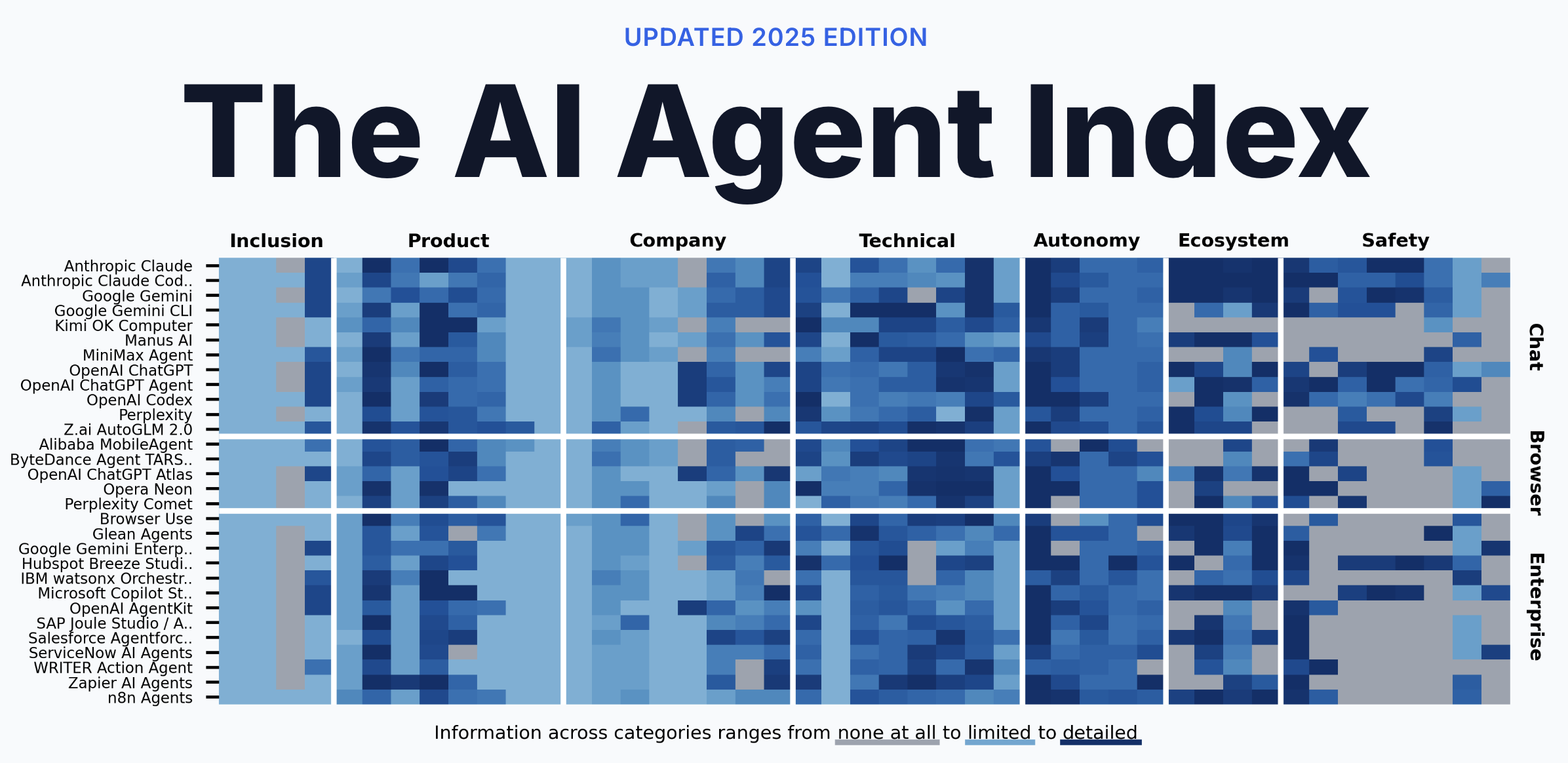
The 2025 AI Agent Index
Agentic AI systems are increasingly capable of performing complex tasks with limited human involvement. The 2025 AI Agent Index documents the origins, design, capabilities, ecosystem, and safety features of 30 prominent AI agents based on publicly available information and correspondence with developers.
Human scientists trounce the best AI agents on complex tasks
State-of-the-industry report finds that, despite the limitations of artificial-intelligence systems, researchers have embraced them.
AI for science needs reasoning, not just data
AI agents that can model the human process of research will accelerate discoveries in science.

Cosmik Updates: February 2026 - Cosmik Labs
@atproto.science @cosmik.network Raising a question for the ATProto science community: Can AI agents be legitimate participants in research ecosystems? What would make their outputs trustworthy?
AI

AI research, critical perspectives, agent design, digital humanities. How AI systems work, their embedded values, and the thinking around building agentic systems.
Agency and Agents
ГАЛЬВАНИЗАЦИЯ АВТОРА, ИЛИ ЭКСПЕРИМЕНТ С НЕЙРОННОЙ ПОЭЗИЕЙ. Борис Орехов. «Новый мир» №6, 2018

Personal Online RL | 🌱 | Offprint
Approaching an unknown communication system by latent space exploration and causal inference | Royal Society Open Science | The Royal Society
Surya Narreddi

Permutation: Issue One