

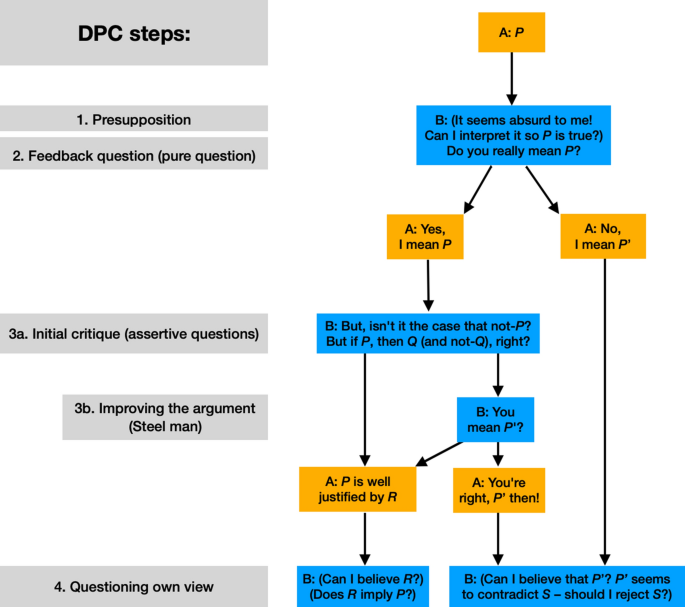
This paper aims to discuss a well-known concept from argumentation theory, namely the principle of charity. It will show that this principle, especially in its contemporary version as formulated by Donald Davidson, meets with some serious problems. Since we need the principle of charity in any kind of critical discussion, we propose the way of modifying it according to the presupponendum—the rule written in the sixteenth century by Ignatius Loyola. While also corresponding with pragma-dialectical rules, it also provides additional content. This will be termed the dialectical principle of charity, and it offers a few steps to be performed during an argument in order to make sure that the participants understand each other well and are not deceived by any cognitive bias. The meaning of these results could be of great significance for argumentation theory, pragma-dialectics and the practice of public discourse as it enhances the principle of charity and makes it easier to apply in argumentation.
Argumentation theory | Communication and Mass Media | Research Starters | EBSCO Research
<p>Argumentation theory explores the processes and methods of reasoning and debate used by individuals in both formal and informal contexts. The theory has roots in ancient philosophical discourse, particularly from figures like Aristotle, and has evolved through the contributions of modern philosophers such as Chaïm Perelman and Stephen Toulmin. It highlights how arguments are structured, identifying key components such as claims, grounds (or data), and warrants, which collectively help participants make their case. </p> <p>Additionally, arguments can be categorized into three main types: factual claims, which are verifiable; judgment or value claims, which are subjective; and policy claims, which pertain to proposed courses of action. This framework acknowledges the influence of personal biases, often shaping the reasoning process, and emphasizes the importance of logical support, backing, qualifiers, and rebuttals in strengthening arguments. In academic contexts, the theory suggests that creating valid topics should focus on policy arguments, while also addressing counterarguments to foster a comprehensive debate. Overall, argumentation theory serves as a critical tool for understanding how reasoning and persuasive communication function in various scenarios.</p>

Reflexive discourse analysis: A methodology for the practice of reflexivity
How to implement reflexivity in practice? Can the knowledge we produce be emancipatory when our discourses recursively originate in the world we aim to challenge? Critical International Relations (IR) scholars have successfully put reflexivity on the agenda based on the theoretical premise that discourse and knowledge play a socio-political role. However, academics often find themselves at a loss when it comes to implementing reflexivity due to the lack of adapted methodological and pedagogical material. This article shifts reflexivity from meta-reflections on the situatedness of research into a distinctive practice of research and writing that can be learned and taught alongside other research practices. To do so, I develop a methodology based on discourse: reflexive discourse analysis (RDA). Based on the discourse analysis of our own discourse and self-resocialisation, RDA aims to reflexively assess and transform our socio-discursive engagement with the world, so as to render it consistent with our intentional socio-political objectives. RDA builds upon a theoretical framework integrating discourse theory to Bourdieu’s conceptual apparatus for reflexivity and practices illustrated in the works of Comte and La Boétie. To illustrate this methodology, I used this very article as a recursive performance. I show how RDA enabled me to identify implicit discriminative mechanisms within my discourse and transform them into an alternative based on love, to produce an article more in line with my socio-political objectives. Overall, this article turns reflexivity into a critical methodology for social change and demonstrates how to integrate criticality methodologically into research and writing.

Les motifs de la confiance (et de la défiance ) politique : intérêt, connaissance et conviction dans les formes du raisonnement politique
Le rapport de confiance ou de défiance unissant les citoyens à la politique se nourrit d’une variété de facteurs relatifs à la position sociale des citoyens, à la mise en cause de leurs intérêts par les politiques publiques comme à leur perception normative de l’univers politiques. En se fondant sur un matériel qualitatif composé de groupes de discussion réunissant des citoyens français faiblement politisés, cette contribution vise à cerner les motifs argumentatifs de la confiance et de la défiance politique. Leurs propos expriment un rapport au politique construit de façon endogène, à dimension fortement normative et manifestant une capacité argumentative fondée sur différents types de principes.
The sound of inevitability
Have you ever argued with someone who is seriously good at debating? I have. It sucks. You’re constantly thrown off-balance, responding to a point you didn’t expect to. You find yourself defending the weak edges of your argument, while the main thrust gets left behind in the back-and-forth, and you end up losing momentum, confidence, and ultimately, the argument. One of my close friends won international debate competitions for fun while we were at university (he’s now a successful criminal barrister), and he told me that the only trick in the book, once you boil it all down, is to make sure the conversation is framed in your terms. Once that happens, it’s all over bar the shouting.
On liberty
Introductory -- Of the liberty of thought and discussion -- Of individuality, as one of the elements of well-being -- Of the limits to the authority of society over the individual -- Applications; Book, leather; Explanatory note by H.E. Barker attached; 18

Reply to Tannenbaum et al.: Constructive dialogue advancing research on civic honesty
Reply to Tannenbaum et al.: Constructive dialogue advancing research on civic honesty

Hegel’s Dialectics
“Dialectics” is a term used to describe a method ofphilosophical argument that involves some sort of contradictoryprocess between opposing sides. In what is perhaps the most classicversion of “dialectics”, the ancient Greek philosopher,Plato (see entry on Plato), for instance, presented his philosophical argument as aback-and-forth dialogue or debate, generally between the character ofSocrates, on one side, and some person or group of people to whomSocrates was talking (his interlocutors), on the other. In the courseof the dialogues, Socrates’ interlocutors propose definitions ofphilosophical concepts or express views that Socrates challenges oropposes. The back-and-forth debate between opposing sides produces akind of linear progression or evolution in philosophical views orpositions: as the dialogues go along, Socrates’ interlocutorschange or refine their views in response to Socrates’ challengesand come to adopt more sophisticated views. The back-and-forthdialectic between Socrates and his interlocutors thus becomesPlato’s way of arguing against the earlier, less sophisticatedviews or positions and for the more sophisticated ones later.

Maite Taboada
Maite Taboada. Professor. Department of Linguistics, Simon Fraser University. Research: discourse analysis, computational linguistics
A quote by Anatole France
The law, in its majestic equality, forbids rich and poor alike to sleep under bridges, to beg in the streets, and to steal their bread.

The Honest Case for the Humanities
Or: Why I’m Tired of My Colleagues Making Arguments That Only Work on Us

Volunteering and Civic Action: Boundaries Blurring, Boundaries Redrawn
The aim of this introduction to the special issue is to call into question the presumed conceptual divide between volunteering and civic action and suggest an analytical tool and four perspectives that bring to light the varying meanings of popular engagement. Volunteering and civic action are laden with different moral meanings, are associated with different theoretical approaches and, just as important, have been assigned different roles in society. This conceptual divide is reflected in the academic debate. Only rarely, however, has the academic debate explored and discussed how the meaning of volunteering and civic action has changed historically. Therefore, we argue for a contextual and relational interpretation of the different forms of popular engagement instead of the application of essentialist definitions of volunteering and civic action. In order to examine the variety of popular engagement without being caught up in pre-made or taken-for-granted conceptualisations of volunteering and civic action as two separate forms of popular engagement, we propose approaching variations of popular engagement with respect to two criteria: first, to what degree popular engagement is enacted in institutionalised spheres of politics or in social public spheres and, second, to what degree actions of popular engagement are controversial or operating in line with what is widely agreed upon and dominant in public opinion. Moreover, we argue that history, discourses, politics and a relational approach are four crucial perspectives in order to reveal the varying meanings of popular engagement.
Most arguments scatter across papers, posts, and threads — and evaporate. A claim tree gives them a stable structure to gather against, the way a cathedral gathers centuries of work into a single, standing thing.
Deeds, Not Words: The Myth of Polite Revolution
A refusal of the sanitized story that rights were won by asking nicely. The suffragettes bombed Westminster Abbey. The Deacons for Defense guarded MLK. Man…
Hey @alexbenzer.com, we're having a discussion on the Discourse that could use your input. #atproto

A lexicon for game activity sharing
discourse.atmosphere.communityOkay, so it's not private, but I threw together a related proposal that could help with this on discourse. This has come up in conversations with @thisismissem.social and @knowtheory.net recently as well.

Proposal: Composable Moderation Working Group
discourse.atprotocol.community
