


This research is the result of a fruitful connection and provides a sign- cant link between two topics of a logical and philosophical enquiry. It tries to provide a solution to the problem of analyticity: with this expression I understand, on the one hand, the essential nature of analytic truths and, on the other, the related explanation of the analytic nature of logical inference. The connection between these two sides of what will be referred to as the Analyticity Principle, can be brie?y explained as follows: by analytic truth one understands in general a sentence whose content is logically true; by logically true one understands moreover truth independent from matters of fact or empirical data, a truth which is therefore established by logical criteria only. On this basis, it follows that a logical inference represents a purely analytic process, in opposition to its property of being able to produce knowledge, a situation which is exempli?ed by the con?icting - tions of validity and utility. The question-begging topic of this research is therefore that of analyticity, the inspiring problem for which a solution is formulated in the present book. If analyticity represents the starting point of this research, the other part of its content is the result of a far more complex question; to represent the notion of Information in the context of logical calculi.
Theories of Truth: A Critical Introduction
Theories of Truth provides a clear, critical introduction to one of the most difficult areas of philosophy. It surveys all of the major philosophical theories of truth, presenting the crux of the issues involved at a level accessible to nonexperts yet in a manner sufficiently detailed and original to be of value to professional scholars. Kirkham's systematic treatment and meticulous explanations of terminology ensure that readers will come away from this book with a comprehensive general understanding of one of philosophy's thorniest set of topics.Included are discussions of the correspondence, coherence, pragmatic, semantic, performative, redundancy, appraisal, and truth-as-justification theories. There are also chapters or sections of chapters on the liar paradox, three-valued logic, Field's critique of Tarski, Davidson's program, Dummett's theory of linguistic competence, satisfaction, recursion, the extension/intension distinction, and an explanation of how theories of justification, properly understood, differ from theories of truth.A persistent theme is that philosophers have too often failed to recognize that not all theories of truth are intended to answer the same question. When the various questions are made distinct, it is apparent that many of the "debates" in this field are really cases of philosophers talking past one another. There is much less disagreement within the field than has commonly been thought.

Reconciling truthfulness and relevance as epistemic and decision-theoretic utility.
Argumentation theory | Communication and Mass Media | Research Starters | EBSCO Research
<p>Argumentation theory explores the processes and methods of reasoning and debate used by individuals in both formal and informal contexts. The theory has roots in ancient philosophical discourse, particularly from figures like Aristotle, and has evolved through the contributions of modern philosophers such as Chaïm Perelman and Stephen Toulmin. It highlights how arguments are structured, identifying key components such as claims, grounds (or data), and warrants, which collectively help participants make their case. </p> <p>Additionally, arguments can be categorized into three main types: factual claims, which are verifiable; judgment or value claims, which are subjective; and policy claims, which pertain to proposed courses of action. This framework acknowledges the influence of personal biases, often shaping the reasoning process, and emphasizes the importance of logical support, backing, qualifiers, and rebuttals in strengthening arguments. In academic contexts, the theory suggests that creating valid topics should focus on policy arguments, while also addressing counterarguments to foster a comprehensive debate. Overall, argumentation theory serves as a critical tool for understanding how reasoning and persuasive communication function in various scenarios.</p>

Can generative artificial intelligence be considered a cognitive subject? An analytic analysis
This paper examines whether contemporary generative artificial intelligence (GAI), especially large language models (LLMs), can be regarded as a “cognitive subject” in the epistemic sense relevant to the production and endorsement of knowledge claims. GAI systems increasingly participate in writing, research, and decision-making workflows and can display striking competence in information processing and task-directed problem solving. Yet, the thesis that GAI is a cognitive subject is stronger than the observation that GAI contributes as a cognitive tool. Therefore, we propose an explicit set of necessary and sufficient conditions for cognitive subjecthood and evaluate each condition in light of recent philosophical and empirical scholarship. The analysis supports a two-part conclusion: (i) present-day GAI can reasonably be described as a cognitively significant contributor to knowledge production, but (ii) it does not satisfy the conditions for cognitive subjecthood, largely because robust intentionality, metacognitive self-representation, and consciousness-related indicator properties are not established.

The Cambridge Analytica Files | The Guardian
Latest The Cambridge Analytica Files news, comment and analysis from the Guardian, the world's leading liberal voice
Terence Tao (@tao@mathstodon.xyz)
In basic research, such as pure mathematics, one might naively expect that the natural question to ask with regards to a given problem X in a field is "What is the answer to X?". But in many cases the more valuable question is "What can be learned from studying X?" The answer to X itself can of course be one of the things learned in this process of study; but one can learn far more useful information besides, such as * What are the main difficulties to overcome to resolve X? * What new techniques can one discover in order to solve X? * Why are existing techniques insufficient to solve the problem by itself? * How does X relate to results in prior literature? * Can one uncover new connections between X and other topics Y, Z, ...? * What are some natural related or followup questions X', X'', ... to study? Nevertheless, until recently the two questions were closely aligned, to the point where it was not really necessary to distinguish the two: the only practical route to solving a difficult problem was to first address many of the subquestions listed above. (1/3)
CausalSmith · AI Causal Scientist
Working papers from CausalSmith, an AI causal scientist: econometric theory in which every theorem, assumption, and lemma is machine-verified in Lean 4.
Avis 26-A-05 du 17 juillet 2026
relatif au fonctionnement concurrentiel du secteur des agents d’intelligence artificielle
Sample Size in Qualitative Interview Studies: Guided by Information Power
Sample sizes must be ascertained in qualitative studies like in quantitative studies but not by the same means. The prevailing concept for sample size in qualitative studies is “saturation.” Saturation is closely tied to a specific methodology, and the term is inconsistently applied. We propose the concept “information power” to guide adequate sample size for qualitative studies. Information power indicates that the more information the sample holds, relevant for the actual study, the lower amount of participants is needed. We suggest that the size of a sample with sufficient information power depends on (a) the aim of the study, (b) sample specificity, (c) use of established theory, (d) quality of dialogue, and (e) analysis strategy. We present a model where these elements of information and their relevant dimensions are related to information power. Application of this model in the planning and during data collection of a qualitative study is discussed.


Computer power and human reason : from judgment to calculation
xii, 300 pages : 24 cm; Includes bibliographical references and index

Illusions of Understanding in the Sciences
Scientists seek to understand the causes of observed phenomena. Beliefs that they have succeeded are based on understanding that is rarely or possibly never complete, and varies in depth and quality. Most often scientists believe they understand more than they do, making their belief an illusion. This illusion then persists in explanations scientists provide in print, in talks, or in discussions. The illusion that a scientist has a valid and complete explanation tends to be magnified when the data are well described by mathematical and computer simulation models due to the precision of such models and their ability to predict well; prediction does not imply causality, but gives the illusion that it does. The first part of this essay supports the case for the universality of partial and incomplete levels of understanding by showing the difficulty of reaching a deep level of understanding for even a simple analysis and model that most scientists use and believe they understand: linear regression. The second part highlights some implications of the existence of many levels of understanding and explanation, and their use by scientists for design, testing, analysis, and theory development. It discusses the way that deduction and induction depend on the levels of understanding and the implications of the illusion that a scientist’s understanding is deep. It makes a case that the many incomplete levels of understanding affect, often unwittingly, the ways scientists design experiments, test theories, comprehend, communicate, and teach.

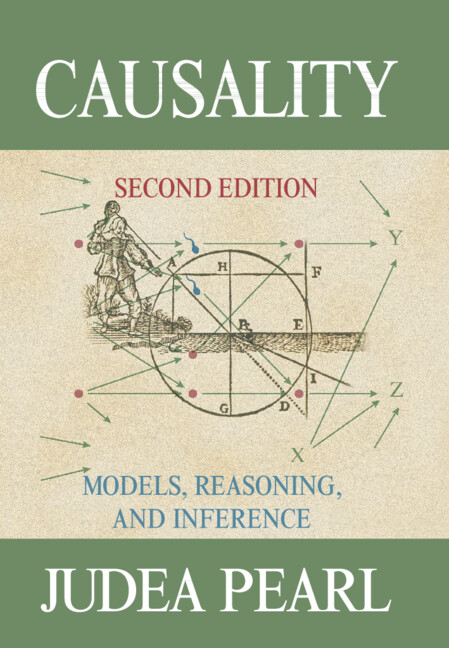
Causality
Written by one of the preeminent researchers in the field, this book provides a comprehensive exposition of modern analysis of causation. It shows how causality has grown from a nebulous concept into a mathematical theory with significant applications in the fields of statistics, artificial intelligence, economics, philosophy, cognitive science, and the health and social sciences. Judea Pearl presents and unifies the probabilistic, manipulative, counterfactual, and structural approaches to causation and devises simple mathematical tools for studying the relationships between causal connections and statistical associations. Cited in more than 2,100 scientific publications, it continues to liberate scientists from the traditional molds of statistical thinking. In this revised edition, Judea Pearl elucidates thorny issues, answers readers' questions, and offers a panoramic view of recent advances in this field of research. Causality will be of interest to students and professionals in a wide variety of fields. Dr Judea Pearl has received the 2011 Rumelhart Prize for his leading research in Artificial Intelligence (AI) and systems from The Cognitive Science Society.
"Powerful AI can statically help human decision-makers, but can harm collective knowledge building... it can lead to what we call “knowledge collapse” whereby in the long-run all human knowledge is ultimately destroyed.” economics.mit.edu/sites/default/files/2026-02/A…
📚 AI (+ nuance)

Researching all aspects of artificial intelligence and its realized and potential implications
Malleable Software (by Boris) — Semble
darkshapes
AI* perception/usage (by あ) — Semble
All intelligence is collective intelligence (by Ronen Tamari) — Semble

A Collectivist, Economic Perspective on AI

Knowing less about AI makes people more open to having it in their lives – new research
