

Writing code comments has always been hard, because communicating is hard. It's hard to not assume context. It's hard to use the right terminology consistently. It's hard to even put comments in the right spots to begin with. It generally takes me several iterations of rewording a comment to get something I'm happy with. I'll write something lousey that takes 5 times as long to read as it should, and then read it. Then I'll remove a couple sentences, tweak what remains and do it again.
Devin Review: AI to Stop Slop | Cognition
As code generation gets easier, code review is the new bottleneck. That's why we're launching a new way to quickly review and understand complex PRs in our latest tool for codebase understanding - augmenting human attention with AI.

AI-slop , GrantaGate and Bad Writing
AI writes poorly because it has crammed too much fanfic jargon
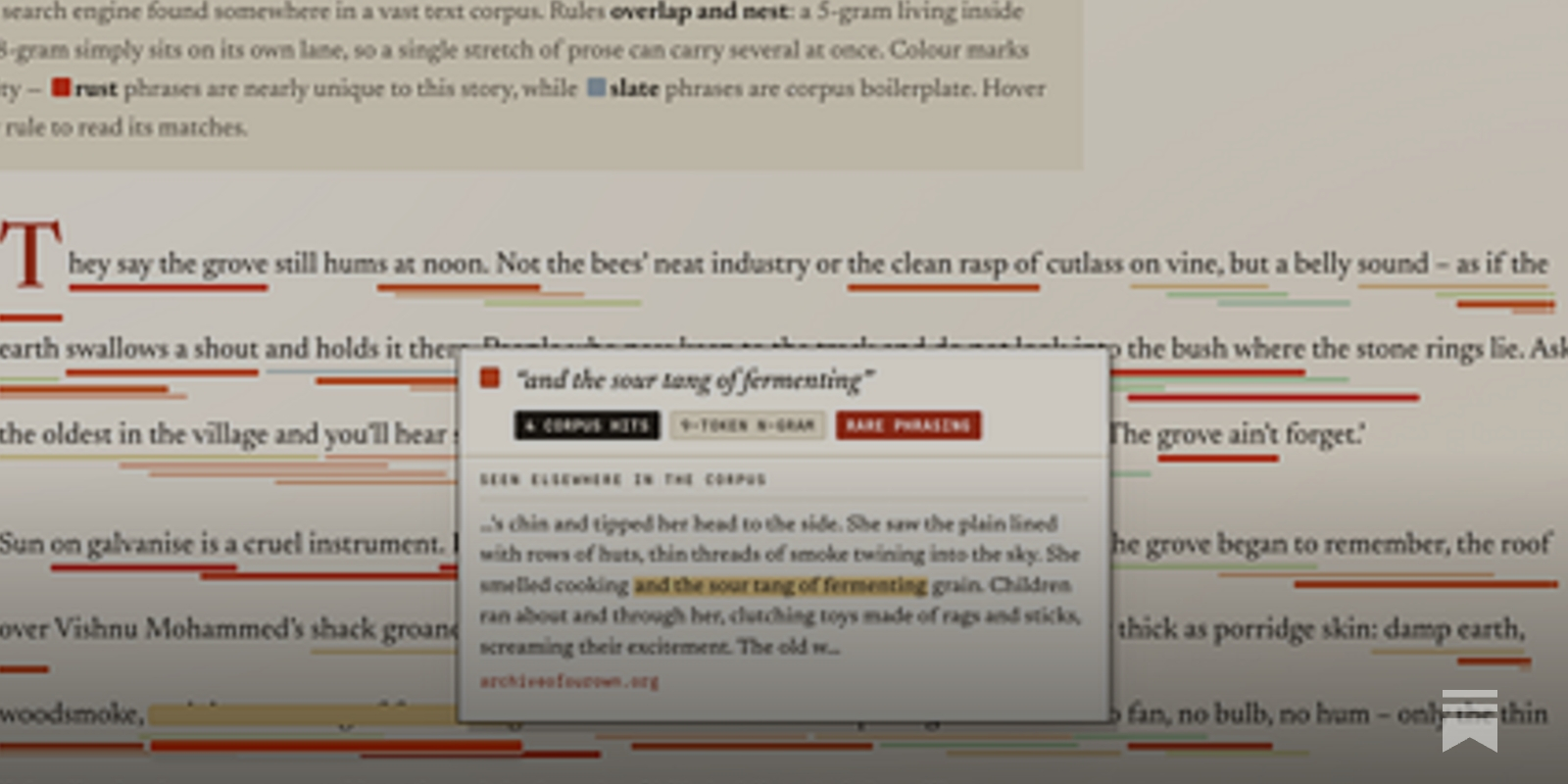

Are you Slop??
Are you Slop? Analyze your 'slop score' - a measure of how generic or unique your text appears to language models.

How to Read an RFC
Requests for Comments (RFCs) are how we specify many protocols on the Internet. These documents are alternatively treated as holy texts by developers who parse them for hidden meanings, then shunned as irrelevant because they can’t be understood. This often leads to frustration and – more significantly – interoperability and security issues. However, with some insight into how they’re constructed and published, it’s a bit easier to understand what you’re looking at.

A break from programming languages
This is a blog post I have been considering writing for a long time.
Writing Code Is Easy. Reading It Isn’t.
Writing code is easy. Once you have a solution in mind, and have mastered the syntax of your favorite programming language, writing code is easy. Having an LLM write entire functions for you? Even eas

The peril of laziness lost | The Observation Deck
In his classic Programming Perl — affectionately known to a generation of technologists as "the Camel Book" — Larry Wall famously wrote of the three virtues of a programmer as laziness, impatience, and hubris: If we’re going to talk about good software design, we have to talk about Laziness, Impatience, and Hubris, the basis of good software design. We’ve all fallen into the trap of using cut-and-paste when we should have defined a higher-level abstraction, if only just a loop or subroutine. To be sure, some folks have gone to the opposite extreme of defining ever-growing mounds of higher level abstractions when they should have used cut-and-paste. Generally, though, most of us need to think about using more abstraction rather than less.
Writing software is hard
Good software is uncommon because writing it is hard. In the abstract, we all know that it is hard. We talk incessantly about how it’s hard. And yet, we also collectively seem shocked — just shocke…

If coding is solved, what now?: Measuring the sloppiness of code | EARENDIL
Exploring how to measure code sloppiness, why correct code can still erode a codebase, and why human intuition and taste still matter.

RFC - Request for comments
I've heard feedback on the @markpub.at lexicon! Thanks to @bmann.ca @blaine.bsky.social @thisismissem.social and others who have given really useful comments. I've published a new version for comment that is still very simple, but has more room for flexibility. Let me know what you think! markpub.at
Markpub.at Markdown Lexicon
markpub.atThis week we built comments into our document editor to show off what can be done with fine-grained permissioning on spaces! Check it out here: chalk.habitat.network

Habitat's road to release: 06 commenting
habitat.leaflet.pub

