

By Nihar B. Shah
Gautam Kamath on Twitter / X
Nihar Shah did a heroic experiment for TMLR: he spent 20-25 hours over two weeks interviewing authors of seemingly low-quality submissions about their own papers. He confirmed what we all suspected: people submitting these papers have *no idea* what is going on in them. https://t.co/6CJF152u7I— Gautam Kamath (@thegautamkamath) September 16, 2026
Vipul Gupta on Twitter / X
Feels bad to say, but paper writing/reviewing is definitely cooked.Reviewed 4 papers recently and genuinely felt like I spent more time reviewing them than the authors spent writing them.— Vipul Gupta (@vipul_1011) September 19, 2026
Thomas G. Dietterich on Twitter / X
Attention @arxiv authors: Our Code of Conduct states that by signing your name as an author of a paper, each author takes full responsibility for all its contents, irrespective of how the contents were generated. 1/— Thomas G. Dietterich (@tdietterich) May 14, 2026
Ana Dodik on Twitter / X
Might be time to recommend this paper to folks. https://t.co/lusvhBgM8k pic.twitter.com/Ju8nwPAja5— Ana Dodik (@ana_dodik) November 12, 2026

Want To Self-Publish A Book? Guy Kawasaki Wants To Help
Self-publishing is easier and more democratic, and authors have more freedom and earn more money per book. But selling those books is much harder without the backing of a traditional publisher.
Authorship, division of labour, material and digital form; thoughts on Samuel A. Moore's Publishing Beyond the Market
On Christmas day, we had a quiet time this year. One of the things I did was to read Moore, Samuel A., Publishing Beyond the Market: Open Access, Care, and the Commons (University of Michigan Press, 2025). This is a most enjoyable book that outlines a project and worldview that I know Sam has been cultivating and refining for many years. I should stress that I am not writing a “review” here. I would be conflicted anyway as I am thanked in the acknowledgements. But it did, like all good books, make me think and I wanted to jot down some thoughts. These thoughts are not necessarily novel – sometimes Sam even explores some of them in the book – but I thought it would be enjoyable to express them nonetheless.

Thomas G. Dietterich on Twitter / X
We are seeing a new trend in submissions to @arxiv (and presumably to conferences and journals): Authors submitting papers whose contents they likely do not understand. 1/— Thomas G. Dietterich (@tdietterich) September 13, 2026
The world’s largest collection of open access research papers
The world’s largest collection of open access research papers
The world’s largest collection of open access research papers
The world’s largest collection of open access research papers
The world’s largest collection of open access research papers
The world’s largest collection of open access research papers
Guest post: Should universities investigate questionable papers students and faculty wrote elsewhere?
Be-Art/iStock I am a research ethicist and often get asked by my university to investigate when potential concerns are raised about our staff or students. One example involved the recent case of th…

Are Scientific Papers Bad?
Nihar Shah did a heroic experiment for TMLR: he spent 20-25 hours over two weeks interviewing authors of seemingly low-quality submissions about their own papers. He confirmed what we all suspected: people submitting these papers have *no idea* what is going on in them.

Transactions on Machine Learning Research
TMLR has faced a deluge of submissions, necessitating stricter desk rejection policies due to limited reviewer capacity Co-EiC Nihar Shah reached out to authors of 10 papers slated for desk reject. Could they answer questions about their *own* submission? medium.com/@TmlrOrg/asking-authors-about…
This is a FRAUDULENT paper, AI-generated. My name was used as an author and I had nothing to do with it, never saw it until today e-pubmed.co.uk/journals/digital-health-imple… The "Editors" Angelo Rossi Mori, David Mensah, and Zarnie Khadjesari and this "Journal" should be reported.
1. Recently I’ve received lots of emails from people I don’t know personally, asking for my feedback on their books or papers. They explain the connection between my work and theirs and ask me to take a look. The catch, of course, is that the emails are transparently, obviously, written by AI.
Personal Journal Club

Papers papers papers
Cognitive Architectures for Language Agents

Thinking—Fast, Slow, and Artificial: How AI is Reshaping Human Reasoning and the Rise of Cognitive Surrender
Warnings for pattern matching
Retrieval-Augmented Code Generation: A Survey with Focus on Repository-Level Approaches
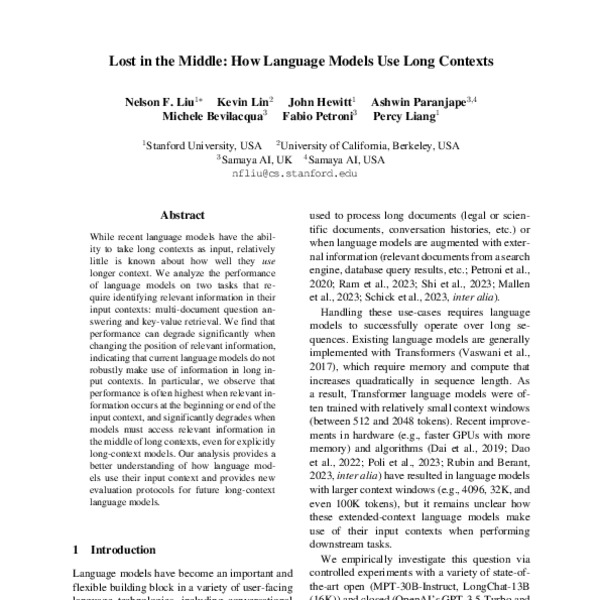
Lost in the Middle: How Language Models Use Long Contexts
TDOP Pratt


