

product, fiber product, base change, coproduct, pullback, pushout, cobase change, equalizer, coequalizer, join, meet, terminal object, initial object, direct product, direct sum
protolab
A patchbay for your schemas. Bidirectional data transformations, drawn as circuits.
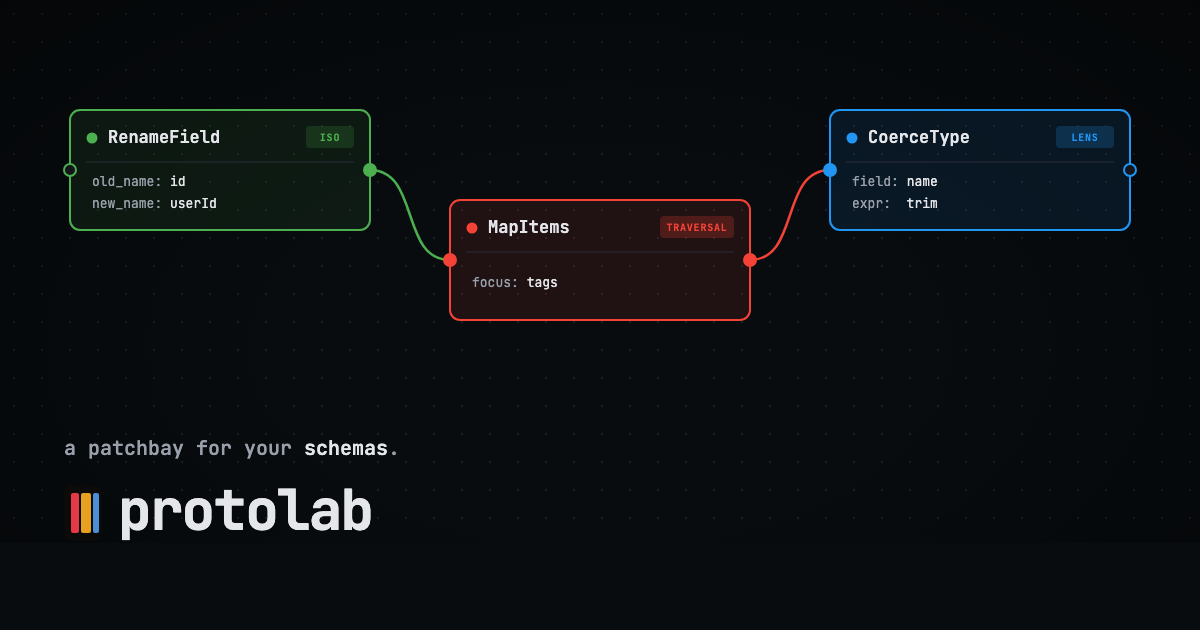
protolab
A patchbay for your schemas. Bidirectional data transformations, drawn as circuits.
Seven Sketches in Compositionality: An Invitation to Applied Category Theory
This book is an invitation to discover advanced topics in category theory through concrete, real-world examples. It aims to give a tour: a gentle, quick introduction to guide later exploration. The tour takes place over seven sketches, each pairing an evocative application, such as databases, electric circuits, or dynamical systems, with the exploration of a categorical structure, such as adjoint functors, enriched categories, or toposes. No prior knowledge of category theory is assumed. A feedback form for typos, comments, questions, and suggestions is available here: https://docs.google.com/document/d/160G9OFcP5DWT8Stn7TxdVx83DJnnf7d5GML0_FOD5Wg/edit

Basic Category Theory
This short introductory category theory textbook is for readers with relatively little mathematical background (e.g. the first half of an undergraduate mathematics degree). At its heart is the concept of a universal property, important throughout mathematics. After a chapter introducing the basic definitions, separate chapters present three ways of expressing universal properties: via adjoint functors, representable functors, and limits. A final chapter ties the three together. For each new categorical concept, a generous supply of examples is provided, taken from different parts of mathematics. At points where the leap in abstraction is particularly great (such as the Yoneda lemma), the reader will find careful and extensive explanations.
What you needa know about Yoneda: profunctor optics and the Yoneda lemma (functional pearl) | Proceedings of the ACM on Programming Languages
Profunctor optics are a neat and composable representation of bidirectional data accessors, including lenses, and their dual, prisms. The profunctor representation exploits higher-order functions and higher-kinded type constructor classes, but the ...

panproto/crates/panproto-lens-dsl at main · panproto/panproto
One engine for schematic version control within and across any schema language. - panproto/panproto
Category Theory for Programmers: The Preface
Table of Contents Part One Category: The Essence of Composition Types and Functions Categories Great and Small Kleisli Categories Products and Coproducts Simple Algebraic Data Types Functors Functo…
Abstract syntax and variable binding
We develop a theory of abstract syntax with variable binding. To every binding signature we associate a category of models consisting of variable sets endowed with compatible algebra and substitution structures. The syntax generated by the signature is the initial model. This gives a notion of initial algebra semantics encompassing the traditional one; besides compositionality, it automatically verifies the semantic substitution lemma.
Categories for the Working Mathematician
Categories for the Working Mathematician provides an array of general ideas useful in a wide variety of fields. Starting from the foundations, this book illuminates the concepts of category, functor, natural transformation, and duality. The book then turns to adjoint functors, which provide a description of universal constructions, an analysis of the representations of functors by sets of morphisms, and a means of manipulating direct and inverse limits. These categorical concepts are extensively illustrated in the remaining chapters, which include many applications of the basic existence theorem for adjoint functors. The categories of algebraic systems are constructed from certain adjoint-like data and characterized by Beck's theorem. After considering a variety of applications, the book continues with the construction and exploitation of Kan extensions. This second edition includes a number of revisions and additions, including two new chapters on topics of active interest. One is onsymmetric monoidal categories and braided monoidal categories and the coherence theorems for them. The second describes 2-categories and the higher dimensional categories which have recently come into prominence. The bibliography has also been expanded to cover some of the many other recent advances concerning categories.
WRKSHP.tools | Product Box
The Product Box exercise helps you when you need to convert an abstract concept into something tangible that you can evaluate with people that were not intimately part of the design process.
nLab
particle, relativistic particle, fundamental particle, spinning particle, superparticle
Frobenius algebra in nLab
A Frobenius algebra is a vector space equipped with the structures both of an algebra and of an a coalgebra in a compatible way, where the compatibility is different from (more “topological” than) that in a bialgebra/Hopf algebra:
A categorical manifesto
This paper tries to explain why and how category theory is useful in computing science, by giving guidelines for applying seven basic categorical concepts: category, functor, natural transformation, limit, adjoint, colimit and comma category. Some examples, intuition, and references are given for each concept, but completeness is not attempted. Some additional categorical concepts and some suggestions for further research are also mentioned. The paper concludes with some philosophical discussion.

Quotient lenses | Proceedings of the 13th ACM SIGPLAN international conference on Functional programming
Bidirectional programming languages are a practical approach to the view update problem. Programs in these languages, called lenses, define both a view and an update policy - i.e., every program can be read as a function mapping sources to views as well ...

10 things I want to work on after the conference - Alex's Blog
a few people found this tool I made a while ago useful in @alex.bsky.team's lexicon workshop yesterday at #atmosphereconf, so resharing here for anyone else who wants to write their lexicons in typescript prototypey.org
Panproto

Algebraic structures to morph between data.
idiolect-dev/idiolect

Aaron Steven White (@aaronstevenwhite.io)

Aaron Steven White (@aaronstevenwhite.io)
panproto/panproto
Machine-readable attitudes - Computational Semantics++

Tessa Brown (@tessa.germnetwork.com)