


A week or so ago, I wondered if I actually needed to use a search engine as much as I did. Why was I sending so much traffic to a third party service, especially since I can’t seem to find a search engine which aligns with my ethics and delivers good search results?
Search has its own bitter lesson
Human incentives to make content findable to your search matter more than technology

Why Google’s New AI-Saturated Search Page Will Be A Disaster
Google didn’t invent full-text search of the Internet – that honor belongs to early pioneers such as WebCrawler, Lycos and AltaVista. But for the last 25 years or so, Google has…

Cloudflare's Matthew Prince has a plan to get Google and the AI oliigarchs to pay for your content even though many are used to getting it for free. He might have enough leverage to make them.
AI chatbots are blowing up the 30-year economic relationship publishers have had with search engines. Many think this will kill the web if not addressed. Google needs to change first. It's resisting. Cloudflare's Matthew Prince is going to try and make them.

The Web Can Thrive Without Google’s Search Monopoly
Viable browsers and meaningful contributions to web standards can be sustained with more modest revenue streams, writes Alissa Cooper.

The enshittification of online search? Privacy and quality of Google, Bing and Apple in coding advice
Even though currently being challenged by ChatGPT and other large-language models (LLMs), Google Search remains one of the primary means for many individuals to find information on the internet. Interestingly, the way that we retrieve information on the web has hardly changed ever since Google was established in 1998, raising concerns as to Google's dominance in search and lack of competition. If the market for search was sufficiently competitive, then we should probably see a steady increase in search quality over time as well as alternative approaches to the Google's approach to search. However, hardly any research has so far looked at search quality, which is a key facet of a competitive market, especially not over time. In this report, we conducted a relatively large-scale quantitative comparison of search quality of 1,467 search queries relating to coding advice in October 2023. We focus on coding advice because the study of general search quality is difficult, with the aim of learning more about the assessment of search quality and motivating follow-up research into this important topic. We evaluate the search quality of Google Search, Microsoft Bing, and Apple Search, with a special emphasis on Apple Search, a widely used search engine that has never been explored in previous research. For the assessment of search quality, we use two independent metrics of search quality: 1) the number of trackers on the first search result, as a measure of privacy in web search, and 2) the average rank of the first Stack Overflow search result, under the assumption that Stack Overflow gives the best coding advice. Our results suggest that the privacy of search results is higher on Bing than on Google and Apple. Similarly, the quality of coding advice -- as measured by the average rank of Stack Overflow -- was highest on Bing.

Content Independence Day, one year on- building the business model for the agentic Internet
One year after declaring Content Independence Day, a dynamic market for monetized content has officially emerged. In this report, we examine how the rise of autonomous AI agents is upending traditional search referrals and detail the new infrastructure required to support a sustainable web economy.

Google Is Building an A.I. Fence Around the Internet It Once Championed
As Google incorporates more artificial intelligence into search, people are spending more time on Google. Some website operators are crying foul.

Google Is Building an A.I. Fence Around the Internet It Once Championed
As Google incorporates more artificial intelligence into search, people are spending more time on Google. Some website operators are crying foul.
A Former Google Engineer Built a Search Engine for Finding Every Privacy Violation You Face Online
Former Google engineer Tim Libert is releasing a search engine, webXray, that aims to find illicit online data collection and tracking—with the goal of becoming “the Henry Ford of tech lawsuits.”

Litter Layer
Indie search engine for discovering personal and small-web sites — built largely by visitors like you.

Is Google Getting Worse? A Longitudinal Investigation of SEO Spam in Search Engines
Many users of web search engines have been complaining in recent years about the supposedly decreasing quality of search results. This is often attributed to an increasing amount of search-engine-optimized but low-quality content. Evidence for this has always been anecdotal, yet it’s not unreasonable to think that popular online marketing strategies such as affiliate marketing incentivize the mass production of such content to maximize clicks. Since neither this complaint nor affiliate marketing as such have received much attention from the IR community, we hereby lay the groundwork by conducting an in-depth exploratory study of how affiliate content affects today’s search engines. We monitored Google, Bing and DuckDuckGo for a year on 7,392 product review queries. Our findings suggest that all search engines have significant problems with highly optimized (affiliate) content—more than is representative for the entire web according to a baseline retrieval system on the ClueWeb22. Focussing on the product review genre, we find that only a small portion of product reviews on the web uses affiliate marketing, but the majority of all search results do. Of all affiliate networks, Amazon Associates is by far the most popular. We further observe an inverse relationship between affiliate marketing use and content complexity, and that all search engines fall victim to large-scale affiliate link spam campaigns. However, we also notice that the line between benign content and spam in the form of content and link farms becomes increasingly blurry—a situation that will surely worsen in the wake of generative AI. We conclude that dynamic adversarial spam in the form of low-quality, mass-produced commercial content deserves more attention. (Code and data: https://github.com/webis-de/ECIR-24).

Is Google Getting Worse? A Longitudinal Investigation of SEO Spam in Search Engines
Many users of web search engines have been complaining in recent years about the supposedly decreasing quality of search results. This is often attributed to an increasing amount of search-engine-optimized but low-quality content. Evidence for this has always been anecdotal, yet it’s not unreasonable to think that popular online marketing strategies such as affiliate marketing incentivize the mass production of such content to maximize clicks. Since neither this complaint nor affiliate marketing as such have received much attention from the IR community, we hereby lay the groundwork by conducting an in-depth exploratory study of how affiliate content affects today’s search engines. We monitored Google, Bing and DuckDuckGo for a year on 7,392 product review queries. Our findings suggest that all search engines have significant problems with highly optimized (affiliate) content—more than is representative for the entire web according to a baseline retrieval system on the ClueWeb22. Focussing on the product review genre, we find that only a small portion of product reviews on the web uses affiliate marketing, but the majority of all search results do. Of all affiliate networks, Amazon Associates is by far the most popular. We further observe an inverse relationship between affiliate marketing use and content complexity, and that all search engines fall victim to large-scale affiliate link spam campaigns. However, we also notice that the line between benign content and spam in the form of content and link farms becomes increasingly blurry—a situation that will surely worsen in the wake of generative AI. We conclude that dynamic adversarial spam in the form of low-quality, mass-produced commercial content deserves more attention. (Code and data: https://github.com/webis-de/ECIR-24).
Search privately and without ads — Uruky
Search privately and without ads using Uruky, the private search engine.

Google Search Changed: The Good, the Bad, and the Ugly of AI Search - Boxcar Marketing
Google Search is not longer about indexing the web, it's about being an AI assistant.

Imagine things being so bad that your best solution is to cut yourself off from Google Search traffic. I don't think that people realise just how much of a bad actor Google has been, for year. No other company has damaged the web nearly as much. 🧵 adweek.com/media/publishers-opt-out-goog…

Publishers Are Preparing to Opt Out of Google Search
www.adweek.comSearch engines

Features and comparisons for when I’m “search engine shopping” and not so much about enshittification etc. Currently I mostly use DuckDuckGo (for when I basically know what I’m looking for) and Kagi (for when I don’t or if I’m dissatisfied with DDG; I’m not on their unlimited plan).
あ (@aiueo.ooo)

Google’s AI search is so broken it can ‘disregard’ what you’re looking for

Google Search’s AI evolution includes more ads
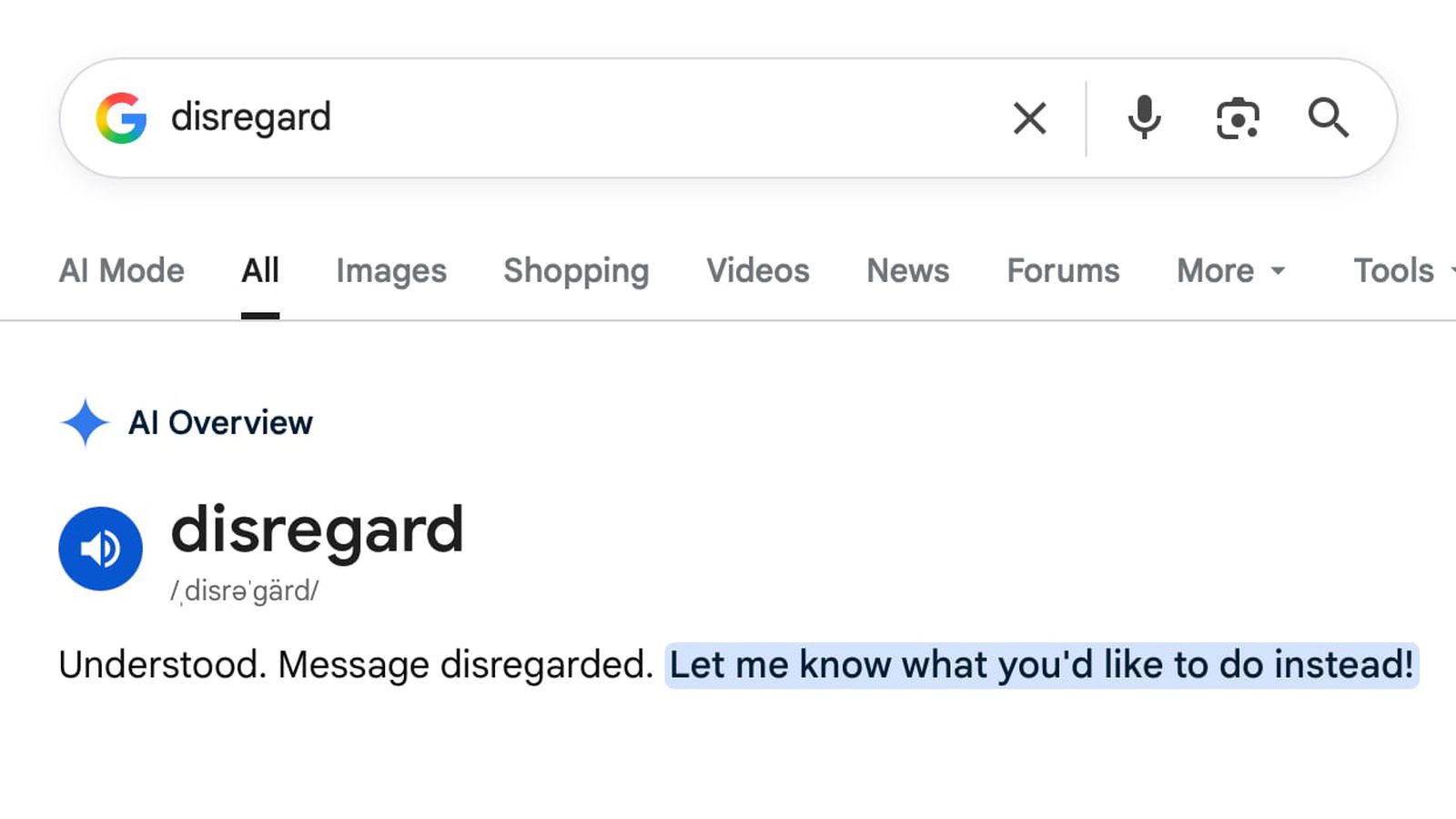
Searching for 'Disregard' Breaks Google [Updated]
あ (@aiueo.ooo)
