


Critical AI Literacy (CAIL) from my perspective.
Towards Critical Artificial Intelligence Literacies
Critical Artificial Intelligence Literacies (CAILs) is the collection of ways of thinking about and relating to so-called artificial intelligence (AI) that rejects dominant frames presented by the technology industry, by naive computationalism, and by dehumanising ideologies. Instead, CAILs centre human cognition and uphold the integrity of academic research and education. We present a selection of CAILs across research and education, which we analyse into the following non-orthogonal dimensions: conceptual clarity, critical thinking, decoloniality, respecting expertise, and slow science. Finally, we note how we see the present with and without a wider adoption of CAILs — a fundamental aspect is the assertion that AI cannot be allowed to drive change, even positive change, in education or research. Instead cultivation of and adherence to shared values and goals must guide us. Ultimately, CAILs minimally ask us to contemplate how we as academics can stop AI companies from wielding so much power.
AI Literacy Across the Curriculum
As you have no doubt seen, AI is becoming ubiquitous in our lives and in the technologies we use every day. Generative AI is no longer an experimental tool, but a deployed technology in many of the…

AI and the crisis of the author
Editor’s note (September 21, 2026): We have removed this essay. AI was used in its preparation. The TLS editorial guidelines prohibit the use of AI in the
We Have Never Taught Critical Thinking (opinion)
AI just makes those failures evident.

Reading List: AI and the Future of Human Autonomy
Open-source reading list from a discussion group hosted by the Liberty Fund

I knew my writing students were using AI. Their confessions led to a powerful teaching moment | Micah Nathan
The problem wasn’t just the perfectly polished, yet mediocre prose. It’s what’s lost when we surrender the struggle to translate thought into words

The Impact of Artificial Intelligence on Human Thought
This research paper examines, from a multidimensional perspective (cognitive, social, ethical, and philosophical), how AI is transforming human thought. It highlights a cognitive offloading effect: the externalization of mental functions to AI can reduce intellectual engagement and weaken critical thinking. On the social level, algorithmic personalization creates filter bubbles that limit the diversity of opinions and can lead to the homogenization of thought and polarization. This research also describes the mechanisms of algorithmic manipulation (exploitation of cognitive biases, automated disinformation, etc.) that amplify AI's power of influence. Finally, the question of potential artificial consciousness is discussed, along with its ethical implications. The report as a whole underscores the risks that AI poses to human intellectual autonomy and creativity, while proposing avenues (education, transparency, governance) to align AI development with the interests of humanity.

I wrote an AI textbook — how long until AI can do it better?
Reflections on AI's writing ability and how AI models get more capable.

The Thoughts The Civilized Keep
The hype around a new AI language generator reveals the sterility of mainstream thinking on AI today — and indeed on how we think about thinking itself.

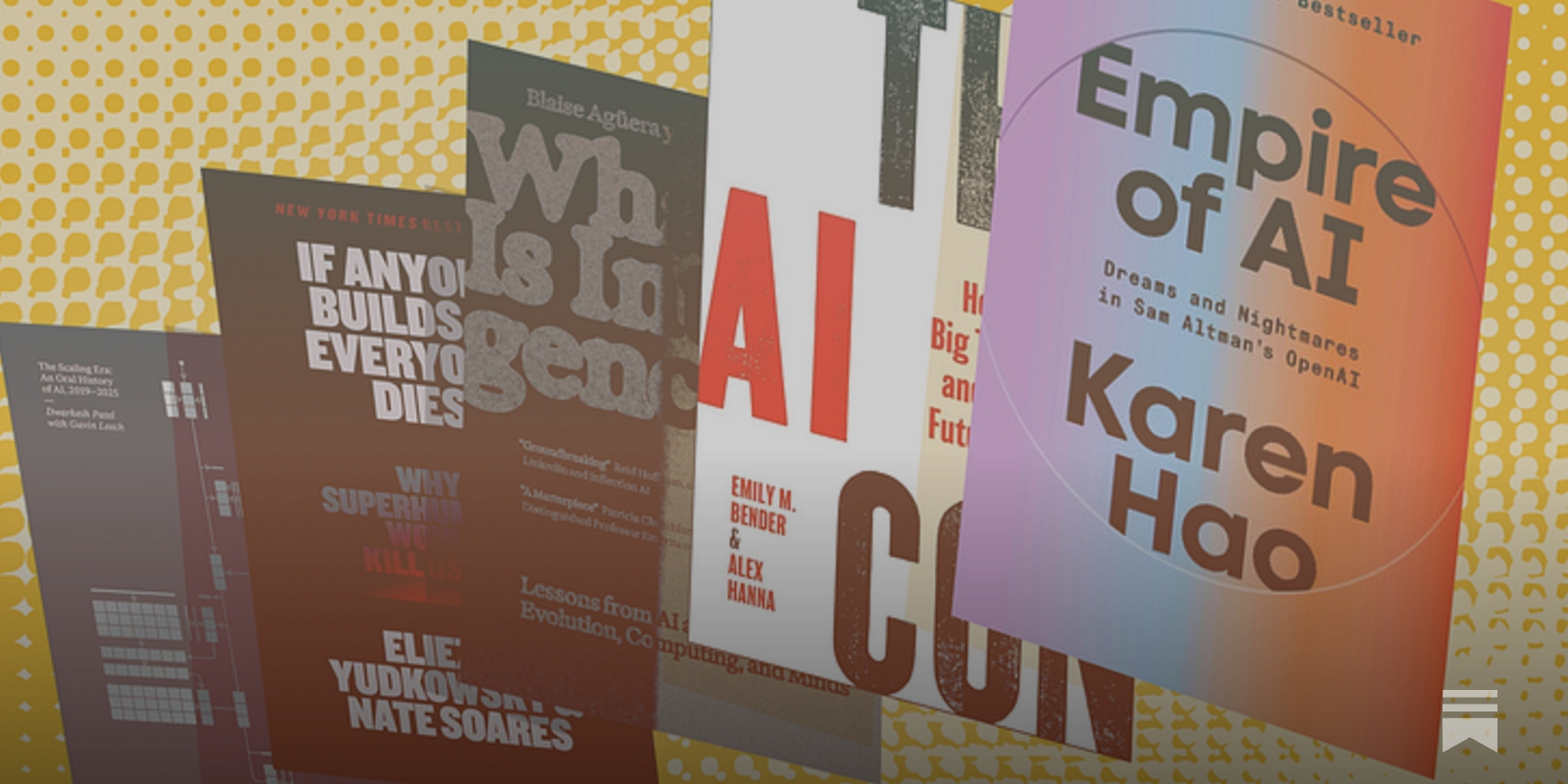
We read a lot of AI books so you don’t have to
“Because every camp needs a book right now”
We Asked the ‘Future of Truth’ Author to Explain How He Used AI. It Didn’t Go Well
A book about how AI shapes perceptions of reality came under fire for using AI-generated quotes. Its problems go beyond that.

trying to articulate what i hate about "AI writing"

dan
so it's like if we imagine a normal distribution but then we set super intense resonance at exactly the middle point. that's how it feels to be surrounded by AI writing every day. it's average *without* the normal distribution — just extreme dose of narrow average. this is what pushes my buttons
AI

AI research, critical perspectives, agent design, digital humanities. How AI systems work, their embedded values, and the thinking around building agentic systems.

Agency and Agents
ГАЛЬВАНИЗАЦИЯ АВТОРА, ИЛИ ЭКСПЕРИМЕНТ С НЕЙРОННОЙ ПОЭЗИЕЙ. Борис Орехов. «Новый мир» №6, 2018

Personal Online RL | 🌱 | Offprint
Approaching an unknown communication system by latent space exploration and causal inference | Royal Society Open Science | The Royal Society
Surya Narreddi

Permutation: Issue One