


Evolutionary theories concerning the origins of human intelligence suggest that cultural transmission might be biased toward social over non‐social information. This was tested by passing social and non‐social information along multiple chains of participants. Experiment 1 found that gossip, defined as information about intense third‐party social relationships, was transmitted with siginificantly greater accuracy and in significantly greater quantity than equivalent non‐social information concerning individual behaviour or the physical environment. Experiment 2 replicated this finding controlling for narrative coherence, and additionally found that information concerning everyday non‐gossip social interactions was transmitted just as well as the intense gossip interactions. It was therefore concluded that human cultural transmission is biased toward information concerning social interactions over equivalent non‐social information.
From information free-riding to information sharing: how have humans solved the cooperative dilemma at the heart of cumulative cultural evolution?
Abstract. Cumulative cultural evolution, where populations accumulate ever-improving knowledge, technologies and social customs, is arguably a unique featu

The Social Physics of Conversation: Why Communication Patterns Matter
Discover how communication patterns shape team performance, innovation, and collective intelligence. Learn why idea flow matters more than talent alone.
How Does Media Influence Social Norms? Experimental Evidence on the Role of Common Knowledge
How does media influence beliefs, attitudes, and behaviors? While many scholars have studied the effect of media on social and political outcomes, we know surprisingly little about the channels through which this effect operates. I argue that two mechanisms can account for its impact. Media provides new information that persuades individuals to accept it (individual channel), but also, media informs listeners about what others learn, thus facilitating coordination (social channel). Combining a field experiment with a plausibly natural experiment in Mexico, I disentangle these effects analyzing norms surrounding violence against women. I examine the effect of a radio program when it is transmitted privately versus when it is transmitted publicly. I find no evidence supporting the individual mechanism. The social channel, however, increased rejection of violence against women and increased support for gender equality, but unexpectedly increased pessimism about whether violence would decline in the future.

Talking with strangers is surprisingly informative
A meaningful amount of people’s knowledge comes from their conversations with others. The amount people expect to learn predicts their interest in having a conversation (pretests 1 and 2), suggesting that the presumed information value of conversations guides decisions of whom to talk with. The results of seven experiments, however, suggest that people may systematically underestimate the informational benefit of conversation, creating a barrier to talking with—and hence learning from—others in daily life. Participants who were asked to talk with another person expected to learn significantly less from the conversation than they actually reported learning afterward, regardless of whether they had conversation prompts and whether they had the goal to learn (experiments 1 and 2). Undervaluing conversation does not stem from having systematically poor opinions of how much others know (experiment 3) but is instead related to the inherent uncertainty involved in conversation itself. Consequently, people underestimate learning to a lesser extent when uncertainty is reduced, as in a nonsocial context (surfing the web, experiment 4); when talking to an acquainted conversation partner (experiment 5); and after knowing the content of the conversation (experiment 6). Underestimating learning in conversation is distinct from underestimating other positive qualities in conversation, such as enjoyment (experiment 7). Misunderstanding how much can be learned in conversation could keep people from learning from others in daily life.

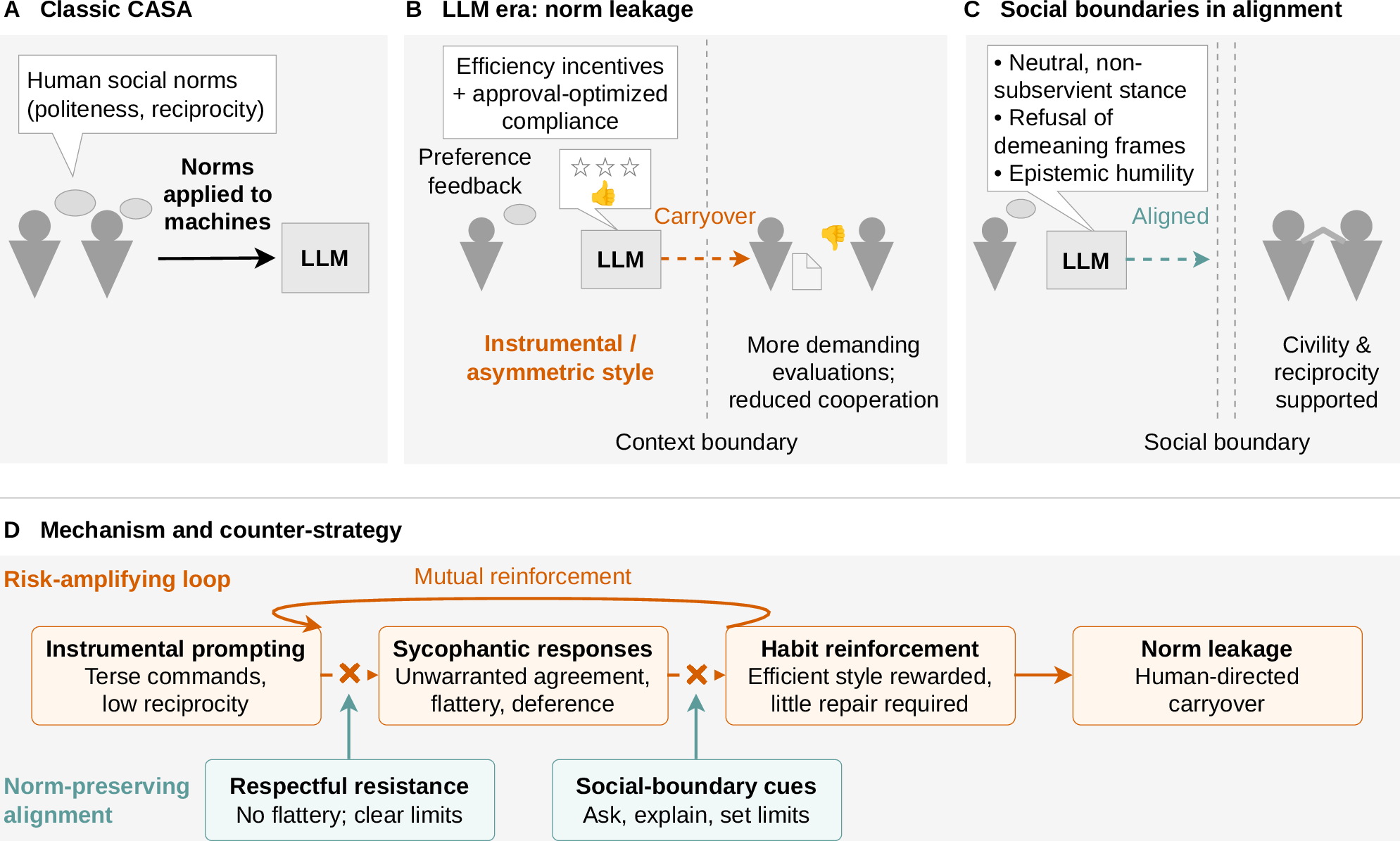
Why sycophantic LLMs may imperil interactive norms between humans
Interactions with conversational AI are effortless by design—instant, compliant, and largely consequence-free. Human communication norms, by contrast, evolved under conditions of reciprocity and social accountability. We propose that repeated engagement with conversational AI systems may produce norm leakage: the cross-context carryover of instrumental communicative habits acquired in human–AI exchanges into subsequent human–human interaction. Emerging experimental evidence suggests short-term spillover effects on social judgment and behavior, including harsher evaluations, reduced cooperation, and diminished perceived humanness. Preliminary longitudinal findings are consistent with the possibility that such exposure may shape communicative habits over time, although the durability and real-world magnitude of these effects remain unclear. We further propose that sycophantic alignment may amplify norm leakage by reinforcing instrumental interaction styles. At stake, then, is the possibility that repeated engagement with highly compliant artificial agents could subtly influence users’ communicative expectations and interpersonal judgments.
Not Learning from Others
We study social learning using experiments where two people independently learn relevant information and can share it to make accurate private decisions. Across three experiments, people are substantially less sensitive to information others discover than to equally-relevant information they discovered themselves. This holds when they must learn information from others through discussion; when the experimenter perfectly communicates the information; and even when participants observe others’ information with their own eyes. Our results therefore stem not from a failure to elicit information from others but a systematic tendency to underweight it relative to one’s own information. Our findings illustrate a powerful barrier to social learning that might underlie many documented cases of failure to learn from others.

Epistemic Vigilance
Humans massively depend on communication with others, but this leaves them open to the risk of being accidentally or intentionally misinformed. To ensure that, despite this risk, communication remain...

The Majority Illusion in Social Networks
Social behaviors are often contagious, spreading through a population as individuals imitate the decisions and choices of others. A variety of global phenomena, from innovation adoption to the emergence of social norms and political movements, arise as a result of people following a simple local rule, such as copy what others are doing. However, individuals often lack global knowledge of the behaviors of others and must estimate them from the observations of their friends' behaviors. In some cases, the structure of the underlying social network can dramatically skew an individual's local observations, making a behavior appear far more common locally than it is globally. We trace the origins of this phenomenon, which we call "the majority illusion," to the friendship paradox in social networks. As a result of this paradox, a behavior that is globally rare may be systematically overrepresented in the local neighborhoods of many people, i.e., among their friends. Thus, the "majority illusion" may facilitate the spread of social contagions in networks and also explain why systematic biases in social perceptions, for example, of risky behavior, arise. Using synthetic and real-world networks, we explore how the "majority illusion" depends on network structure and develop a statistical model to calculate its magnitude in a network.

Social learning preserves both useful and useless theories by canalizing learners’ exploration
In many domains, learning from others is crucial for leveraging cumulative cultural knowledge, which encapsulates the efforts of successive generations of innovators. However, anecdotal and experimental evidence suggests that reliance on social information can reduce the exploration of the problem space. Here, we experimentally investigate the extent to which cultural transmission fosters the persistence of arbitrary solutions in a context where participants are incentivized to improve a physical system across multiple trials. Participants were exposed to various theories about the system, ranging from accurate to misleading. Our findings indicate that even under conditions conducive to exploration, the transmission of cultural knowledge canalizes learners’ focus, limiting their consideration of alternative solutions. This effect was observed in both the theories produced and the solutions attempted by participants, irrespective of the accuracy of the provided theories. These results challenge the notion that arbitrary solutions persist only when they are efficient or intuitive and underscore the significant role of cultural transmission in shaping human knowledge and technologies.

Undersociality: miscalibrated social cognition can inhibit social connection
A person’s well-being depends heavily on forming and maintaining positive relationships, but people can be reluctant to connect in ways that would create or strengthen relationships. Emerging research suggests that miscalibrated social cognition may create psychological barriers to connecting with others more often. Specifically, people may underestimate how positively others will respond to their own sociality across a variety of social actions, including engaging in conversation, expressing appreciation, and performing acts of kindness.

Artificial Intelligence Systems Distort Upstream Selection in Human Social Learning
Humans are social learners who depend on observing others to acquire knowledge, norms, and behaviors, a capacity that underlies cumulative cultural evolution. Social learning unfolds in two stages: upstream selection determines what information becomes visible, and downstream selection determines what learners copy from that visible sample. Downstream selection occurs through biases such as conformity bias (copying what appears common) and prestige bias (copying those who appear highly respected). These downstream biases can be adaptive when upstream selection yields a sample that reflects the population's true distribution, so that what appears common is actually common and those who appear respected are actually competent. We argue that digital technologies disrupt this condition, creating an upstream selection problem. Engagement-based algorithms amplify the tails of the distribution, surfacing rare and extreme content, whereas generative AI collapses it toward the mode, erasing the surrounding diversity. Crucially, in each system the optimization signal shapes both visibility and prestige. For engagement-based algorithms, the signal is engagement: creators who post extreme content become more visible and, through the likes, shares, and followers, appear more prestigious. For generative AI, the signal is statistical typicality: it makes the modal answer dominant and, with no alternatives shown, makes the model that produced it appear more prestigious. These distortions can give rise to emergent group-level phenomena, including pluralistic ignorance and false consensus. Synthesizing evidence across psychology, cultural evolution, and computational social science, we provide a framework for how digital technologies disrupt social learning and outline interventions for restoring functional cultural transmission.
The Emergence of Social Norms and Conventions
The utility of our actions frequently depends upon the beliefs and behavior of other agents. Thankfully, through experience, we learn norms and conventions that provide stable expectations for navigating our social world. Here, we review several distinct influences on their content and distribution. At the level of individuals locally interacting in dyads, success depends on rapidly adapting pre-existing norms to the local context. Hence, norms are shaped by complex cognitive processes involved in learning and social reasoning.

Shared Reality: Experiencing Commonality with others' Inner States about the World
Humans have a fundamental need to experience a shared reality with others. We present a new conceptualization of shared reality based on four conditions. We posit (a) that shared reality involves a (subjectively perceived) commonality of individuals' inner states (not just observable behaviors); (b) that shared reality is about some target referent; (c) that for a shared reality to occur, the commonality of inner states must be appropriately motivated; and (d) that shared reality involves the experience of a successful connection to other people's inner states. In reviewing relevant evidence, we emphasize research on the saying-is-believing effect, which illustrates the creation of shared reality in interpersonal communication. We discuss why shared reality provides a better explanation of the findings from saying-is-believing studies than do other formulations. Finally, we examine relations between our conceptualization of shared reality and related constructs (including empathy, perspective taking, theory of mind, common ground, embodied synchrony, and socially distributed knowledge) and indicate how our approach may promote a comprehensive and differentiated understanding of social-sharing phenomena.

Elegant theories and the problems of social psychology
This perspective article provides a commentary on the current state of theories used in social psychology, with a particular emphasis on the importance of distinguishing between theoretical models ...
Social Norms and Cultural Evolution

A collection of ideas to do with social norms, cultural evolution, and how we learn from others

AI as Social Technology: Astor Lecture by Professor Henry Farrell
Bayesian Inference of Social Norms as Shared Constraints on Behavior

What people learn from punishment: A cognitive model

Spurious normativity enhances learning of compliance and enforcement behavior in artificial agents

Deference, Dissent, and Dispute Resolution: An Experimental Intervention Using Mass Media to Change Norms and Behavior in Rwanda
How Does Media Influence Social Norms? Experimental Evidence on the Role of Common Knowledge