

We’re developing Metavaluation — a participatory framework for recognising and rewarding the value of diverse contributions, from creative work and care to logistics and leadership.
Mapping an Ecology of Integrative Approaches to Addressing the Metacrisis
Dear friends, The Institute of Applied Metatheory (IAM) is pleased to announce the release of a new white paper that charts the landscape of leading-edge responses to the global metacrisis. In “Mapping an Ecology of Integrative Approaches to Addressing the Metacrisis”, IAM scholars Brandon Norgaard, Nicholas Hedlund, PhD, and Claudia Meglin provide a sweeping (albeit
Beyond the Artifact: Power as a Lens for Creativity Support Tools
How to balance full-time work with creative projects – The Creative Independent
A guide to finding the right day job, protecting your time, and building creative habits by Jeffrey Silverstein. Illustrated by Sunny Eckerle.
Care as methodology
On being a researcher in the strategy industry. And reflections on how care becomes a valuable scarcity in a world where speed and ego erode the sincerity of knowledge.

Great creative work is usually the product of a single person
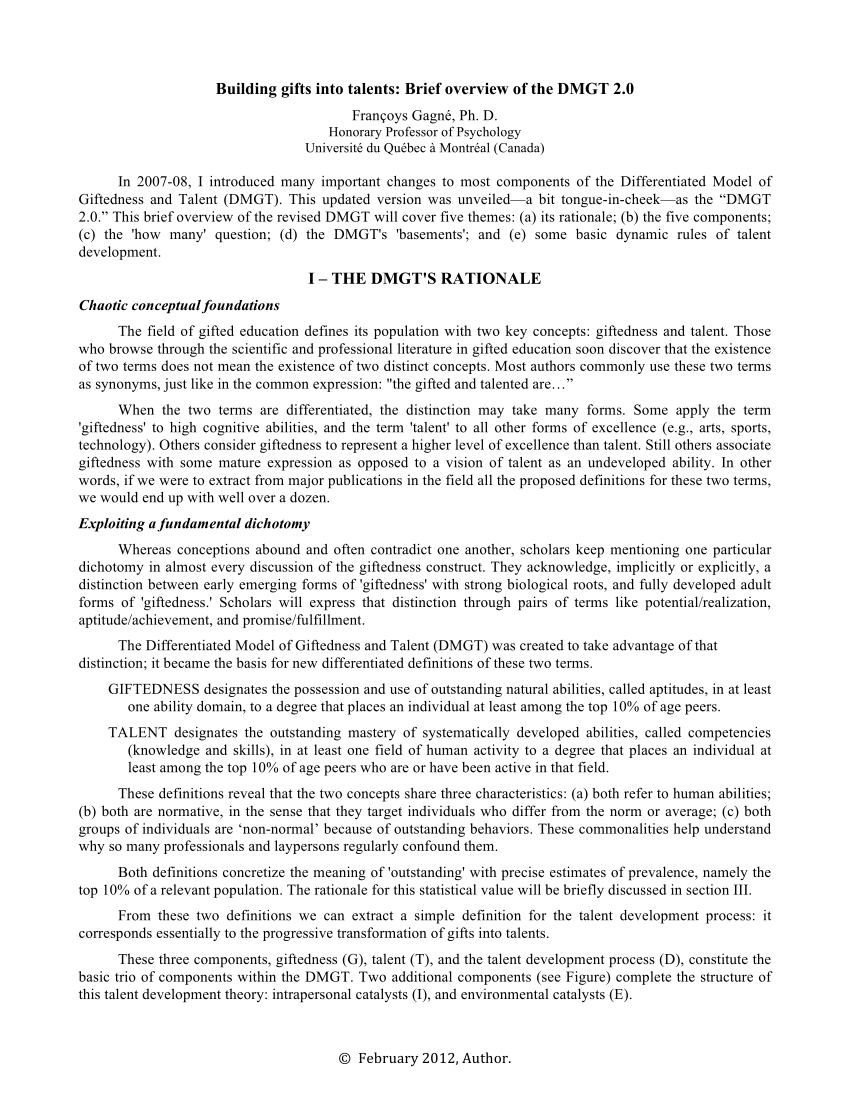
(PDF) Building gifts into talents: Detailed overview of the DMGT 2.0
PDF | On Jan 1, 2009, F. Gagné published Building gifts into talents: Detailed overview of the DMGT 2.0 | Find, read and cite all the research you need on ResearchGate
Visualize Value — Ideas, made visible
An ongoing practice of turning ideas into images. Visual ideas about work, markets, technology, culture, and human behavior by Jack Butcher.

Opinion | In Praise of Mediocrity (Published 2018)
The pursuit of excellence has infiltrated and corrupted the world of leisure.

Metaventory — the meta-science community
A comprehensive community of the people building meta-science and the tools they make — psychology and economics first, growing science-wide.

A Vision of Metascience
How does the culture of science change and improve? Many people have identified shortcomings in core social processes of science, such as peer review, how grants are awarded, how people are selected to become scientists, and so on. Yet despite often compelling criticisms, strong barriers inhibit widespread change in such social processes. The result is near stasis, and apathy about the prospects for improvement. People sometimes start new research institutions intended to do things differently; unfortunately such institutions are often changed more by the existing ecosystem than they change it. In this essay we sketch a vision of how the social processes of science may be rapidly improved. In this vision, metascience plays a key role: it deepens our understanding of which social processes best support discovery; that understanding can then help drive change. We introduce the notion of a metascience entrepreneur, a person seeking to achieve a scalable improvement in the social processes of science. We argue that: (1) metascience is an imaginative design practice, exploring an enormous design space for social processes; (2) that exploration aims to find new social processes which unlock latent potential for discovery; (3) decentralized change must be possible, so outsiders with superior ideas can't be blocked by established power centers; (4) ideally, change would align with what is best for science and for humanity, not merely what is fashionable, politically popular, or media-friendly; (5) the net result would be a far more structurally diverse set of environments for doing science; and (6) this would enable crucial types of work difficult or impossible within existing environments. For this vision to succeed metascience must develop and intertwine three elements: an imaginative design practice, an entrepreneurial discipline, and a research field. Overall, it is a vision in which metascience is an engine of improvement for the social processes and ultimately the culture of science.
Being a curious leader
Being a curious leader, by Emma Wilson, explores how curiosity can reshape leadership in research environments. Drawing on personal experience, this piece highlights the value of listening, asking questions, and embracing uncertainty as strengths rather than weaknesses. It reflects on how curiosity, reflexivity, and openness to different perspectives can foster more inclusive, collaborative, and supportive research cultures.
Ideation with Generative AI—in Consumer Research and Beyond
Abstract The use of generative AI (genAI) in consumer research is rapidly evolving, with applications including synthetic data generation, data analysis, and more. However, their role in creative ideation—a cornerstone of consumer research—remains underexplored. Drawing on the human creativity literature, we propose that ideation with genAI is facilitated by its productivity and semantic breadth, which are psychologically analogous to the dual pathways of persistence and flexibility in human ideation. Further, we distinguish between the utility of genAI as a key ideator versus humans as key ideator, conceptualized through the genAI ideation roles of Designer and Writer and of Interviewer and Actor. While genAI excels in generating incremental improvements, its potential for groundbreaking innovation could be unlocked by leveraging its ability to prompt human creativity. This article advances the theoretical and practical understanding of genAI in ideation for consumer research, offering numerous practical guidelines for integrating generative AI into research while emphasizing human–AI collaboration to achieve radical insights.
Projects – discover our non-empty spaces
Fostering spaces for growth is an important part of our trajectory. We seek to harness the combined power of practice, critical inquiry and creativity to address some of the issues of our times - health, environmental awareness, social equality and multilingual, trans-cultural collaborations.
Values Aren’t a Moral Imperative
Credit: pxhere One of the most impactful exercises in DRI Your Career has been the values exercise (Jean wrote about it here). At first this surprised me, but then I thought about it more. Even whe…

Expecting researcher taste and judgement to become increasingly valuable (this is from Anthropic's Opus 5.5 system card) anthropic.com/claude-opus-5-5-system-card
