

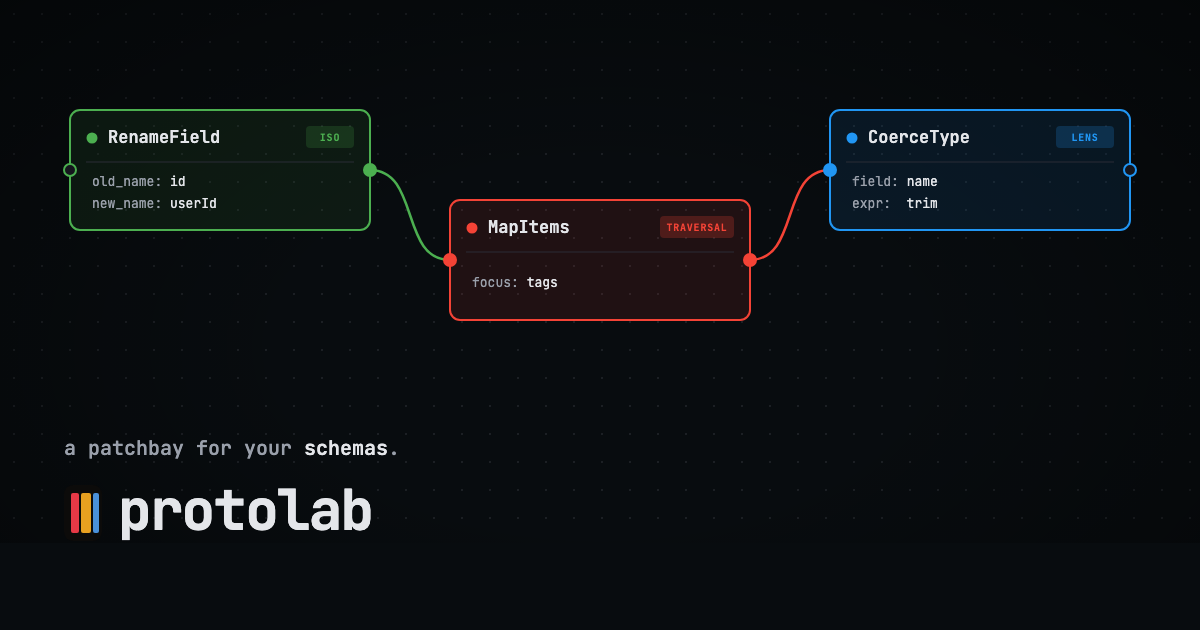
A patchbay for your schemas. Bidirectional data transformations, drawn as circuits.
protolab
A patchbay for your schemas. Bidirectional data transformations, drawn as circuits.
Composing schema mappings: Second-order dependencies to the rescue: ACM Transactions on Database Systems: Vol 30, No 4
A schema mapping is a specification that describes how data structured under one schema (the source schema) is to be transformed into data structured under a different schema (the target schema). A fundamental problem is composing schema mappings: given ...

Algebraic data integration
In this paper, we develop an algebraic approach to data integration by combining techniques from functional programming, category theory, and database theory. In our formalism, database schemas and instances are algebraic (multi-sorted equational) theories of a certain form. Schemas denote categories, and instances denote their initial (term) algebras. The instances on a schema S form a category, S–Inst, and a morphism of schemas F : S → T induces three adjoint data migration functors: ΣF : S–Inst → T–Inst, defined by substitution along F, which has a right adjoint ΔF : T–Inst → S–Inst, which in turn has a right adjoint ΠF : S–Inst → T–Inst. We present a query language based on for/where/return syntax where each query denotes a sequence of data migration functors; a pushout-based design pattern for performing data integration using our formalism; and describe the implementation of our formalism in a tool we call AQL (Algebraic Query Language).
Bidirectional model transformations in QVT: semantic issues and open questions
We consider the OMG’s queries, views and transformations standard as applied to the specification of bidirectional transformations between models. We discuss what is meant by bidirectional transformations, and the model-driven development scenarios in which they are needed. We analyse the fundamental requirements on tools which support such transformations, and discuss some semantic issues which arise. In particular, we show that any transformation language sufficient to the needs of model-driven development would have to be able to express non-bijective transformations. We argue that a considerable amount of basic research is needed before suitable tools will be fully realisable, and suggest directions for this future research.
The operad of wiring diagrams: formalizing a graphical language for databases, recursion, and plug-and-play circuits
Wiring diagrams, as seen in digital circuits, can be nested hierarchically and thus have an aspect of self-similarity. We show that wiring diagrams form the morphisms of an operad $\mcT$, capturing this self-similarity. We discuss the algebra $\Rel$ of mathematical relations on $\mcT$, and in so doing use wiring diagrams as a graphical language with which to structure queries on relational databases. We give the example of circuit diagrams as a special case. We move on to show how plug-and-play devices and also recursion can be formulated in the operadic framework as well. Throughout we include many examples and figures.

Relational foundations for functorial data migration | Proceedings of the 15th Symposium on Database Programming Languages
In this paper we present a simple database definition language: that of categories and functors. A database schema is a small category and an instance is a set-valued functor on it. We show that morphisms of schemas induce three ''data migration ...
panproto/panproto
One engine for schematic version control within and across any schema language.
Functorial data migration
In this paper we present a simple database definition language: that of categories and functors. A database schema is a small category and an instance is a set-valued functor on it. We show that morphisms of schemas induce three “data migration functors”, which translate instances from one schema to the other in canonical ways. These functors parameterize projections, unions, and joins over all tables simultaneously and can be used in place of conjunctive and disjunctive queries. We also show how to connect a database and a functional programming language by introducing a functorial connection between the schema and the category of types for that language. We begin the paper with a multitude of examples to motivate the definitions, and near the end we provide a dictionary whereby one can translate database concepts into category-theoretic concepts and vice versa.
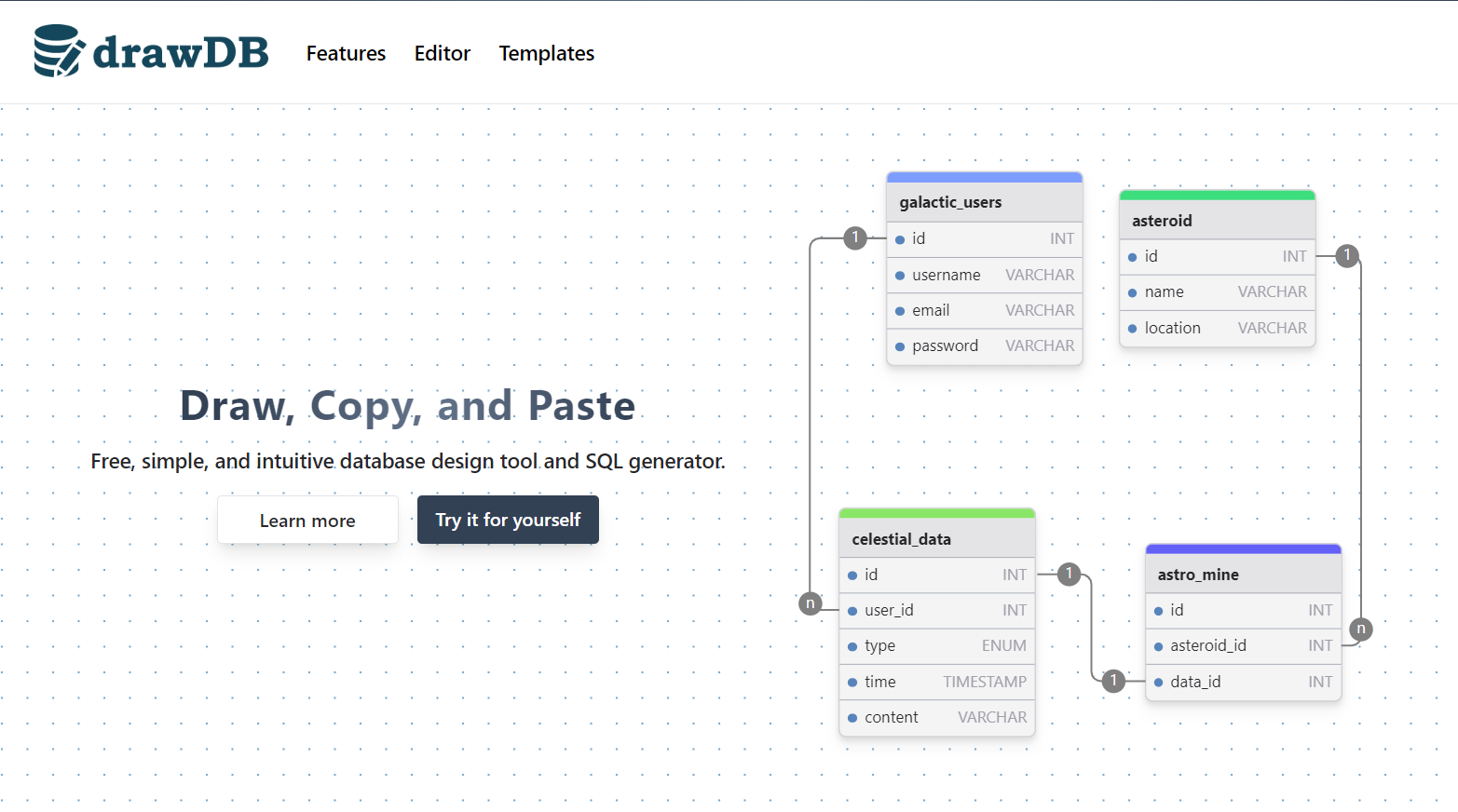
drawDB | Online database diagram editor and SQL generator
Online database entity-relationship diagram editor, data modeler, and SQL generator. Design, visualize, and export scripts without an account and completely free of charge.
Specification of graph translators with triple graph grammars
Data integration is a key issue for any integrated set of software tools. A typical CASE environment, for instance, offers tools for the manipulation of requirements and software design documents, and it provides more or less sophisticated assistance for keeping these documents in a consistent state. Up to now, almost all data consistency observing or preserving integration tools are hand-crafted due to the lack of generic implementation frameworks and the absence of adequate specification formalisms. Triple graph grammars are intended to fill this gap and to support the specification of interdependencies between graph-like data structures on a very high level. Furthermore, they are the fundamentals of a new machinery for the production of batch-oriented as well as incrementally working data integration tools.

Show me the data - Design Notes
Project Cambria: Translate your data with lenses
Changing schemas in distributed software is hard. Could adopting bidirectional lenses help?
Bidirectional Transformations: A Cross-Discipline Perspective
The GRACE International Meeting on Bidirectional Transformations was held in December 2008 near Tokyo, Japan. The meeting brought together researchers and practitioners from a variety of sub-disciplines of computer science to share research efforts and help create a new community. In this report, we survey the state of the art and summarize the technical presentations delivered at the meeting. We also describe some insights gathered from our discussions and introduce a new effort to establish a benchmark for bidirectional transformations.

Panproto

Algebraic structures to morph between data.
idiolect-dev/idiolect

Aaron Steven White (@aaronstevenwhite.io)

Aaron Steven White (@aaronstevenwhite.io)
panproto/panproto
Machine-readable attitudes - Computational Semantics++

Tessa Brown (@tessa.germnetwork.com)