


A magazine of weird, forward-gazing writing.
The revolt of the reader | The Observation Deck
Reading is important to me. While I’m not a quick reader nor an especially voracious one, I have found that long-form reading has had a profound influence on me over my life. And because reading is important to me, writing is too: writing not only allows us to convey our ideas, but the very act forces us to test and distill them — at once making our ideas more robust while providing the vehicle by which to share them.
On Writing #3
Periodically I like to gather various observations about writing, and share my perspective.

Protocolized Writing Workshop
Your chance to race to the frontier of modern AI-forward writing and publishing

The 'Paperwork Flood': How I Drowned a Bureaucrat before dinner., Sightless Scribbles
A fabulously gay blind author.

Manuscript — an imagined editor for research writing
A walk through an imagined product for academic writing, mocked up by Claude Design.
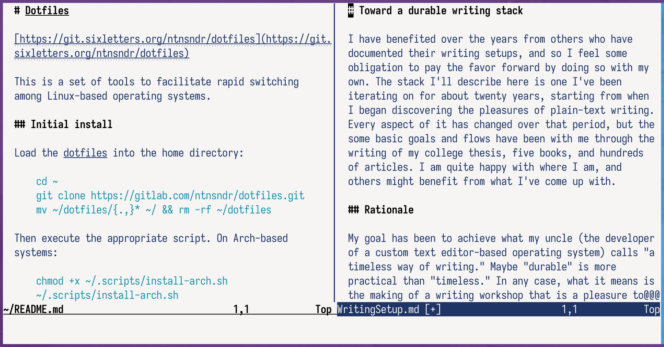
Toward a durable writing stack – Writings and rehearsals by Nathan Schneider
I have benefited over the years from others who have documented their writing setups, and so I feel some obligation to pay the favor forward by doing so with my own. The stack I’ll describe here is one I’ve been iterating on for about twenty years, starting from when I began discovering the pleasures of plain-text writing. Every aspect of it has changed over that period, but the some basic goals and flows have been with me through the writing of my college thesis, five books, and hundreds of articles. I am quite happy with where I am, and others might benefit from what I’ve come up with.
Wanderstop | The Paper Pilot
The Paper Pilot's digital garden of thoughts on philosophy, politics, and sociology
Recursive Summaries | The Paper Pilot
The Paper Pilot's digital garden of thoughts on philosophy, politics, and sociology
The pivot - Charlie's Diary
Back to: Interim update | Forward to: In the eyeball waiting room
What’s Happening to Reading?
For many people, A.I. may be bringing the age of traditional text to an end.

Hardcover
We're a social network for book lovers to find life changing books, track what you read & want to read, and connect with passionate readers.


Standard Reader · blog index
Finally had some time (to attempt) to catch up on reading the articles published on Offprint. Wanted to share a few that were fun reads First article is by @bunniesin.space. They’re exploring the world of atproto and reading their thoughts and confusion on @mu.social’s lex extension was a good read

Some thoughts on extending lexicons
amybunny.offprint.appPersonal Journal Club

Papers papers papers
Cognitive Architectures for Language Agents

Thinking—Fast, Slow, and Artificial: How AI is Reshaping Human Reasoning and the Rise of Cognitive Surrender
Warnings for pattern matching
Retrieval-Augmented Code Generation: A Survey with Focus on Repository-Level Approaches
Lost in the Middle: How Language Models Use Long Contexts
TDOP Pratt
