

From an early age, humans exhibit a tendency to identify, adopt, andenforce the norms of their local communities. Norms are the socialrules that mark out what is appropriate, allowed, required, orforbidden in different situations for various community members. Theserules are informal in the sense that although they are sometimesrepresented in formal laws, like the rule governing which side of theroad to drive on, they need not be explicitly codified to effectivelyinfluence behavior. There are rules that forbid theft or the breakingof promises, but also rules that govern how close it is appropriate tostand to someone while talking to them, or how loud one should talkduring the conversation. Thus understood, norms regulate a wide rangeof activity. They exhibit cultural variability in their prescriptionsand proscriptions, but the presence of norms in general appears to beculturally universal. Some norms exhibit characteristics that areoften associated with morality, such as a rule that applies toeveryone and prohibits causing unnecessary harm. Other norms applyonly to certain people, such as those that delimit appropriateclothing for members of different genders, or those concerning theexpectations and responsibilities ascribed to individuals who occupypositions of leadership. The norms that prevail in a community can bemore or less fair, reasonable, or impartial, and can be subject tocritique and change.
Rethinking Norm Psychology
Norms permeate human life. Most of people’s activities can be characterized by rules about what is appropriate, allowed, required, or forbidden—rules that are crucial in making people hyper-cooperative animals. In this article, I examine the current cognitive-evolutionary account of “norm psychology” and propose an alternative that is better supported by evidence and better placed to promote interdisciplinary dialogue. The incumbent theory focuses on rules and claims that humans genetically inherit cognitive and motivational mechanisms specialized for processing these rules. The cultural-evolutionary alternative defines normativity in relation to behavior—compliance, enforcement, and commentary—and suggests that it depends on implicit and explicit processes. The implicit processes are genetically inherited and domain-general; rather than being specialized for normativity, they do many jobs in many species. The explicit processes are culturally inherited and domain-specific; they are constructed from mentalizing and reasoning by social interaction in childhood. The cultural-evolutionary, or “cognitive gadget,” perspective suggests that people alive today—parents, educators, elders, politicians, lawyers—have more responsibility for sustaining normativity than the nativist view implies. People’s actions not only shape and transmit the rules, but they also create in each new generation mental processes that can grasp the rules and put them into action.

Social Norms
Social norms, the informal rules that govern behavior in groups andsocieties, have been extensively studied in the social sciences.Anthropologists have described how social norms function in differentcultures (Geertz 1973), sociologists have focused on their socialfunctions and how they motivate people to act (Durkheim 1895 [1982],1950 [1957]; Parsons 1937; Parsons & Shils 1951; James Coleman1990; Hechter & Opp 2001), and economists have explored howadherence to norms influences market behavior (Akerlof 1976; Young1998a). More recently, also legal scholars have touted social norms asefficient alternatives to legal rules, as they may internalizenegative externalities and provide signaling mechanisms at little orno cost (Ellickson 1991; Posner 2000).
Norms in the Wild: How to Diagnose, Measure, and Change Social Norms
Abstract. Norms in the Wild takes a unique look at social norms, answering questions about diagnosis (how can we tell that a shared practice is a social no

Children's Acquisition and Application of Norms
All human societies are permeated by collectively shared entities that govern daily social interactions and promote coordination and cooperation: norms. While the study of norm development is not new to developmental psychology, it has only recently been the target of an interdisciplinary wave of research using new methodologies and (often) complementary theoretical accounts to describe and explain the origins and potentially species-unique aspects of human norm psychology. Here we review recent developmental research showing that young children swiftly acquire and infer norms in a variety of social contexts. Moreover, children actively enforce these norms, even as unaffected bystanders, when third parties do things the wrong way. This research suggests that the foundations of human norm psychology can be found in early childhood. Deeper insights into the ontogenetic roots of norm psychology may contribute to understanding the evolutionary emergence of human cooperation and its maintenance in the contemporary world.
Norm Dynamics: Interdisciplinary Perspectives on Social Norm Emergence, Persistence, and Change
Social norms are the glue that holds society together, yet our knowledge of them remains heavily intellectually siloed. This article provides an interdisciplinary review of the emerging field of norm dynamics by integrating research across the social sciences through a cultural-evolutionary lens. After reviewing key distinctions in theory and method, we discuss research on norm psychology—the neural and cognitive underpinnings of social norm learning and acquisition. We then overview how norms emerge and spread through intergenerational transmission, social networks, and group-level ecological and historical factors. Next, we discuss multilevel factors that lead norms to persist, change, or erode over time. We also consider cultural mismatches that can arise when a changing environment leads once-beneficial norms to become maladaptive. Finally, we discuss potential future research directions and the implications of norm dynamics for theory and policy.

Norms: An Integrated Framework
Norms are a foundational concept in sociology. Following a period of skepticism about norms as overly deterministic and as paying too little attention to social conflict, inequalities, and agency, the past 20 years have seen a proliferation of norms research across the social sciences. Here we focus on the burgeoning research in sociology to answer questions about where norms come from, why people enforce them, and how they are applied. To do so, we rely on three key theoretical approaches in the literature—consequentialist, relational, and agentic. As we apply these approaches, we explore their implications for what are arguably the two most fundamental issues in sociology—social order and inequality. We conclude by synthesizing and building on existing norms research to produce an integrated theoretical framework that can shed light on aspects of norms that are currently not well understood—in particular, their change and erosion.

How we learn social norms: a three-stage model for social norm learning
As social animals, humans are unique to make the world function well by developing, maintaining, and enforcing social norms. As a prerequisite among these norm-related processes, learning social norms can act as a basis that helps us quickly coordinate with others, which is beneficial to social inclusion when people enter into a new environment or experience certain sociocultural changes. Given the positive effects of learning social norms on social order and sociocultural adaptability in daily life, there is an urgent need to understand the underlying mechanisms of social norm learning. In this article, we review a set of works regarding social norms and highlight the specificity of social norm learning. We then propose an integrated model of social norm learning containing three stages, i.e., pre-learning, reinforcement learning, and internalization, map a potential brain network in processing social norm learning, and further discuss the potential influencing factors that modulate social norm learning. Finally, we outline a couple of future directions along this line, including theoretical (i.e., societal and individual differences in social norm learning), methodological (i.e., longitudinal research, experimental methods, neuroimaging studies), and practical issues.

Norm theory: Comparing reality to its alternatives.
Discover this 1986 paper in Psychological Review by Kahneman, Daniel; and, Miller, Dale T. focusing on: Attribution; Emotional Responses; Social Norms; Judgment; Models Abstract: Presents a theory of norms and normality and applies the theory to phenomena of emotional responses, social judgment, and conversations about causes. Norms are assumed to be constructed ad hoc by recruiting specific representations. Category norms are derived by recruiting exemplars. Specific objects or events generate their own norms by retrieval of similar experiences stored in memory or by construction of counterfactual alternatives. The normality of a stimulus is evaluated by comparing it with the norms that it evokes after the fact, rather than to precomputed expectations. Norm theory is applied in analyses of the enhanced emotional response to events that have abnormal causes, of the generation of predictions and inferences from observations of behavior, and of the role of norms in causal questions and answers. (3 p ref) (PsycInfo Database Record (c) 2025 APA, all rights reserved)
Metanorms generate stable yet adaptable normative social order in a politically decentralized society
Abstract Norms are essential for social stability but can hinder adaptability in changing environments. Yet human societies have found ways to modify existing norms or create new ones in response to novel challenges. This paper proposes a framework for understanding adaptive norm evolution. First, drawing on a theory of legal order, we posit that societies balance normative stability and adaptability through metanorms—rules that govern the process by which norms are interpreted, changed and enforced. Second, we test this idea in the context of customary dispute resolution by elders among the Turkana, a pastoralist society in Kenya. Based on vignette experiments with 369 participants, we found that community members were significantly more willing to enforce decisions when elders aligned their conduct with metanorms. Elders are constrained in their ability to alter long-standing customs, but by following metanorms, they can create new rules for novel situations. These findings support our proposed mechanism: in the absence of centralized authority, metanorms governing normative institutions allow for adaptive norm change while preserving cultural continuity. We conclude by suggesting that group-level selection acts on cultural variation in metanorms, shaping the evolvability of normative systems and enabling societies to sustain adaptive legal order without coercive centralized power. This article is part of the theme issue ‘Transforming cultural evolution research and its application to global futures’.

The Emergence of Social Norms and Conventions
The utility of our actions frequently depends upon the beliefs and behavior of other agents. Thankfully, through experience, we learn norms and conventions that provide stable expectations for navigating our social world. Here, we review several distinct influences on their content and distribution. At the level of individuals locally interacting in dyads, success depends on rapidly adapting pre-existing norms to the local context. Hence, norms are shaped by complex cognitive processes involved in learning and social reasoning.

How social norms emerge: The interindividual actor–critic.
Spurious normativity enhances learning of compliance and enforcement behavior in artificial agents
Significance The fact that humans enforce and comply with norms is an important reason why humans enjoy higher levels of cooperation and welfare than other animals. Some norms are relatively easy to explain: They may prohibit obviously harmful or uncooperative actions. But many norms are not easy to explain. For example, most cultures prohibit eating certain kinds of foods, and almost all societies have rules about what constitutes appropriate clothing, language, and gestures. Using a computational model focused on learning shows that apparently pointless rules can have an indirect effect on welfare. They can help agents learn how to enforce and comply with norms in general, improving the group’s ability to enforce norms that have a direct effect on welfare. , How do societies learn and maintain social norms? Here we use multiagent reinforcement learning to investigate the learning dynamics of enforcement and compliance behaviors. Artificial agents populate a foraging environment and need to learn to avoid a poisonous berry. Agents learn to avoid eating poisonous berries better when doing so is taboo, meaning the behavior is punished by other agents. The taboo helps overcome a credit assignment problem in discovering delayed health effects. Critically, introducing an additional taboo, which results in punishment for eating a harmless berry, further improves overall returns. This “silly rule” counterintuitively has a positive effect because it gives agents more practice in learning rule enforcement. By probing what individual agents have learned, we demonstrate that normative behavior relies on a sequence of learned skills. Learning rule compliance builds upon prior learning of rule enforcement by other agents. Our results highlight the benefit of employing a multiagent reinforcement learning computational model focused on learning to implement complex actions.

Bayesian Inference of Social Norms as Shared Constraints on Behavior
People act upon their desires, but often, also act in adherence to implicit social norms. How do people infer these unstated social norms from others' behavior, especially in novel social contexts? We propose that laypeople have intuitive theories of social norms as behavioral constraints shared across different agents in the same social context. We formalize inference of norms using a Bayesian Theory of Mind approach, and show that this computational approach provides excellent predictions of how people infer norms in two scenarios. Our results suggest that people separate the influence of norms and individual desires on others' actions, and have implications for modelling generalizations of hidden causes of behavior.

So It Is, So It Shall Be: Group Regularities License Children's Prescriptive Judgments
Abstract When do descriptive regularities (what characteristics individuals have) become prescriptive norms (what characteristics individuals should have)? We examined children's (4–13 years) and adults' use of group regularities to make prescriptive judgments, employing novel groups (Hibbles and Glerks) that engaged in morally neutral behaviors (e.g., eating different kinds of berries). Participants were introduced to conforming or non‐conforming individuals (e.g., a Hibble who ate berries more typical of a Glerk). Children negatively evaluated non‐conformity, with negative evaluations declining with age (Study 1). These effects were replicable across competitive and cooperative intergroup contexts (Study 2) and stemmed from reasoning about group regularities rather than reasoning about individual regularities (Study 3). These data provide new insights into children's group concepts and have important implications for understanding the development of stereotyping and norm enforcement.

Social Chemistry 101: Learning to Reason about Social and Moral Norms
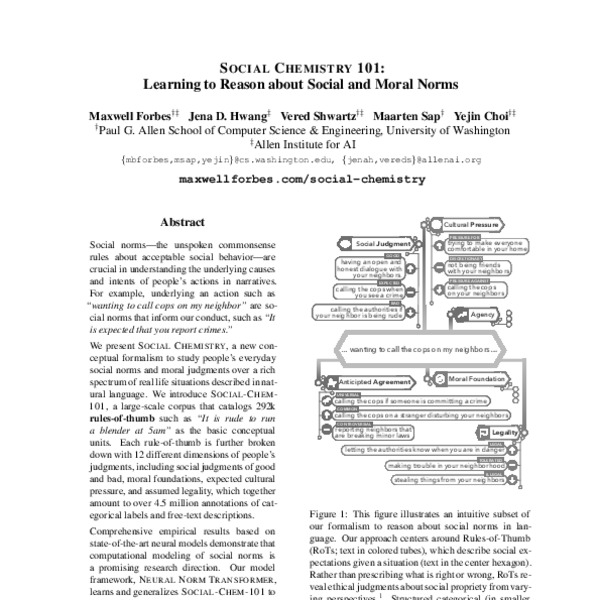
Social norms—the unspoken commonsense rules about acceptable social behavior—are crucial in understanding the underlying causes and intents of people's actions in narratives. For example, underlying an action such as “wanting to call cops on my neighbor” are social norms that inform our conduct, such as “It is expected that you report crimes.” We present SOCIAL CHEMISTRY, a new conceptual formalism to study people's everyday social norms and moral judgments over a rich spectrum of real life situations described in natural language. We introduce SOCIAL-CHEM-101, a large-scale corpus that catalogs 292k rules-of-thumb such as “It is rude to run a blender at 5am” as the basic conceptual units. Each rule-of-thumb is further broken down with 12 different dimensions of people's judgments, including social judgments of good and bad, moral foundations, expected cultural pressure, and assumed legality, which together amount to over 4.5 million annotations of categorical labels and free-text descriptions. Comprehensive empirical results based on state-of-the-art neural models demonstrate that computational modeling of social norms is a promising research direction. Our model framework, Neural Norm Transformer, learns and generalizes SOCIAL-CHEM-101 to successfully reason about previously unseen situations, generating relevant (and potentially novel) attribute-aware social rules-of-thumb.
Social Norms and Cultural Evolution

A collection of ideas to do with social norms, cultural evolution, and how we learn from others

AI as Social Technology: Astor Lecture by Professor Henry Farrell
Bayesian Inference of Social Norms as Shared Constraints on Behavior

What people learn from punishment: A cognitive model
Spurious normativity enhances learning of compliance and enforcement behavior in artificial agents

Deference, Dissent, and Dispute Resolution: An Experimental Intervention Using Mass Media to Change Norms and Behavior in Rwanda
How Does Media Influence Social Norms? Experimental Evidence on the Role of Common Knowledge