

t ATmosphereConf 2026, Victoria Machado de Oliveira (@vicwalker.dev.br) presented on how to attract non-English-speaking users. Her talk was structured aroun…
Experience Localization: What Non-English Communities Actually Need from ATProto - Nightflight
A specification request from the second-largest language community on Bluesky
How Arrival Turned Linguistics Into One of the Most Gripping Dramas of the Year
If you’ve ever been to a foreign country where you don’t speak the language, you know that an inability to communicate can be frustrating, if not a bit

Mitigating Cross-Lingual Cultural Inconsistencies in LLMs via...
Despite their impressive capabilities, multilingual large language models (MLLMs) frequently exhibit inconsistent behaviour when the prompt's language changes. While such adaptation is generally...

Language Access in Healthcare — Discourse Graph
An open, AI-assisted evidence synthesis of how language concordance — matching patients with providers or interpreters who share their language — affects healthcare outcomes. Every question, claim, evidence item, caveat, and source is its own addressable node.

The shrinking landscape of linguistic diversity in the age of large language models
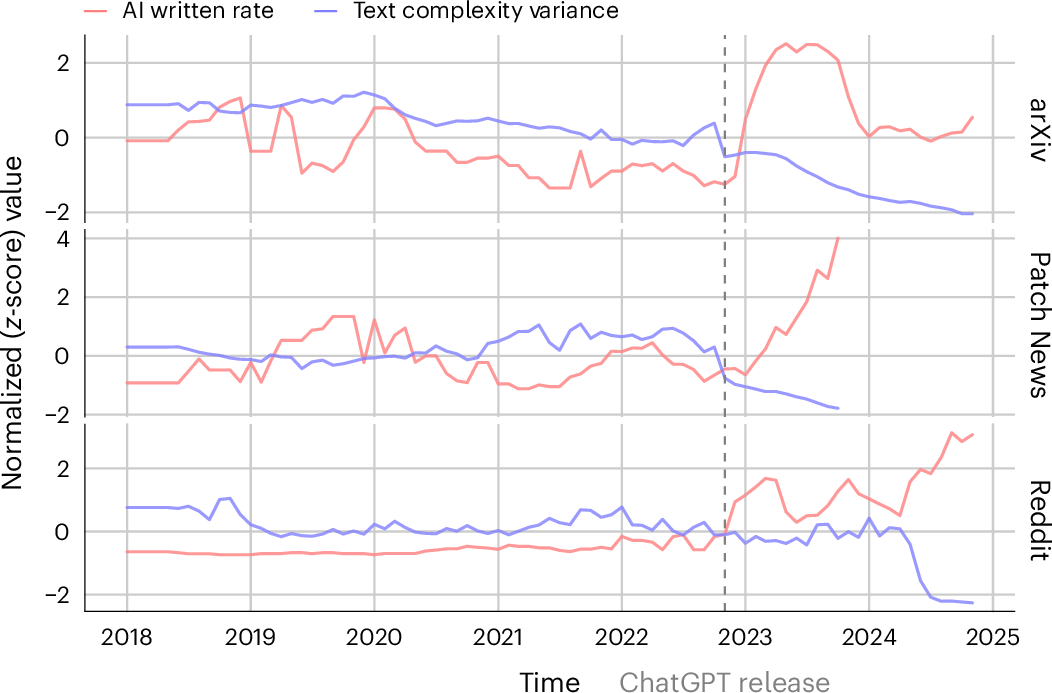
Language is far more than a communication tool; it encodes a wealth of information about a person’s identity, psychological state and social context, providing valuable insights for diverse fields including psychology, marketing and healthcare. Across three studies spanning seven datasets in different domains and over 880,000 texts, we show that the widespread adoption of large language models (LLMs) as writing assistants is linked to declines in linguistic diversity, interfering with the societal and psychological insights language provides. While core content is retained when LLMs polish and rewrite texts, LLMs also homogenize writing styles, reducing writing-complexity variance by a statistically significant 21–50% across datasets and models (P ≤ 0.05), and amplify patterns associated with dominant characteristics while suppressing others, emphasizing conformity over individuality. These trends hold across different LLMs, prompts and contexts, with potential implications for diagnostic processes, personalization efforts, hiring assessments and cultural preservation.
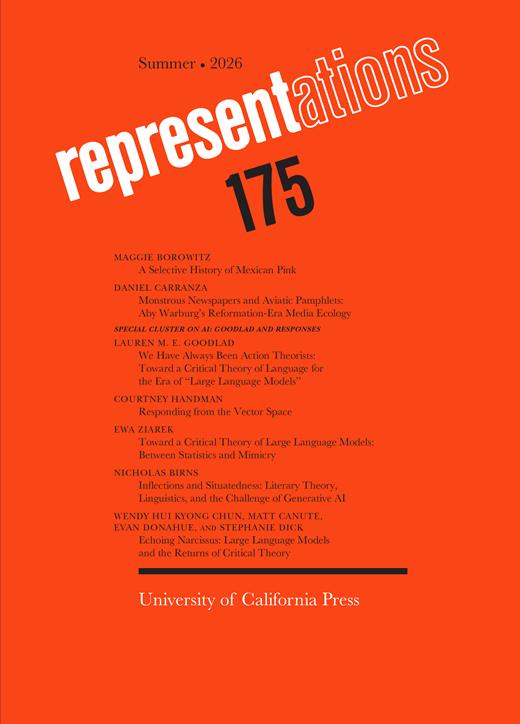
We Have Always Been Action TheoristsToward a Critical Theory of Language for the Era of “Large Language Models”
Scholars of literature and culture understandably place themselves among the world’s premiere experts on matters of language. But they also know that fields like linguistics and communication have their own ways of studying how people express themselves through speech and written media. A key difference concerns the theories and methodologies...
‘Unbelievably dangerous’: experts sound alarm after ChatGPT Health fails to recognise medical emergencies
Study finds ChatGPT Health did not recommend a hospital visit when medically necessary in more than half of cases

Stanford researcher: Hallucinatory ‘voices’ shaped by local culture
Stanford anthropologist Tanya Luhrmann found that voice-hearing experiences of people with serious psychotic disorders are shaped by local culture – in the United States, the voices are harsh and threatening; in Africa and India, they are more benign and playful. This may have clinical implications for how to treat people with schizophrenia, she suggests.

What are these new conversational tools appearing on some stories?
CBC is testing new tools for online conversations as part of the Public Spaces Incubator, an international partnership among six public...
💥 New paper 💥 We discover a form of covert racism in LLMs that is triggered by dialect features alone, with massive harms for affected groups. For example, GPT-4 is more likely to suggest that defendants be sentenced to death when they speak African American English. 🧵
💥 New paper 💥We discover a form of covert racism in LLMs that is triggered by dialect features alone, with massive harms for affected groups.For example, GPT-4 is more likely to suggest that defendants be sentenced to death when they speak African American English.🧵 pic.twitter.com/2sblyxEV0n— Valentin Hofmann (@vjhofmann) March 4, 2024

A few simple tips for better online meetings (COVID-19 edition)
One of the implications of the COVID-19 virus (Coronavirus Disease) has been that many in-person events and meetings are getting cancelled…

If caring solved i18n, it would already be solved. Part two of a cognitive linguist's response to #ATmosphereConf — this time to @vicwalker.dev.br . Three cases, three misdiagnoses. plurality.leaflet.pub/3mit3ebov6s25

The Clinic: Three Cases from the Other Side of i18n - Nightflight
plurality.leaflet.pubFull essay below. Written at @bmann.ca 's prompting in the Discourse thread — language barriers keeping atproto's non-English implementations out of the design conversation. night-terrace.offprint.app/a/3mlxygoehwd23-three-layers-…

Three Layers of Post Editing in atproto: A Case for History-Preserving Design | Nighthaven⛺︎ | Offprint
night-terrace.offprint.appto my i18n experts, is there a type out there that I can use in my lexicons? I want to be language friendly, but alas am ignorant!

Common "langs" type?
discourse.atmosphere.communityExperience Localization: what non-English communities need from ATProto. A spec request from Bluesky's second-largest language community. Five asks for @alexbenzer.com's Discover team. Responds to @vicwalker.dev.br and @signez.fr at #ATmosphereConf. plurality.leaflet.pub/3mhunxn7y3s22 $ATOPR ▰▰▰▰▱

Experience Localization: What Non-English Communities Actually Need from ATProto - Nightflight
plurality.leaflet.pubOn Sunday, March 29, I will be hosting a Panel and Discussion at #AtmosphereConf about "How to have more non-english speaking users". Check more details here: atmo.rsvp/p/atmosphereconf.org/e/WOkL11… For those who can't be in-person in Vancouver, it will be streamed through Streamplace too!

How to have more non-english speaking users
atmo.rsvp

