


Citizen science can be a powerful approach to foster the successful implementation of technological innovations in health, care or well-being. Involving experience experts as co-researchers or co-designers of technological innovations facilitates mutual learning, community building, and empowerment. By utilizing the expert knowledge of the intended users, innovations have a better chance to get adopted and solve complex health-related problems. As citizen science is still a relatively new practice for health and well-being, little is known about effective methods and guidelines for successful collaboration. This scoping review aims to provide insight in (1) the levels of citizen involvement in current research on technological innovations for health, care or well-being, (2) the used participatory methodologies, and (3) lesson’s learned by the researchers., A scoping review was conducted and reported in accordance with the PRISMA-ScR guidelines. The search was performed in SCOPUS in January 2021 and included peer-reviewed journal and conference papers published between 2016 and 2020. The final selection (N = 83) was limited to empirical studies that had a clear focus on technological innovations for health, care or well-being and involved citizens at the level of collaboration or higher. Our results show a growing interest in citizens science as an inclusive research approach. Citizens are predominantly involved in the design phase of innovations and less in the preparation, data-analyses or reporting phase. Eight records had citizens in the lead in one of the research phases., Researcher use different terms to describe their methodological approach including participatory design, co-design, community based participatory research, co-creation, public and patient involvement, partcipatory action research, user-centred design and citizen science. Our selection of cases shows that succesful citizen science projects develop a structural and longitudinal partnership with their collaborators, use a situated and adaptive research approach, and have researchers that are willing to abandon traditional power dynamics and engage in a mutual learning experience.
Peer Production in Citizen Science: A Community-Centered Approach on the Example of Personal Science
Citizen science encompasses a wide range of practices where online collaboration for knowledge production plays a significant role. However, the study of forms of online collaboration other than crowdsourcing in citizen science has remained largely unexplored. This thesis aims to fill this gap by investigating peer production as a form of collaboration in online citizen science communities of practice. First, peer production theory was operationalized as a working model and used to analyze collaboration in citizen science case studies. This was followed by a comprehensive participatory design process for a specific use case involving the personal science community of practice. This process resulted in the creation of the “Personal Science Wiki”, an online space for consolidating community knowledge through peer production. Subsequently, a usability and card sorting study identified and resolved issues with the wiki implementation, and provided insights into mental models and content requirements regarding self-research knowledge. The lessons learned from the participatory design process were generalized as process recommendations for designing peer production solutions and knowledge management systems with communities of practice.
Combining Social Science and Environmental Health Research for Community Engagement
Social science-environmental health (SS-EH) research takes many structural forms and contributes to a wide variety of topical areas. In this article we discuss the general nature of SS-EH contributions and offer a new typology of SS-EH practice that situates this type of research in a larger transdisciplinary sensibility: (1) environmental health science influenced by social science; (2) social science studies of environmental health; and (3) social science-environmental health collaborations. We describe examples from our own and others’ work and we discuss the central role that research centers, training programs, and conferences play in furthering SS-EH research. We argue that the third form of SS-EH research, SS-EH collaborations, offers the greatest potential for improving public and environmental health, though such collaborations come with important challenges and demand constant reflexivity on the part of researchers.

Civic, Citizen and Grassroots Science: Towards a Transformative Scientific Research Model | Request PDF
Request PDF | On Jan 1, 2013, Jessica McCallum Breen and others published Civic, Citizen and Grassroots Science: Towards a Transformative Scientific Research Model | Find, read and cite all the research you need on ResearchGate

Civic Health Project
Technology can connect or divide us. At Civic Health Project, we're dedicated to advancing massively scalable solutions to society's dangerous divisions.
Why Do We Call It Participatory Science? | Smithsonian Environmental Research Center
Implementation of Digital Monitoring Services During the COVID-19 Pandemic for Patients With Chronic Diseases: Design Science Approach
Background: The COVID-19 pandemic is straining health systems and disrupting the delivery of health care services, in particular, for older adults and people with chronic conditions, who are particularly vulnerable to COVID-19 infection. Objective: The aim of this project was to support primary health care provision with a digital health platform that will allow primary care physicians and nurses to remotely manage the care of patients with chronic diseases or COVID-19 infections. Methods: For the rapid design and implementation of a digital platform to support primary health care services, we followed the Design Science implementation framework: (1) problem identification and motivation, (2) definition of the objectives aligned with goal-oriented care, (3) artefact design and development based on Scrum, (4) solution demonstration, (5) evaluation, and (6) communication. Results: The digital platform was developed for the specific objectives of the project and successfully piloted in 3 primary health care centers in the Lisbon Health Region. Health professionals (n=53) were able to remotely manage their first patients safely and thoroughly, with high degrees of satisfaction. Conclusions: Although still in the first steps of implementation, its positive uptake, by both health care providers and patients, is a promising result. There were several limitations including the low number of participating health care units. Further research is planned to deploy the platform to many more primary health care centers and evaluate the impact on patient’s health related outcomes.

How can citizen science reduce psychological distance to science? Insights from three projects in contested environmental contexts
Citizen science (CS) is a participatory mode of knowledge production, enabling non-scientific actors to contribute to and sometimes contest scientific agendas and interpretations, making it a way to bridge science and society. This paper examines how that potential unfolds by analysing the individual perspectives of citizen scientists through the lens of Psychological Distance to Science (PSYDISC). Drawing on three case studies of contested environmental CS, we identify which contextual aspects of CS shape citizen scientists' experiences of social, spatial, temporal, or hypothetical distance to relevant science, and how these experiences may relate to trust. Our findings underscore the role of science communication as both a channel for dissemination, and as a constitutive element of participatory research; crucial for reducing psychological distance and enabling socially robust knowledge production, especially in contested, policy-relevant science settings.
Crowdsourced Health Research Studies: An Important Emerging Complement to Clinical Trials in the Public Health Research Ecosystem
Background: Crowdsourced health research studies are the nexus of three contemporary trends: 1) citizen science (non-professionally trained individuals conducting science-related activities); 2) crowdsourcing (use of web-based technologies to recruit project participants); and 3) medicine 2.0 / health 2.0 (active participation of individuals in their health care particularly using web 2.0 technologies). Crowdsourced health research studies have arisen as a natural extension of the activities of health social networks (online health interest communities), and can be researcher-organized or participant-organized. In the last few years, professional researchers have been crowdsourcing cohorts from health social networks for the conduct of traditional studies. Participants have also begun to organize their own research studies through health social networks and health collaboration communities created especially for the purpose of self-experimentation and the investigation of health-related concerns. Objective: The objective of this analysis is to undertake a comprehensive narrative review of crowdsourced health research studies. This review will assess the status, impact, and prospects of crowdsourced health research studies. Methods: Crowdsourced health research studies were identified through a search of literature published from 2000 to 2011 and informal interviews conducted 2008-2011. Keyword terms related to crowdsourcing were sought in Medline/PubMed. Papers that presented results from human health studies that included crowdsourced populations were selected for inclusion. Crowdsourced health research studies not published in the scientific literature were identified by attending industry conferences and events, interviewing attendees, and reviewing related websites. Results: Participatory health is a growing area with individuals using health social networks, crowdsourced studies, smartphone health applications, and personal health records to achieve positive outcomes for a variety of health conditions. PatientsLikeMe and 23andMe are the leading operators of researcher-organized, crowdsourced health research studies. These operators have published findings in the areas of disease research, drug response, user experience in crowdsourced studies, and genetic association. Quantified Self, Genomera, and DIYgenomics are communities of participant-organized health research studies where individuals conduct self-experimentation and group studies. Crowdsourced health research studies have a diversity of intended outcomes and levels of scientific rigor. Conclusions: Participatory health initiatives are becoming part of the public health ecosystem and their rapid growth is facilitated by Internet and social networking influences. Large-scale parameter-stratified cohorts have potential to facilitate a next-generation understanding of disease and drug response. Not only is the large size of crowdsourced cohorts an asset to medical discovery, too is the near-immediate speed at which medical findings might be tested and applied. Participatory health initiatives are expanding the scope of medicine from a traditional focus on disease cure to a personalized preventive approach. Crowdsourced health research studies are a promising complement and extension to traditional clinical trials as a model for the conduct of health research.

Connecting Research with Community - Civic Innovation Lab
Welcome to Civic Innovation Lab, where we drive social impact through collaborative solutions and empower communities. Join us in fostering sustainable development, co-creating initiatives, and advancing inclusive governance for a better future.

Consumer Entrapment
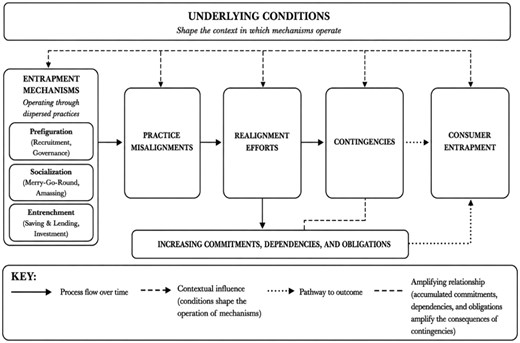
Abstract Why do consumers sometimes remain trapped in the very practices and communities that once helped them? Consumer practice research has largely emphasized the enabling outcomes of sustained practice participation, with less attention given to how those same practices can become entrapping. This article explores how consumer entrapment emerges within interconnected collective practices. Drawing on an ethnographic study of Chama, a community-based savings and support group in Kenya, it integrates practice theory with Hodder’s theory of entanglement. The study identifies three mechanisms (prefiguration, socialization, and entrenchment) through which participation generates commitments, dependencies, and obligations that produce recurring practice misalignments. Consumers continually work to realign these misalignments, yet under specific conditions, these efforts reproduce the contingencies that sustain participation while progressively deepening entrapment. The findings reveal a central tension: efforts to restore practice alignment can sustain what consumers value while simultaneously reproducing the interdependencies through which consumer entrapment emerges.
How public involvement can improve the science of AI
As AI systems from decision-making algorithms to generative AI are deployed more widely, computer scientists and social scientists alike are being called on to provide trustworthy quantitative evaluations of AI safety and reliability. These calls have included demands from affected parties to be given a seat at the table of AI evaluation. What, if anything, can public involvement add to the science of AI? In this perspective, we summarize the sociotechnical challenge of evaluating AI systems, which often adapt to multiple layers of social context that shape their outcomes. We then offer guidance for improving the science of AI by engaging lived-experience experts in the design, data collection, and interpretation of scientific evaluations. This article reviews common models of public engagement in AI research alongside common concerns about participatory methods, including questions about generalizable knowledge, subjectivity, reliability, and practical logistics. To address these questions, we summarize the literature on participatory science, discuss case studies from AI in healthcare, and share our own experience evaluating AI in areas from policing systems to social media algorithms. Overall, we describe five parts of any quantitative evaluation where public participation can improve the science of AI: equipoise, explanation, measurement, inference, and interpretation. We conclude with reflections on the role that participatory science can play in trustworthy AI by supporting trustworthy science.

An introduction to radical participatory design: decolonising participatory design processes
Outside of community-led design projects, most participatory design processes initiated by a company or organisation maintain or even strengthen power imbalances between the design organisation and the community on whose purported behalf they are designing, further increasing the absencing experience. Radical participatory design (RPD) is a radically relational answer to the coloniality inherent in participatory design where the community members’ disappointment is greater due to the greater expectations and presencing potential of a ‘participatory design’ process. We introduce the term RPD to show how research and design processes can be truly participatory to the root or core. Instead of treating participatory design as a method, a way of conducting a method, or a methodology, we introduce RPD as a meta-methodology, a way of doing any methodology. We explicitly describe what participation means and compare and contrast design processes based on the amount of participation, creating a typology of participation. We introduce ‘designer as community member’, ‘community member as designer,’ and ‘community member as facilitator’ models and provide characteristics for the meta-methodology of RPD.

An introduction to radical participatory design: decolonising participatory design processes
Outside of community-led design projects, most participatory design processes initiated by a company or organisation maintain or even strengthen power imbalances between the design organisation and the community on whose purported behalf they are designing, further increasing the absencing experience. Radical participatory design (RPD) is a radically relational answer to the coloniality inherent in participatory design where the community members’ disappointment is greater due to the greater expectations and presencing potential of a ‘participatory design’ process. We introduce the term RPD to show how research and design processes can be truly participatory to the root or core. Instead of treating participatory design as a method, a way of conducting a method, or a methodology, we introduce RPD as a meta-methodology, a way of doing any methodology. We explicitly describe what participation means and compare and contrast design processes based on the amount of participation, creating a typology of participation. We introduce ‘designer as community member’, ‘community member as designer,’ and ‘community member as facilitator’ models and provide characteristics for the meta-methodology of RPD.
New Project to Tackle the Challenge of Scaling Democratic Innovations | CoP CC on Participatory and Deliberative Democracy
The “Missing Link” between Research and Society
Co-creation process of an app for people with rare diseases - a citizen science approach
Background Rare diseases affect a small percentage of the population, leading to challenges such as delayed diagnoses and limited treatment options. Mobile health technologies offer solutions to improve patient outcomes, yet their application in rare diseases remains underexplored. The German citizen science project SelEe created a customizable app for the self-management of rare diseases through a co-creation process that involved patients with such conditions. Methods The project consisted of three phases. In Phase 1, 9 to 68 patients or relatives of patients participated in workshops to define research topics and app requirements. Phase 2 involved a core research team of nine patients and researchers who iteratively developed the app, released in March 2023. Phase 3 focused on evaluating the app’s usage and usability through an in-app survey conducted from March 2023 to February 2024. We utilized descriptive statistics to evaluate app usage and employed the mHealth App Usability Questionnaire to assess usability. Results The SelEe app offers the possibility to create and store data in a personalized health diary. Patients can create their own templates or use templates which were defined by the core research team. Users can record findings (e.g. blood test results) and export data using different graphs and formats. Furthermore, the app supports blind users. The app was downloaded 3040 times and 1456 users registered, with 1967 unique diseases entered. 50.7% of the diseases were rare, 30.5% non-rare, and 18.8% were classified as suspected, undefined, or symptoms. A total of 1223 valid user profiles were analyzed for app usage and demographics. Furthermore, 432 users qualified for the in-app survey by making at least one health diary entry, and 117 participated. The app was rated with an overall usability score of 5.19 out of 7. While the app’s health diary function was frequently used, other functionalities like findings and data export were less utilized. Feedback highlighted the need for improved usability and additional features. Conclusions The study highlights active patient engagement in developing a mobile health app for individuals with rare diseases. Although improvements are necessary for broader acceptance, the app is promising for the management of rare diseases. Supplementary information The online version contains supplementary material available at 10.1186/s13023-025-04140-1.
Cool example of participatory research from The Long Haul. Different from many citizen science projects where scientists bring the questions, in the Appalachian land study people chose the question, learned the method, did the work, and found answers to problems that mattered to their community

Ronen Tamari
Weekend reading: "Long Haul" by Myles Horton, have a feeling it's going to be a real banger. (on the Highlander Folk School for social change) highlandercenter.org/product/the-long-haul-an-auto…