


Membrane protrusion at the leading edge of migrating cells is driven by the polymerization of actin. Recent studies using advanced imaging techniques raised a lively controversy about the morphology of these filaments; however, common ground between the two sides now appears to have been found. Here we discuss how the controversy has led to a deeper consideration of the architecture of actin networks underlying cell migration, and has helped define new challenges that lie ahead.
Summary of "Improvising to cellular playgrounds in Realtalk", Aug 2023
The evolving concept of cell identity in the single cell era
Summary: This Spotlight explores emerging technologies that are enabling the systematic and unbiased quantification of cell identity, and how these efforts will enable the construction of high-resolution, dynamic cell atlases.

PTI-125 Reduces Biomarkers of Alzheimer’s Disease in Patients
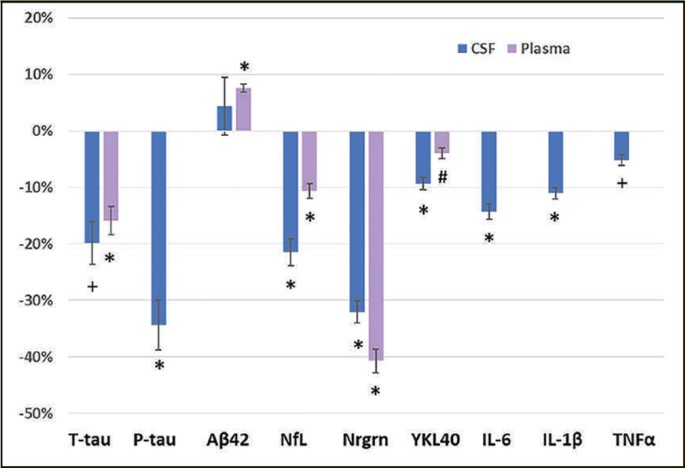
The most common dementia worldwide, Alzheimer’s disease is often diagnosed via biomarkers in cerebrospinal fluid, including reduced levels of Aβ1-42, and increases in total tau and phosphorylated tau-181. Here we describe results of a Phase 2a study of a promising new drug candidate that significantly reversed all measured biomarkers of Alzheimer’s disease, neurodegeneration and neuroinflammation. PTI-125 is an oral small molecule drug candidate that binds and reverses an altered conformation of the scaffolding protein filamin A found in Alzheimer’s disease brain. Altered filamin A links to the α7-nicotinic acetylcholine receptor to allow Aβ42’s toxic signaling through this receptor to hyperphosphorylate tau. Altered filamin A also links to toll-like receptor 4 to enable Aβ-induced persistent activation of this receptor and inflammatory cytokine release. Restoring the native shape of filamin A prevents or reverses filamin A’s linkages to the α7-nicotinic acetylcholine receptor and tolllike receptor 4, thereby blocking Aβ42’s activation of these receptors. The result is reduced tau hyperphosphorylation and neuroinflammation, with multiple functional improvements demonstrated in transgenic mice and postmortem Alzheimer’s disease brain.
For the First Time, a Cell Built From Scratch Grows and Divides | Quanta Magazine
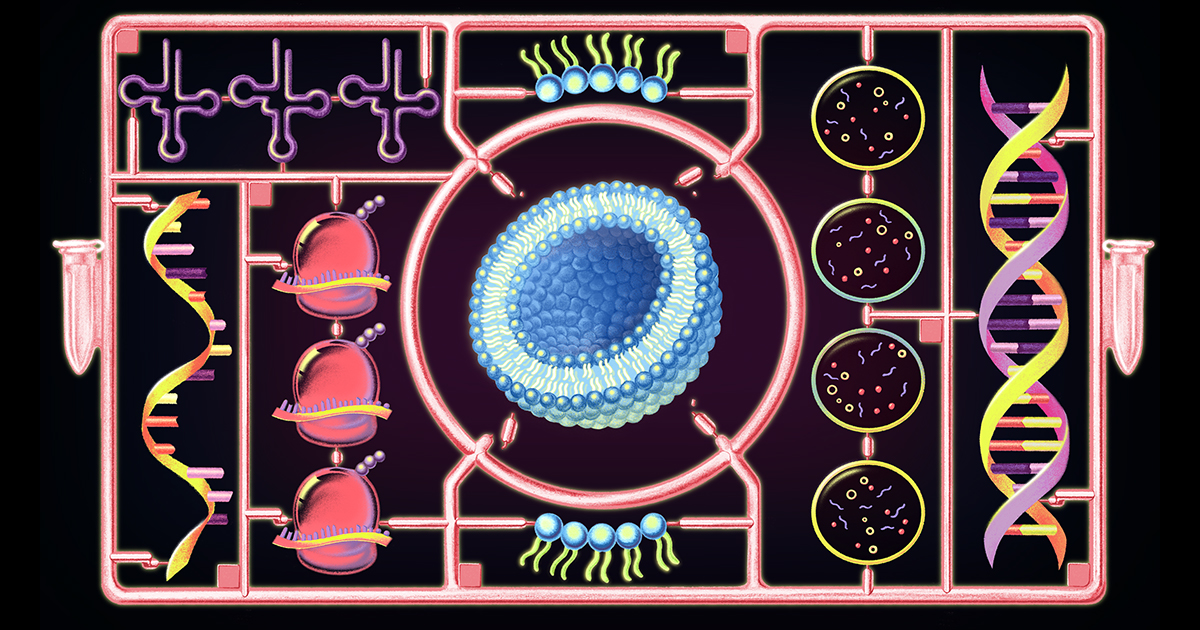
Scientists built a synthetic cell that combines more lifelike properties than ever before — proof of concept that it’s possible to bring nonliving materials to life, or something close to it, in the lab.
For the First Time, a Cell Built From Scratch Grows and Divides | Quanta Magazine
Scientists built a synthetic cell that combines more lifelike properties than ever before — proof of concept that it’s possible to bring nonliving materials to life, or something close to it, in the lab.
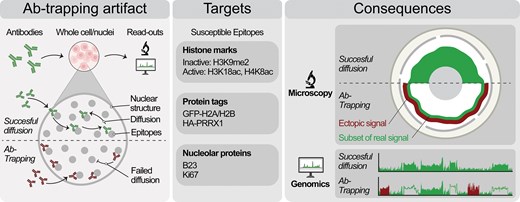
Antibody-trapping presents a widespread pitfall for microscopy and genomics in the nucleus
Abstract. Chromatin has a complex 3D structure and diverse binding proteins that coordinate the genome’s most essential functions. Many microscopy and geno
The Role of Osteocytes in Targeted Bone Remodeling: A Mathematical Model
Until recently many studies of bone remodeling at the cellular level have focused on the behavior of mature osteoblasts and osteoclasts, and their respective precursor cells, with the role of osteocytes and bone lining cells left largely unexplored. This is particularly true with respect to the mathematical modeling of bone remodeling. However, there is increasing evidence that osteocytes play important roles in the cycle of targeted bone remodeling, in serving as a significant source of RANKL to support osteoclastogenesis, and in secreting the bone formation inhibitor sclerostin. Moreover, there is also increasing interest in sclerostin, an osteocyte-secreted bone formation inhibitor, and its role in regulating local response to changes in the bone microenvironment. Here we develop a cell population model of bone remodeling that includes the role of osteocytes, sclerostin, and allows for the possibility of RANKL expression by osteocyte cell populations. We have aimed to give a simple, yet still tractable, model that remains faithful to the underlying system based on the known literature. This model extends and complements many of the existing mathematical models for bone remodeling, but can be used to explore aspects of the process of bone remodeling that were previously beyond the scope of prior modeling work. Through numerical simulations we demonstrate that our model can be used to explore theoretically many of the qualitative features of the role of osteocytes in bone biology as presented in recent literature.
The cell membrane as the ‘missing link’ for the evolution of consciousness
While Prof. Torday agrees with Federico Faggin that quantum mechanics is salient to consciousness, he maintains that the role of the cell membrane—which separates an organism from its environment—is key to the selective assimilation or mirroring of the quantum properties of the cosmos into the differentiated consciousness of the organism. This essay is short, dense, and may be difficult to unpack. But it handsomely rewards the effort of the patient and determined reader. The many literature citations in the essay also provide rich ground for further exploration.

Steering yourself by the bootstraps: how cells create their own gradients for chemotaxis
Chemotaxis, where cell movement is steered by chemical gradients, is a widespread and essential way of organising cell behaviour. But where do the instructions come from – who makes gradients, and how are they controlled? We discuss the emerging concept that chemotactic cells often create attractant gradients at the same time as responding to them. This self-guidance is more robust, works across greater distances, and is more informative about the local environment than passive responses. Several mechanisms can establish autonomous gradients.

Arthropod exoskeleton
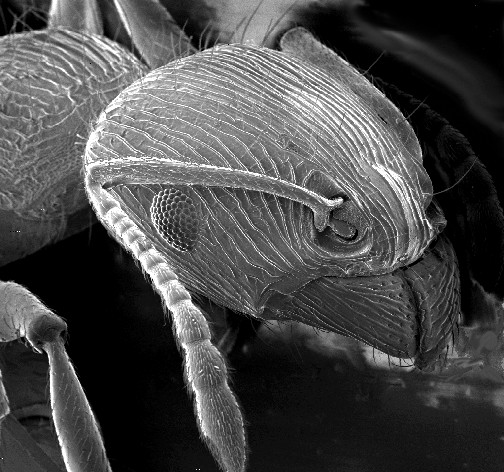
Arthropods are covered with a tough, resilient integument, cuticle or exoskeleton of chitin. Generally the exoskeleton will have thickened areas in which the chitin is reinforced or stiffened by materials such as minerals or hardened proteins. This happens in parts of the body where there is a need for rigidity or elasticity. Typically the mineral crystals, mainly calcium carbonate, are deposited among the chitin and protein molecules in a process called biomineralization. The crystals and fibres interpenetrate and reinforce each other, the minerals supplying the hardness and resistance to compression, while the chitin supplies the tensile strength. Biomineralization occurs mainly in crustaceans. In insects and arachnids, the main reinforcing materials are various proteins hardened by linking the fibres in processes called sclerotisation and the hardened proteins are called sclerotin. The dorsal tergum, ventral sternum, and the lateral pleura form the hardened plates or sclerites of a typical body segment.
Temporal tissue dynamics from a spatial snapshot
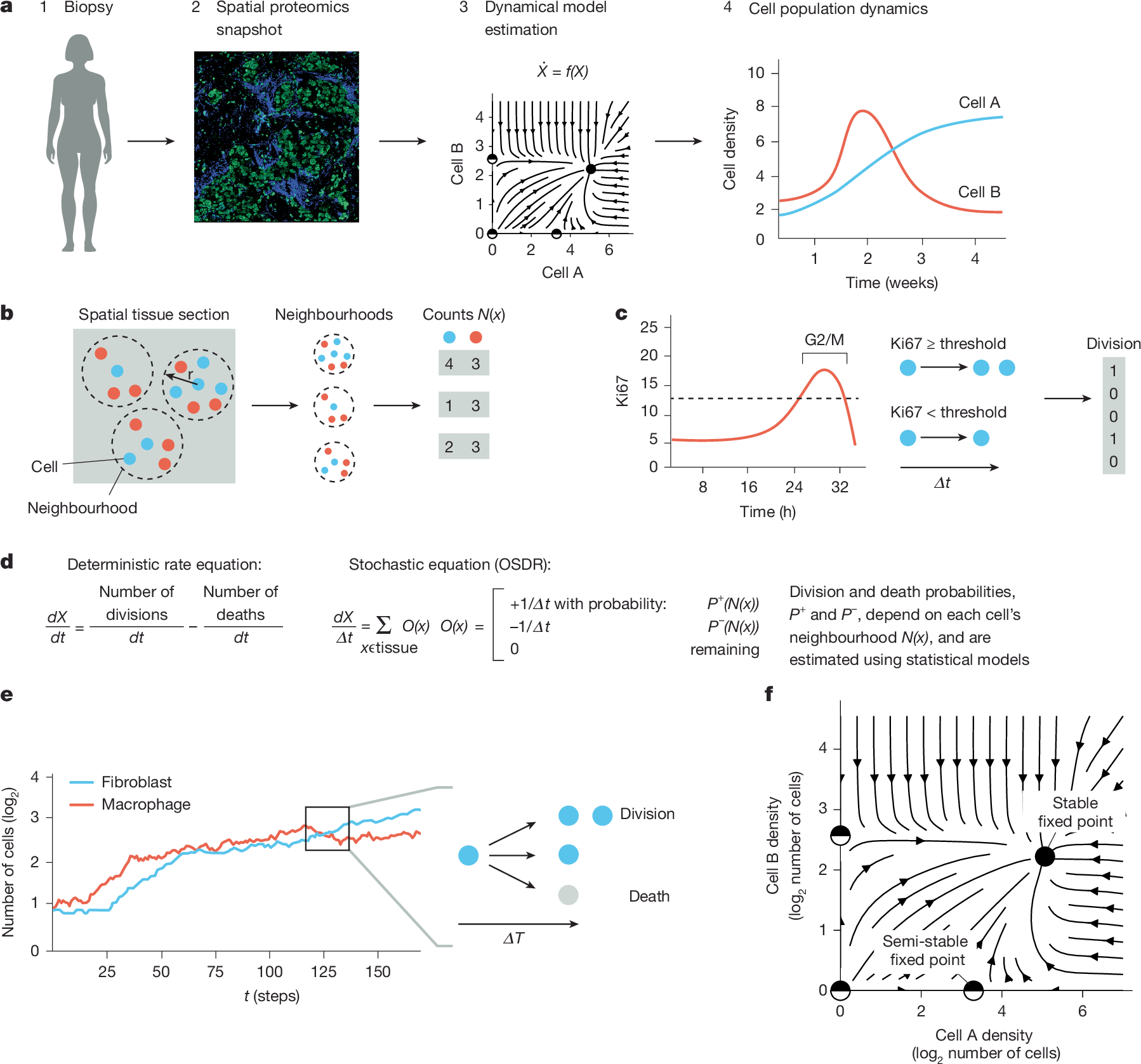
Physiological and pathological processes such as inflammation and cancer emerge from interactions between cells over time1. However, methods to follow cell populations over time within the native context of a human tissue are lacking because a biopsy offers only a single snapshot. Here we present one-shot tissue dynamics reconstruction (OSDR), an approach to estimate a dynamical model of cell populations based on a single tissue sample. OSDR uses spatial proteomics to learn how the composition of cellular neighbourhoods influences division rate, providing a dynamical model of cell population change over time. We apply OSDR to human breast cancer data2–4, and reconstruct two fixed points of fibroblasts and macrophage interactions5,6. These fixed points correspond to hot and cold fibrosis7, in agreement with co-culture experiments that measured these dynamics directly8. We then use OSDR to discover a pulse-generating excitable circuit of T and B cells in the tumour microenvironment, suggesting temporal flares of anticancer immune responses. Finally, we study longitudinal biopsies from a triple-negative breast cancer clinical trial3, in which OSDR predicts the collapse of the tumour cell population in responders but not in non-responders, based on early-treatment biopsies. OSDR can be applied to a wide range of spatial proteomics assays to enable analysis of tissue dynamics based on patient biopsies.
Quantifying cell-state densities in single-cell phenotypic landscapes using Mellon
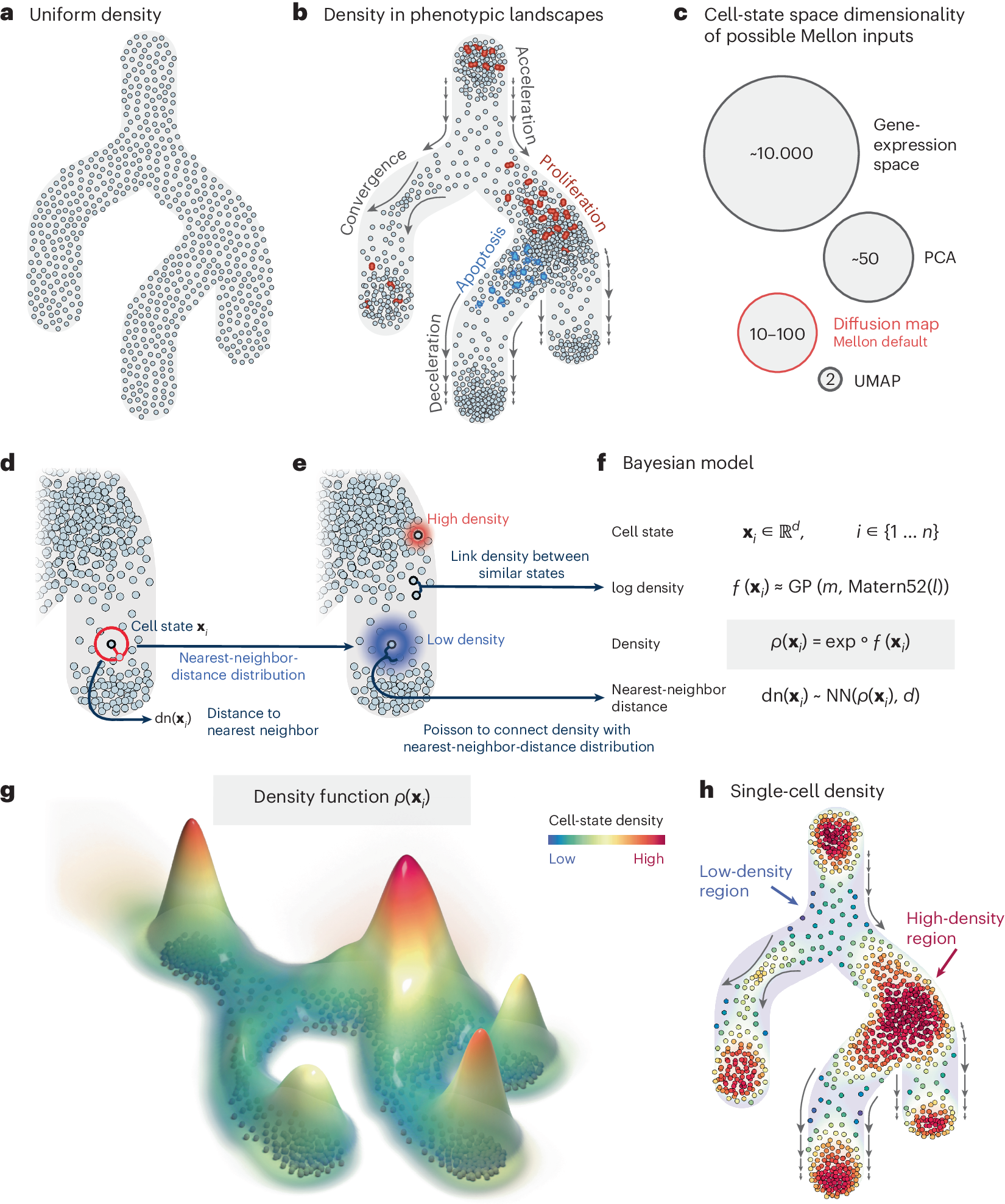
Cell-state density characterizes the distribution of cells along phenotypic landscapes and is crucial for unraveling the mechanisms that drive diverse biological processes. Here, we present Mellon, an algorithm for estimation of cell-state densities from high-dimensional representations of single-cell data. We demonstrate Mellon’s efficacy by dissecting the density landscape of differentiating systems, revealing a consistent pattern of high-density regions corresponding to major cell types intertwined with low-density, rare transitory states. We present evidence implicating enhancer priming and the activation of master regulators in emergence of these transitory states. Mellon offers the flexibility to perform temporal interpolation of time-series data, providing a detailed view of cell-state dynamics during developmental processes. Mellon facilitates density estimation across various single-cell data modalities, scaling linearly with the number of cells. Our work underscores the importance of cell-state density in understanding the differentiation processes, and the potential of Mellon to provide insights into mechanisms guiding biological trajectories.
Bone remodeling: A tissue-level process emerging from cell-level molecular algorithms
The human skeleton undergoes constant remodeling throughout the lifetime. Processes occurring on microscopic and molecular scales degrade bone and replace it with new, fully functional tissue. Multiple bone remodeling events occur simultaneously, continuously and independently throughout the body, so that the entire skeleton is completely renewed about every ten years.Bone remodeling is performed by groups of cells called Bone Multicellular Units (BMU). BMUs consist of different cell types, some specialized in the resorption of old bone, others encharged with producing new bone to replace the former. These processes are tightly regulated so that the amount of new bone produced is in perfect equilibrium with that of old bone removed, thus maintaining bone microscopic structure.To date, many regulatory molecules involved in bone remodeling have been identified, but the precise mechanism of BMU operation remains to be fully elucidated. Given the complexity of the signaling pathways already known, one may question whether such complexity is an inherent requirement of the process or whether some subset of the multiple constituents could fulfill the essential role, leaving functional redundancy to serve an alternative safety role. We propose in this work a minimal model of BMU function that involves a limited number of signals able to account for fully functional BMU operation. Our main assumptions were i) at any given time, any cell within a BMU can select only one among a limited choice of decisions, i.e. divide, die, migrate or differentiate, ii) this decision is irreversibly determined by depletion of an appropriate internal inhibitor and iii) the dynamics of any such inhibitor are coupled to that of specific external mediators, such as hormones, cytokines, growth factors. It was thus shown that efficient BMU operation manifests as an emergent process, which results from the individual and collective decisions taken by cells within the BMU unit in the absence of any external planning.
Foaming photopolymers as a high-resolution biomimetic printing platform
Nature creates a diverse range of foam-like materials, from bones to banana peels, through a rich orchestration of physical and biochemical processes across hierarchical length scales1. Here, we introduce deep-foam photolithography, a spatially controlled, light-induced foaming process in which a photosensitized polymer film is exposed to deeply penetrating UV-A light, which initiates the production of both scission and crosslinked polymers throughout the depth of the film. Hypotonically driven case II permeation2 of a weak solvent triggers pore nucleation, expansion and a controllable viscoelastic collapse to create foams through a localized solubilization of polymer fragments within a crosslinked network. The resemblance to amorphous structural whites in nature enables inkless printing in white and greyscale; the resolution is high enough (about 20,000 dots per inch) to generate diffractive colour. This uniquely allows the printing of mechanically expanded and collapsed foams with high aspect ratios (20×); controlled collapse creates hierarchically rough surfaces with lotus-like super-hydrophobicity. Deep-foam photolithography is applied to both films and fibres, using a range of amorphous and semi-crystalline polymeric materials. Patterning μm-level spatial differences in foamability, wettability, optical properties and local thickness enables high-resolution printing, microfluidics and picolitre capture of liquids and colloidal matter.

Foaming photopolymers as a high-resolution biomimetic printing platform
Nature creates a diverse range of foam-like materials, from bones to banana peels, through a rich orchestration of physical and biochemical processes across hierarchical length scales1. Here, we introduce deep-foam photolithography, a spatially controlled, light-induced foaming process in which a photosensitized polymer film is exposed to deeply penetrating UV-A light, which initiates the production of both scission and crosslinked polymers throughout the depth of the film. Hypotonically driven case II permeation2 of a weak solvent triggers pore nucleation, expansion and a controllable viscoelastic collapse to create foams through a localized solubilization of polymer fragments within a crosslinked network. The resemblance to amorphous structural whites in nature enables inkless printing in white and greyscale; the resolution is high enough (about 20,000 dots per inch) to generate diffractive colour. This uniquely allows the printing of mechanically expanded and collapsed foams with high aspect ratios (20×); controlled collapse creates hierarchically rough surfaces with lotus-like super-hydrophobicity. Deep-foam photolithography is applied to both films and fibres, using a range of amorphous and semi-crystalline polymeric materials. Patterning μm-level spatial differences in foamability, wettability, optical properties and local thickness enables high-resolution printing, microfluidics and picolitre capture of liquids and colloidal matter.
Open-source software reveals complete 3D architecture of brain cells
The neurons in our brain that underlie thought connect to each other using tiny branch-like structures on their surfaces known as dendritic spines. Now scientists at Columbia's Zuckerman Institute and ...
