

Trees, maps, and theorems
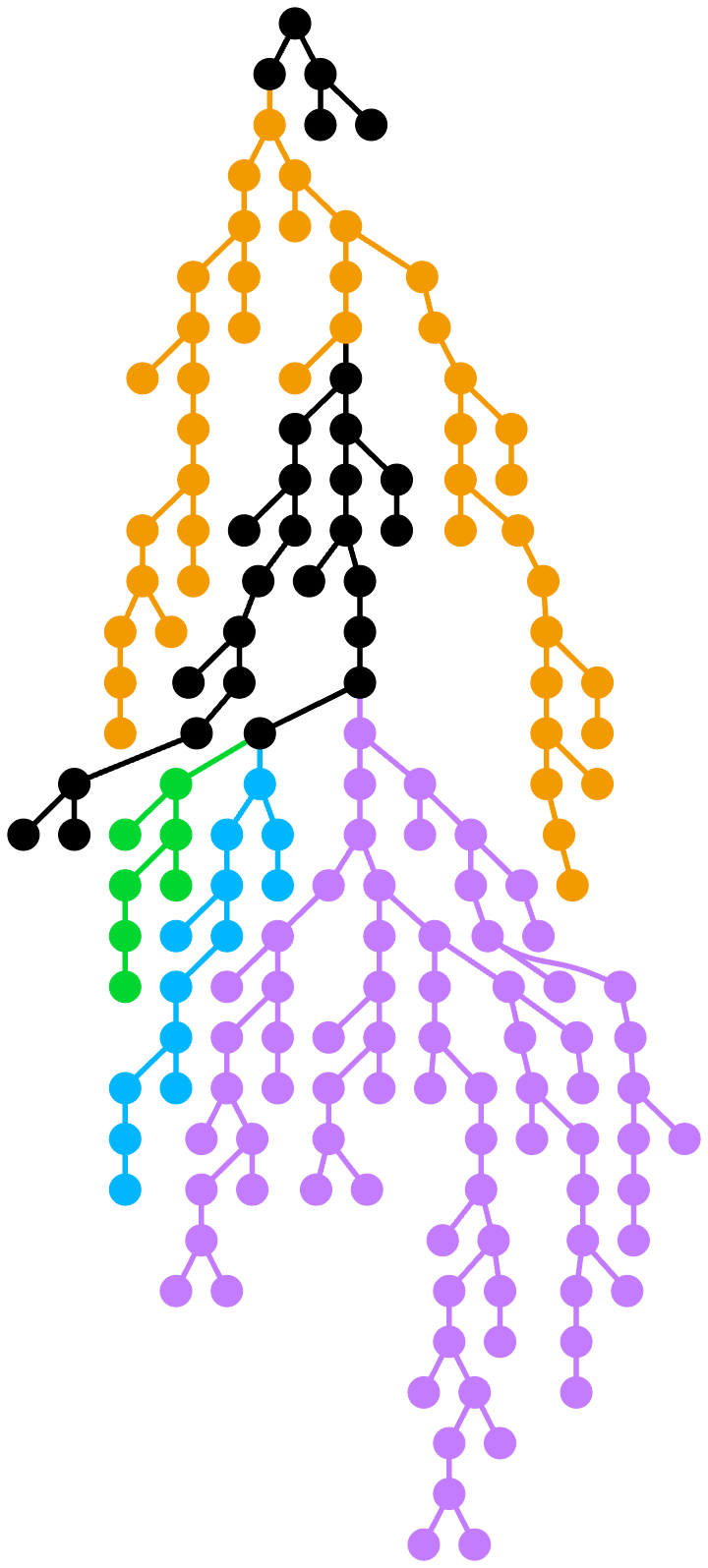
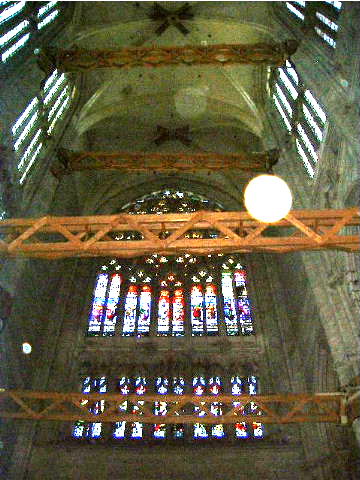
Most arguments scatter across papers, posts, and threads — and evaporate. A claim tree gives them a stable structure to gather against, the way a cathedral gathers centuries of work into a single, standing thing.
Combinators for bidirectional tree transformations: A linguistic approach to the view-update problem: ACM Transactions on Programming Languages and Systems: Vol 29, No 3
We propose a novel approach to the view-update problem for tree-structured data: a domain-specific programming language in which all expressions denote bidirectional transformations on trees. In one direction, these transformations---dubbed lenses---map ...

The operad of wiring diagrams: formalizing a graphical language for databases, recursion, and plug-and-play circuits
Wiring diagrams, as seen in digital circuits, can be nested hierarchically and thus have an aspect of self-similarity. We show that wiring diagrams form the morphisms of an operad $\mcT$, capturing this self-similarity. We discuss the algebra $\Rel$ of mathematical relations on $\mcT$, and in so doing use wiring diagrams as a graphical language with which to structure queries on relational databases. We give the example of circuit diagrams as a special case. We move on to show how plug-and-play devices and also recursion can be formulated in the operadic framework as well. Throughout we include many examples and figures.

Functorial data migration
In this paper we present a simple database definition language: that of categories and functors. A database schema is a small category and an instance is a set-valued functor on it. We show that morphisms of schemas induce three “data migration functors”, which translate instances from one schema to the other in canonical ways. These functors parameterize projections, unions, and joins over all tables simultaneously and can be used in place of conjunctive and disjunctive queries. We also show how to connect a database and a functional programming language by introducing a functorial connection between the schema and the category of types for that language. We begin the paper with a multitude of examples to motivate the definitions, and near the end we provide a dictionary whereby one can translate database concepts into category-theoretic concepts and vice versa.
Category Theory Illustrated - index
What does a debate between two ancient Greek philosophers have to do with the code running your computer? How can a simple map reveal the deepest secrets of the universe’s structure?
Fruits - Graph All The Things
Fruits - Graph All The Things, a math blog by Martin Loncaric
Relational foundations for functorial data migration | Proceedings of the 15th Symposium on Database Programming Languages
In this paper we present a simple database definition language: that of categories and functors. A database schema is a small category and an instance is a set-valued functor on it. We show that morphisms of schemas induce three ''data migration ...
Categorical Data Structures for Technical Computing
Many mathematical objects can be represented as functors from finitely-presented categories $\mathsf{C}$ to $\mathsf{Set}$. For instance, graphs are functors to $\mathsf{Set}$ from the category with two parallel arrows. Such functors are known informally as $\mathsf{C}$-sets. In this paper, we describe and implement an extension of $\mathsf{C}$-sets having data attributes with fixed types, such as graphs with labeled vertices or real-valued edge weights. We call such structures "acsets," short for "attributed $\mathsf{C}$-sets." Derived from previous work on algebraic databases, acsets are a joint generalization of graphs and data frames. They also encompass more elaborate graph-like objects such as wiring diagrams and Petri nets with rate constants. We develop the mathematical theory of acsets and then describe a generic implementation in the Julia programming language, which uses advanced language features to achieve performance comparable with specialized data structures.

Basic Category Theory
This short introductory category theory textbook is for readers with relatively little mathematical background (e.g. the first half of an undergraduate mathematics degree). At its heart is the concept of a universal property, important throughout mathematics. After a chapter introducing the basic definitions, separate chapters present three ways of expressing universal properties: via adjoint functors, representable functors, and limits. A final chapter ties the three together. For each new categorical concept, a generous supply of examples is provided, taken from different parts of mathematics. At points where the leap in abstraction is particularly great (such as the Yoneda lemma), the reader will find careful and extensive explanations.
Generic deriving of generic traversals | Proceedings of the ACM on Programming Languages
Functional programmers have an established tradition of using traversals as a design pattern to work with recursive data structures. The technique is so prolific that a whole host of libraries have been designed to help in the task of automatically ...

Formalizing 100 Theorems
There is a "top 100" of mathematical theorems on the web, which is a rather arbitrary list (and most of the theorems seem rather elementary), but still is nice to look at. On the current page I keep track of which theorems from this list have been formalized. Currently the fraction that already has been formalized seems to be
Homotopy Type Theory: Univalent Foundations of Mathematics
Homotopy type theory is a new branch of mathematics, based on a recently discovered connection between homotopy theory and type theory, which brings new ideas into the very foundation of mathematics. On the one hand, Voevodsky's subtle and beautiful "univalence axiom" implies that isomorphic structures can be identified. On the other hand, "higher inductive types" provide direct, logical descriptions of some of the basic spaces and constructions of homotopy theory. Both are impossible to capture directly in classical set-theoretic foundations, but when combined in homotopy type theory, they permit an entirely new kind of "logic of homotopy types". This suggests a new conception of foundations of mathematics, with intrinsic homotopical content, an "invariant" conception of the objects of mathematics -- and convenient machine implementations, which can serve as a practical aid to the working mathematician. This book is intended as a first systematic exposition of the basics of the resulting "Univalent Foundations" program, and a collection of examples of this new style of reasoning -- but without requiring the reader to know or learn any formal logic, or to use any computer proof assistant.
Categories for the Working Mathematician
Categories for the Working Mathematician provides an array of general ideas useful in a wide variety of fields. Starting from the foundations, this book illuminates the concepts of category, functor, natural transformation, and duality. The book then turns to adjoint functors, which provide a description of universal constructions, an analysis of the representations of functors by sets of morphisms, and a means of manipulating direct and inverse limits. These categorical concepts are extensively illustrated in the remaining chapters, which include many applications of the basic existence theorem for adjoint functors. The categories of algebraic systems are constructed from certain adjoint-like data and characterized by Beck's theorem. After considering a variety of applications, the book continues with the construction and exploitation of Kan extensions. This second edition includes a number of revisions and additions, including two new chapters on topics of active interest. One is onsymmetric monoidal categories and braided monoidal categories and the coherence theorems for them. The second describes 2-categories and the higher dimensional categories which have recently come into prominence. The bibliography has also been expanded to cover some of the many other recent advances concerning categories.
Category Theory for Programmers: The Preface
Table of Contents Part One Category: The Essence of Composition Types and Functions Categories Great and Small Kleisli Categories Products and Coproducts Simple Algebraic Data Types Functors Functo…
eLife Claim Trees — eLife Claim Trees
Panel-level claim graphs for reproducibility — eLife Claim Trees