


Exploring how AI impacts human judgments and decisions.
The Impact of Artificial Intelligence on Human Thought
This research paper examines, from a multidimensional perspective (cognitive, social, ethical, and philosophical), how AI is transforming human thought. It highlights a cognitive offloading effect: the externalization of mental functions to AI can reduce intellectual engagement and weaken critical thinking. On the social level, algorithmic personalization creates filter bubbles that limit the diversity of opinions and can lead to the homogenization of thought and polarization. This research also describes the mechanisms of algorithmic manipulation (exploitation of cognitive biases, automated disinformation, etc.) that amplify AI's power of influence. Finally, the question of potential artificial consciousness is discussed, along with its ethical implications. The report as a whole underscores the risks that AI poses to human intellectual autonomy and creativity, while proposing avenues (education, transparency, governance) to align AI development with the interests of humanity.

Thinking—Fast, Slow, and Artificial: How AI is Reshaping Human Reasoning and the Rise of Cognitive Surrender
People increasingly consult generative artificial intelligence (AI) while reasoning. As AI becomes embedded in daily thought, what becomes of human judgment? We

Study: Sycophantic AI can undermine human judgment
Subjects who interacted with AI tools were more likely to think they were right, less likely to resolve conflicts.

AI co-scientists are revolutionizing how research is done
Artificial-intelligence systems can generate hypotheses, design experiments and analyse data — but humans still need to decide what makes sense.

AI Behavioral Science
We outline a foundation for a new field of ``AI Behavioral Science,'' covering three perspectives. First, as AI becomes ubiquitous and is increasingly proprietary and opaque, it becomes vital to develop techniques for assessing AI behavior. We outline how tools developed to assess people's behaviors by social scientists can be used to assess and infer AI's behaviors biases, tendencies, and heuristics. Second, we also discuss how AI can change the ways in which we learn about human behavior. Beyond its computational power, AI offers new techniques for simulating, inferring, and predicting human behaviors that we outline and discuss. Third, as humans and AI are interacting in increasingly complex and intertwined systems, we need to understand the implications for the resulting economic and political outcomes. We outline issues that are increasingly pressing concerning the future of human-AI interactions and potential changes and disruptions that can ensue.
Dario Amodei — Machines of Loving Grace
How AI Could Transform the World for the Better

Dario Amodei — Machines of Loving Grace
How AI Could Transform the World for the Better
AI FOR EPISTEMICS & COORDINATION
Civilization and technology have radically improved the human condition. Nonetheless, the world sometimes goes in directions which essentially nobody would prefer — e.g., nuclear arms races, unexpected financial crashes, predatory marketing, or ubiquitous political misinformation.
Human perspectives on AI · Global Voices
This GV Spotlight edition will explore how the use of, promotion of, and resistance to artificial intelligence is playing out for the Global Majority.

Human scientists trounce the best AI agents on complex tasks
State-of-the-industry report finds that, despite the limitations of artificial-intelligence systems, researchers have embraced them.
More Than a Tool
What We Learned from a Year of Conversations About AI
The social consequences of AI delegation
A substantial body of recent work has debated whether large language models (LLMs) can serve as substitutes for human participants in behavioural research. This debate, however, captures only one direction of a rapidly changing relationship. The more consequential question is not simply whether researchers should use LLMs as human surrogates, but whether - and under what conditions - humans are beginning to use LLMs as surrogates for their own deliberation. Across domains including health, law, finance, education, and personal guidance, increasing numbers of people consult generative AI systems before, alongside, or instead of human experts, peers, or independent judgment. Although evidence for actual delegation remains uneven, this uncertainty makes the phenomenon an urgent social-scientific object of study. We argue for a research programme that treats LLMs as consequential social actors in a functional sense: systems whose outputs shape human decisions, social norms, and collective dynamics.
AI Behavioral Science: A Framework and Agenda
We discuss the challenges and opportunities present in the rapidly emerging area of “AI Behavioral Science.” We frame it via three subfields. First, as AI becomes ubiquitous and is increasingly proprietary and opaque, it becomes vital to develop models of AI and methods for assessing AI behavior. We outline how tools developed to assess people’s behaviors by social scientists can be used to model, assess and infer AI’s behaviors biases, tendencies, and heuristics. Second, we also discuss how AI can change the ways in which we learn about human behavior. Beyond its computational power, AI offers new techniques for simulating, inferring, predicting, and analyzing human behaviors. Third, as humans and AI are interacting in increasingly complex and intertwined systems, we need to analyze and model human-AI interactions including how human and AI behaviors depend on interactions at the individual level, how interacting systems of humans and AI behave, and ultimately how AI’s integration into society affects economic and political outcomes. We discuss current research, questions, agendas, and goals in each of these three subfields and how they depend upon each other.
After AI Takes Everything | Airing
Prompted by letters from three engineers, the author asks what remains for humans as AI takes over execution, naming judgment, taste, and derivation as irreplaceable, and warns against the erosion of subjecthood.
AI Predictions, Big and Small

A compilation of ideas and writing where there is some prediction of the future so that we can look back one day and compare.
AI Tools for Academic Research
Survey Shield
Scimeto - Automated Manuscript Integrity Checker
jusi-aalto/strategic-revision
The Metacheck Manual
Getting Started with Claude Code: A Researcher’s Setup Guide

RegCheck

Mustafa Suleyman: My new Turing test would see if AI can make $1 million
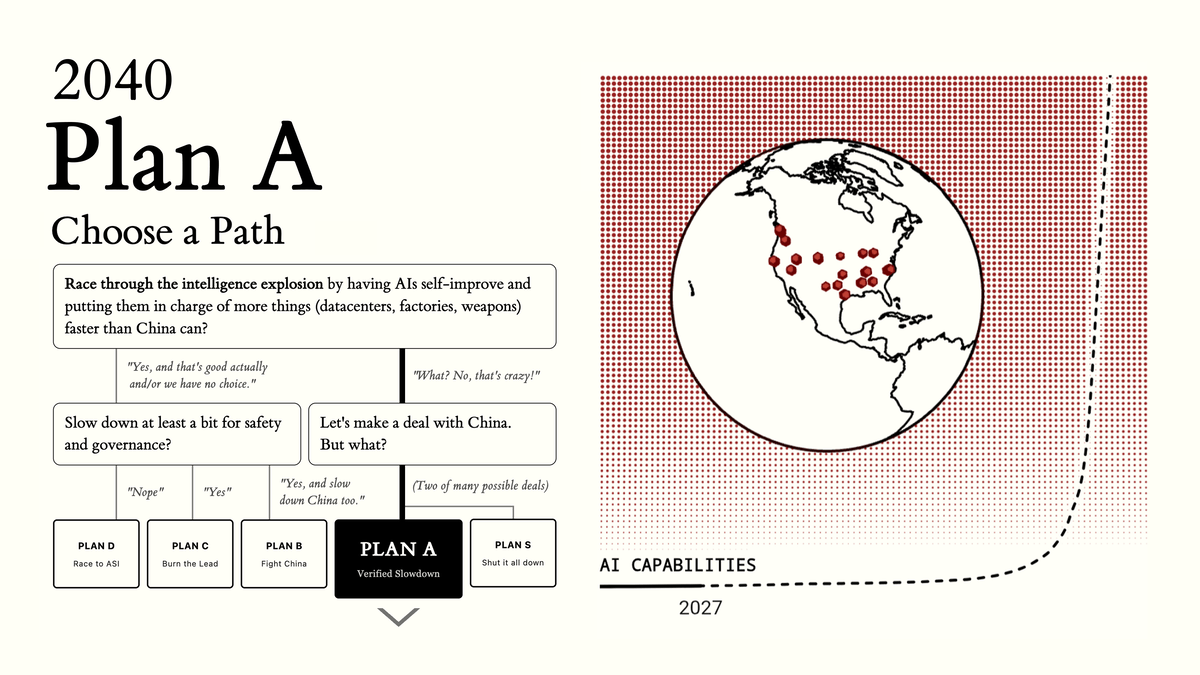
AI 2040: Plan A
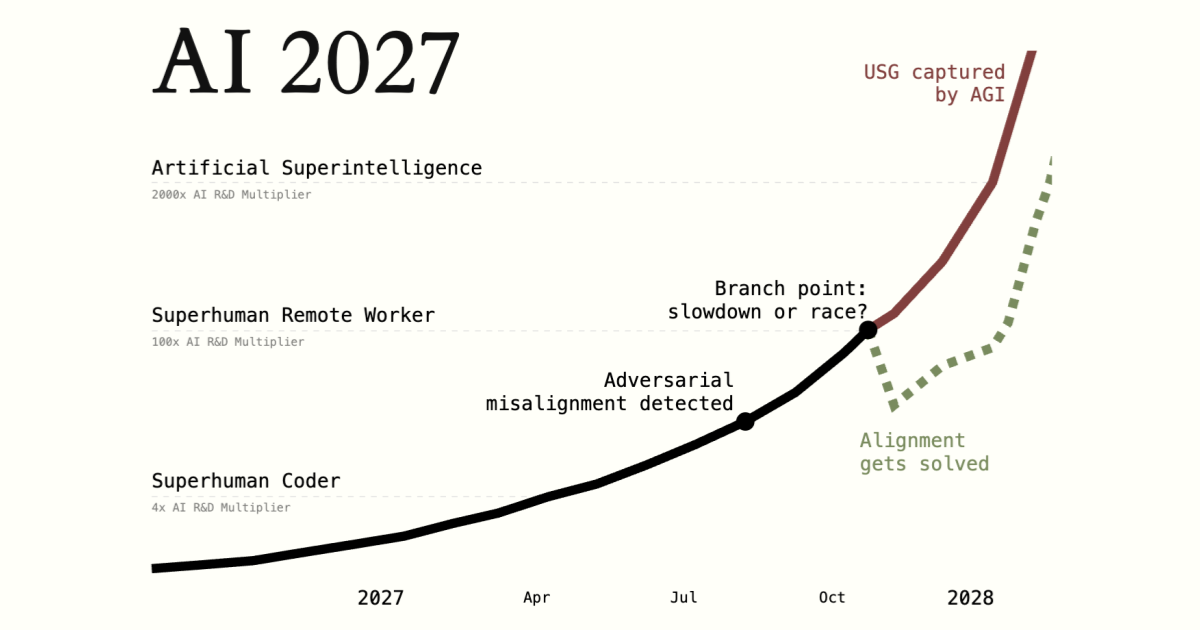
AI 2027
Dean W. Ball on Twitter / X
Dean W. Ball on Twitter / X

OpenAI drops a bomb on maths