


2025-0915_OP-MiniWS-r4.pdf
Tony Feng on Twitter / X
I am a mathematician but I avoided commenting on this because the problems are (far) outside my domain. Even if I sat down to read the technical details (which I have not), it would be hard to appreciate the context of prior work, etc. But I've gotten enough sense of things… https://t.co/VZzosBYFto— Tony Feng (@tonylfeng) August 5, 2026
Volume 384 Issue 2320 | Philosophical Transactions of the Royal Society A | The Royal Society
Influential themed journal issues across the physical mathematical and engineering sciences.

Donald MacKenzie · AI’s Scale
AI’s scale doesn’t matter just to specialists. The rest of us are being taken on a ride along the logarithmic curve...

Dylan Wiliam on Twitter / X
The best journal article titles tell you what the study actually found, rather than being a teaser to make you read the paper. Here's a good example: "Spaced mathematics practice improves test scores and reduces overconfidence" https://t.co/iXxdkAgYPM ($)— Dylan Wiliam (@dylanwiliam) December 31, 2024

Joao Pereira's Twitter Thread | Xunroll
I do not understand why we are all piling on one paper. Is there anything obviously wrong with it, aside from personal views on length? Any data anomalies ...

Complete Works (1977–2024) — Hirsch Argument Atlas
This atlas maps the complete argument of E.D. Hirsch Jr. across 10 books spanning 1977 to 2024. Every claim is extracted, every piece of evidence tracked, and every counter-argument surfaced. A separate layer of external scholarly research provides independent context.
Thoughtful and relevant outside math. A partial summary: Gowers thinks it’s important to sustain a human mathematical culture, but is unconvinced by the Leiden Declaration’s attempt to do that by reaffirming human ownership of specific *discoveries*.

tachikoma
an interesting blog post by Timothy Gowers on the Leiden declaration (on AI and Math), on why he didn't sign. it gets to a subtler aspect of control over AI and our future.
Interesting footnote on math arXiv arxiv.org/abs/2608.16066v1
James then uses probably the biggest overinflator here: papermills. Papermills are like a bogeyman of #ScientificPublishing. Today, if you want to raise alarm about a paper (or besmirch someone you don't like, it really goes both ways), you can just claim the study comes from a papermill /22
math complex systems

papers added probably have a bio connection or implication i made

Unless you have skipped a lot of school, or work, or both – or you live in the USA – you have probably used an A4 sheet of paper before now. Have you ever wondered …

Quantifying causal emergence shows that macro can beat micro | PNAS
Personal Journal Club

Papers papers papers
Cognitive Architectures for Language Agents

Thinking—Fast, Slow, and Artificial: How AI is Reshaping Human Reasoning and the Rise of Cognitive Surrender
Warnings for pattern matching
Retrieval-Augmented Code Generation: A Survey with Focus on Repository-Level Approaches
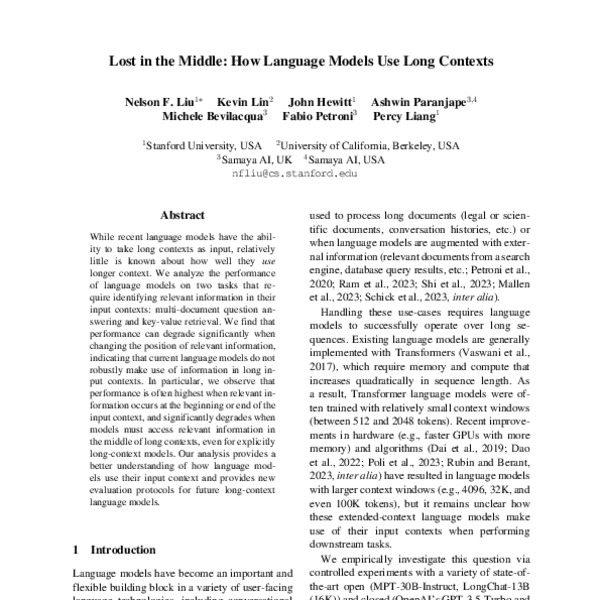
Lost in the Middle: How Language Models Use Long Contexts
TDOP Pratt


