

Physics has not been a materialist science for decades. Empiricism displaced materialism. Yet, there is this "rational" culture that seems strongly tied to capitalist growth models, that pretends it is the inheritor of a hegemonic physical reality of materialism. Largely born in the post WW2 era. Here are collected the significant, growing but largely ignored evidence showing that human experential reality is significantly of biological inheritance, quite independent of external "matter"
Economics for the future – Beyond the superorganism
Our environment and economy are at a crossroads. This paper attempts a cohesive narrative on how human evolved behavior, money, energy, economy and th…
About — Every Object an Archive
We interview people about their experiences with technological objects that were once everywhere, but are now being replaced or redesigned. We are interested in the physical experience of living with these objects, their handfeel and relationships to our bodies. We are also interested in how they shaped our habits, relationships, and ways of being. Technologies are more than physical objects: whole worlds of infrastructure, process, policy and culture are built around them.

Degrowth can work — here’s how science can help
Wealthy countries can create prosperity while using less materials and energy if they abandon economic growth as an objective.

The Social Construction of Facts and Artefacts: or How the Sociology of Science and the Sociology of Technology might Benefit Each Other
The need for an integrated social constructivist approach towards the study of science and technology is outlined. Within such a programme both scientific facts and technological artefacts are to be understood as social constructs. Literature on the sociology of science, the science-technology relationship, and technology studies is reviewed. The empirical programme of relativism within the sociology of scientific knowledge and a recent study of the social construction of technological artefacts are combined to produce the new approach. The concepts of `interpretative flexibility' and `closure mechanism', and the notion of `social group' are developed and illustrated by reference to a study of solar physics and a study of the development of the bicycle. The paper concludes by setting out some of the terrain to be explored in future studies.

Material World by Ed Conway | Penguin Random House Canada
THE NEW YORK TIMES BOOK REVIEW EDITORS' CHOICE • AN ECONOMIST BEST BOOK OF THE YEAR • Sand, salt, iron, copper, oil, and lithium. These fundamental materials have created empires, razed civilizations, and fed our ingenuity and greed for thousands of years. Without them, our modern world would not exist, and the battle to control them will determine our future. • Finalist for the Financial Times and Schroders Business Book of the Year Award

Taking on the Technosphere: A Kitchen Debate
In his original writings on the technosphere from the early 2010s, Peter Haff identified its existence as a grand metabolizing system. Back in early 2016, spurred on by the preparation for HKW’s Anthropocene Campus: The Technosphere Issue, a vehement debate sprang up in the home of science and technology scholars Gabrielle Hecht and Paul N. Edwards: How valid is Haff’s approach? What is its overall reality? And what is its heuristic purpose? In this republication of their dispute, you, the reader, can engage alongside Hecht and Edwards in the ongoing question of whether the concept of the technosphere is indeed “a useful tool,” “silverware,” or “a barren gadget” in understanding the current and future condition of planet Earth.

Planetary carambolage: The evolutionary political economy of technology, nature and work
The following editorial introduces the special issue (SI) on “Work, Environment and Planetary-scale Computation in Political-Economic Evolution”. Here, however, we go beyond an outline of what each contribution to the SI addresses, and attempt to draw a more pronounced shared embedding of the arguments that have come to the fore. The original idea of this SI was to synthesize a range of contemporary global political-economic challenges, i.e. (1) technology (esp. digital transformation), (2) nature (esp. ecological crisis) and (3) work (esp. precarization via the evolving platform economy). The main argument developed in this editorial reflection focuses on the common ground and origin of those processes found in the complex evolution of capitalist development. We frame the latter by assigning it a new term, i.e. “planetary carambolage”.
Frameworks v0.2
FRAMEWORKS v0.2 Many of the thoughts in this document draw on and synthesize concepts from economics, math, physics, chemistry, biology, and psychology. Here are a handful of core concepts that are often relied on as inputs: Activation energy Behavioral economics Cognitive biases Darwinism En...

Newton's "Absurdity"
A look at the history of scientific progress through an often unused perspective: the people that actually lived it.

A new middle-class fraction with a distinct subjectivity: Tech workers and the transformation of the entrepreneurial self
With the rise of digital capitalism, a novel occupational segment has emerged: so-called ‘tech workers’. Members of this grouping render and encode the digital technologies that permeate contemporary social life. While there are many studies about highly precarious digital labourers, research on these digital professionals remains scarce. Based on 40 original interviews, the article explores the subjectivity of tech workers. Specifically, it asks whether understandings of middle-class employees as entrepreneurial selves with a holistic market orientation hold true for this grouping, or whether new cultures of subjectivation are emerging. The key finding from these interviews is that tech workers show contours of a post-neoliberal subjectivity. While the figure of the entrepreneurial self remains an alluring force, this study detected four transformative cultures of subjectivation: (1) a return of the critique of economic inequality; (2) a concern for diversity; (3) an ethic of mindfulness; and (4) a lifestyle that signals ordinariness. These distinct forms of subjectivity point to the formation of a new middle-class fraction. However, drawing on the sociology of critique, this article also considers how this transformation of subjectivity can be appropriated as yet another new spirit of capitalism.
The Nature of Technology: What It Is and How It Evolves
Leading scientific theorist W. Brian Arthur puts forth …

The 1989 CBC Massey Lectures, "The Real World of Technology"
Technology has always been a part of human existence. Today though, says the experimental physicist, Ursula M. Franklin, technology has large-scale effects on culture itself. Ursula Franklin is an experimental physicist, University Professor Emeritus at the University of Toronto, a former board member of the National Research Council and the Science Council of Canada, and a companion of the Order...

Systems of Global Governance in the Era of Human-Machine Convergence
Technology is increasingly shaping our social structures and is becoming a driving force in altering human biology. Besides, human activities already proved to have a significant impact on the Earth system which in turn generates complex feedback loops between social and ecological systems. Furthermore, since our species evolved relatively fast from small groups of hunter-gatherers to large and technology-intensive urban agglomerations, it is not a surprise that the major institutions of human society are no longer fit to cope with the present complexity. In this note we draw foundational parallelisms between neurophysiological systems and ICT-enabled social systems, discussing how frameworks rooted in biology and physics could provide heuristic value in the design of evolutionary systems relevant to politics and economics. In this regard we highlight how the governance of emerging technology (i.e. nanotechnology, biotechnology, information technology, and cognitive science), and the one of climate change both presently confront us with a number of connected challenges. In particular: historically high level of inequality; the co-existence of growing multipolar cultural systems in an unprecedentedly connected world; the unlikely reaching of the institutional agreements required to deviate abnormal trajectories of development. We argue that wise general solutions to such interrelated issues should embed the deep understanding of how to elicit mutual incentives in the socio-economic subsystems of Earth system in order to jointly concur to a global utility function (e.g. avoiding the reach of planetary boundaries and widespread social unrest). We leave some open questions on how techno-social systems can effectively learn and adapt with respect to our understanding of geopolitical complexity.

If you’re an AT Proto enthusiast, do yourself a favour and read @yanisvaroufakis.bsky.social ‘s “Technofeudalism”. I swear you’ll have an eureka moment of understanding the real potential of AT Proto within society.
Social construction of technology

static1.squarespace.com

Infrastructural Attachments: Austerity, Sovereignty, and Expertise in Kenya

Technostructuralism — Andrew Lilley Brinker

Tools for Thought as Cultural Practices, not Computational Objects
nissenbaum.tech.cornell.edu

1. History of programming and why it matters today
What is the most frustrating tech "solution" that developers keep trying to force on you?

Techno-solutionism

Ask Disabled People What They Want. It’s Not Always Technology.
Technoableism
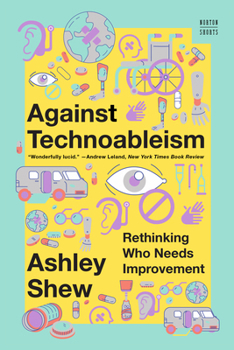
Against Technoableism: Rethinking Who... book by Ashley Shew
