

Algebraic structures to morph between data.
panproto/crates/panproto-lens-dsl at main · panproto/panproto
One engine for schematic version control within and across any schema language. - panproto/panproto
protolab
A patchbay for your schemas. Bidirectional data transformations, drawn as circuits.
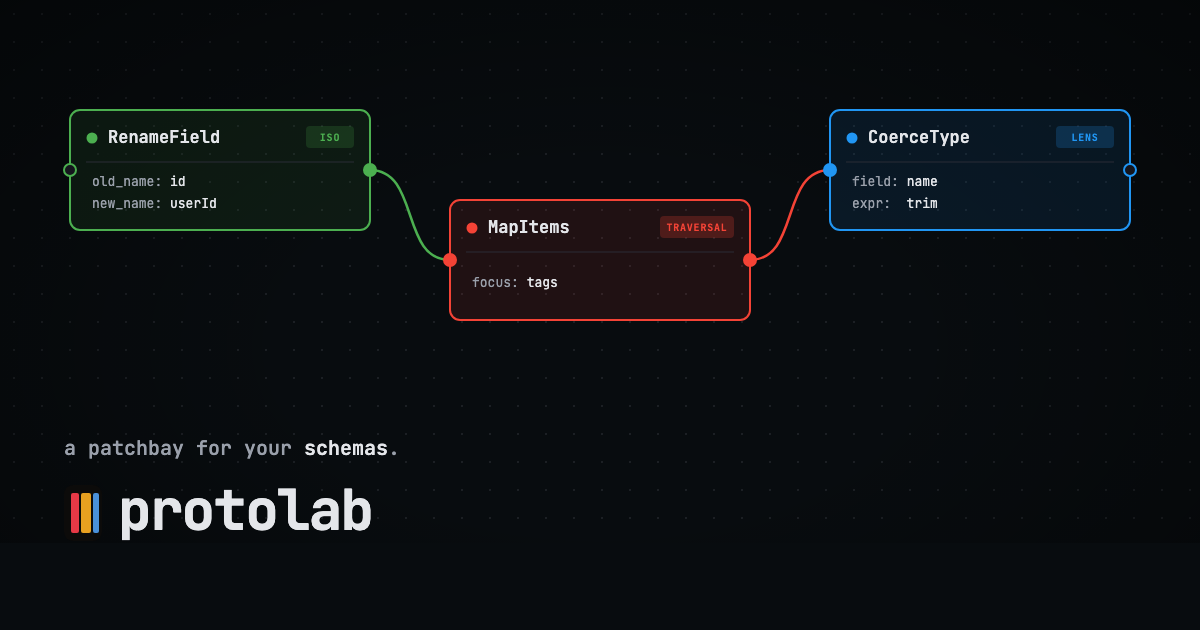
protolab
A patchbay for your schemas. Bidirectional data transformations, drawn as circuits.
What you needa know about Yoneda: profunctor optics and the Yoneda lemma (functional pearl) | Proceedings of the ACM on Programming Languages
Profunctor optics are a neat and composable representation of bidirectional data accessors, including lenses, and their dual, prisms. The profunctor representation exploits higher-order functions and higher-kinded type constructor classes, but the ...

Algebraic data integration
In this paper, we develop an algebraic approach to data integration by combining techniques from functional programming, category theory, and database theory. In our formalism, database schemas and instances are algebraic (multi-sorted equational) theories of a certain form. Schemas denote categories, and instances denote their initial (term) algebras. The instances on a schema S form a category, S–Inst, and a morphism of schemas F : S → T induces three adjoint data migration functors: ΣF : S–Inst → T–Inst, defined by substitution along F, which has a right adjoint ΔF : T–Inst → S–Inst, which in turn has a right adjoint ΠF : S–Inst → T–Inst. We present a query language based on for/where/return syntax where each query denotes a sequence of data migration functors; a pushout-based design pattern for performing data integration using our formalism; and describe the implementation of our formalism in a tool we call AQL (Algebraic Query Language).
Symmetric lenses | Proceedings of the 38th annual ACM SIGPLAN-SIGACT symposium on Principles of programming languages
A lens is a bidirectional transformation between a pair of connected data structures, capable of translating an edit on one structure into an appropriate edit on the other. Many varieties of lenses have been studied, but none, to date, has offered a ...

panproto | schematic version control
One engine for schematic version control within and across any schema language.
Profunctor Optics, a Categorical Update
Optics are bidirectional data accessors that capture data transformation patterns such as accessing subfields or iterating over containers. Profunctor optics are a particular choice of representation supporting modularity, meaning that we can construct accessors for complex structures by combining simpler ones. Profunctor optics have previously been studied only in an unenriched and non-mixed setting, in which both directions of access are modelled in the same category. However, functional programming languages are arguably better described by enriched categories; and we have found that some structures in the literature are actually mixed optics, with access directions modelled in different categories. Our work generalizes a classic result by Pastro and Street on Tambara theory and uses it to describe mixed V-enriched profunctor optics and to endow them with V-category structure. We provide some original families of optics and derivations, including an elementary one for traversals. Finally, we discuss a Haskell implementation.

Functorial data migration
In this paper we present a simple database definition language: that of categories and functors. A database schema is a small category and an instance is a set-valued functor on it. We show that morphisms of schemas induce three “data migration functors”, which translate instances from one schema to the other in canonical ways. These functors parameterize projections, unions, and joins over all tables simultaneously and can be used in place of conjunctive and disjunctive queries. We also show how to connect a database and a functional programming language by introducing a functorial connection between the schema and the category of types for that language. We begin the paper with a multitude of examples to motivate the definitions, and near the end we provide a dictionary whereby one can translate database concepts into category-theoretic concepts and vice versa.
Categorical Data Structures for Technical Computing
Many mathematical objects can be represented as functors from finitely-presented categories $\mathsf{C}$ to $\mathsf{Set}$. For instance, graphs are functors to $\mathsf{Set}$ from the category with two parallel arrows. Such functors are known informally as $\mathsf{C}$-sets. In this paper, we describe and implement an extension of $\mathsf{C}$-sets having data attributes with fixed types, such as graphs with labeled vertices or real-valued edge weights. We call such structures "acsets," short for "attributed $\mathsf{C}$-sets." Derived from previous work on algebraic databases, acsets are a joint generalization of graphs and data frames. They also encompass more elaborate graph-like objects such as wiring diagrams and Petri nets with rate constants. We develop the mathematical theory of acsets and then describe a generic implementation in the Julia programming language, which uses advanced language features to achieve performance comparable with specialized data structures.
Dependent Optics
A wide variety of bidirectional data accessors, ranging from mixed optics to functor lenses, can be formalized within a unique framework-dependent optics. Starting from two indexed categories, which encode what maps are allowed in the forward and backward directions, we define the category of dependent optics and establish under what assumptions it has coproducts. Different choices of indexed categories correspond to different families of optics: we discuss dependent lenses and prisms, as well as closed dependent optics. We introduce the notion of Tambara representation and use it to classify contravariant functors from the category of optics, thus generalizing the profunctor encoding of optics to the dependent case.

We have a new project! Didactic is a typed data library for python built on top of panproto. It provides class-based authoring like pydantic. But under the hood each Model is a panproto Theory, which gives you access to panproto's migration and codegen capabilities. Docs at panproto.dev/didactic/.

GitHub - panproto/didactic: A typed data library for Python on top of panproto.
github.com
