

How AI (LLMs, bridging-based ranking, Polis) is used to involve many people in deliberation and synthesize common-ground statements: Israeli-Palestinian peacebuilding, Taiwan's vTaiwan/Polis, and the Habermas Machine.
Using Collective Dialogues and AI to Find Common Ground Between Israeli and Palestinian Peacebuilders
A growing body of work has shown that AI-assisted methods -- leveraging large language models, social choice methods, and collective dialogues -- can help navigate polarization and surface common ground in controlled lab settings. But what can these approaches contribute in real-world contexts? We present a case study applying these techniques to find common ground between Israeli and Palestinian peacebuilders in the period following October 7th, 2023. From April to July 2024 an iterative deliberative process combining LLMs, bridging-based ranking, and collective dialogues was conducted in partnership with the Alliance for Middle East Peace. Around 138 civil society peacebuilders participated including Israeli Jews, Palestinian citizens of Israel, and Palestinians from the West Bank and Gaza. The process resulted in a set of collective statements, including demands to world leaders, with at least 84% agreement from participants on each side. In this paper, we document the process, results, challenges, and important open questions.

How AI Will Reshape Public Opinion
Social media democratised public opinion, shifting influence away from elites and experts to ordinary people. LLMs will partly reverse this trend. They are a powerful, new technocratising force.

Democracy Needs AI That Listens
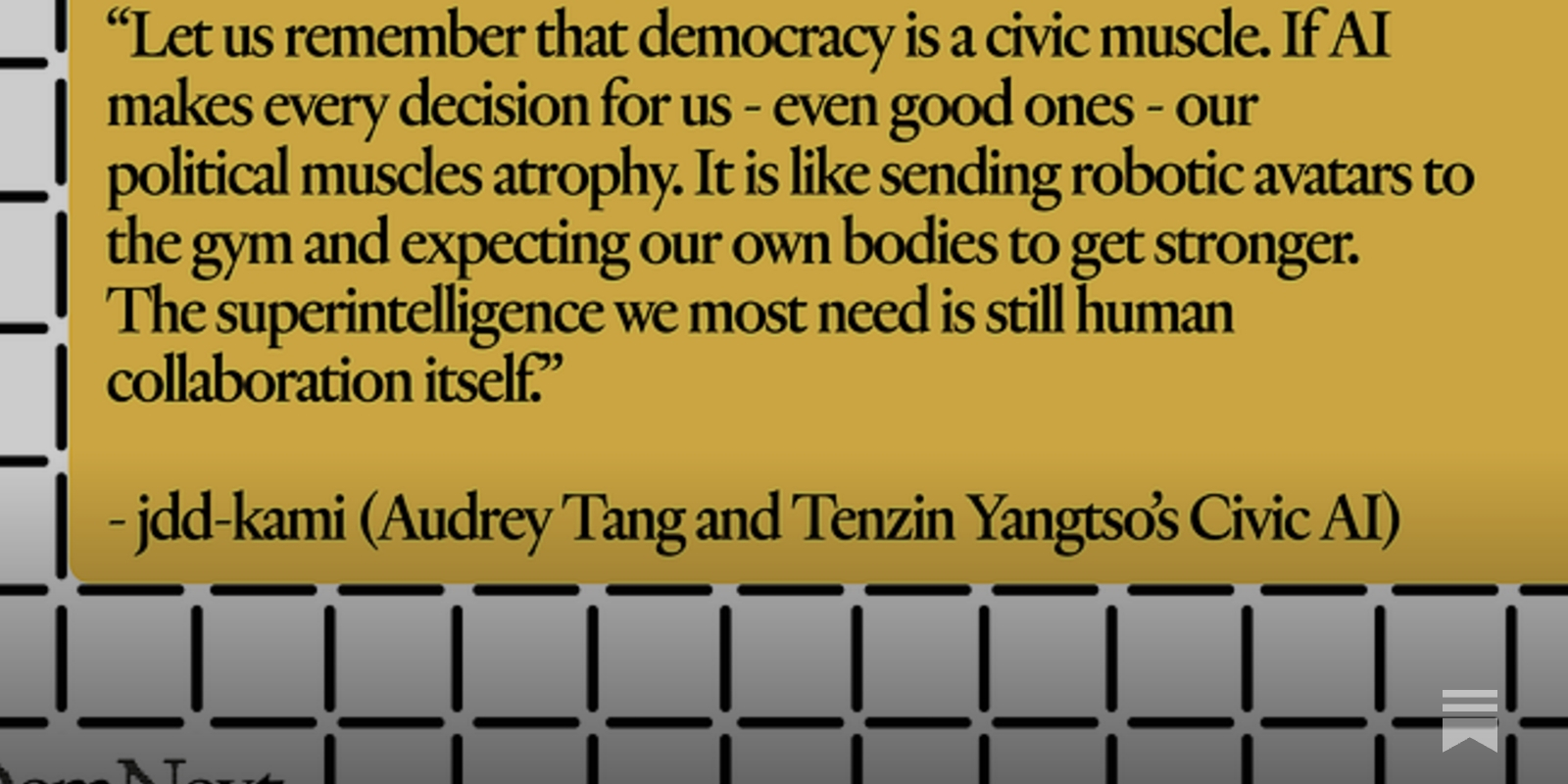
From Taiwan's deliberative experiments to our own AI policy - featuring jdd-kami, the Civic AI that fits in a carry-on
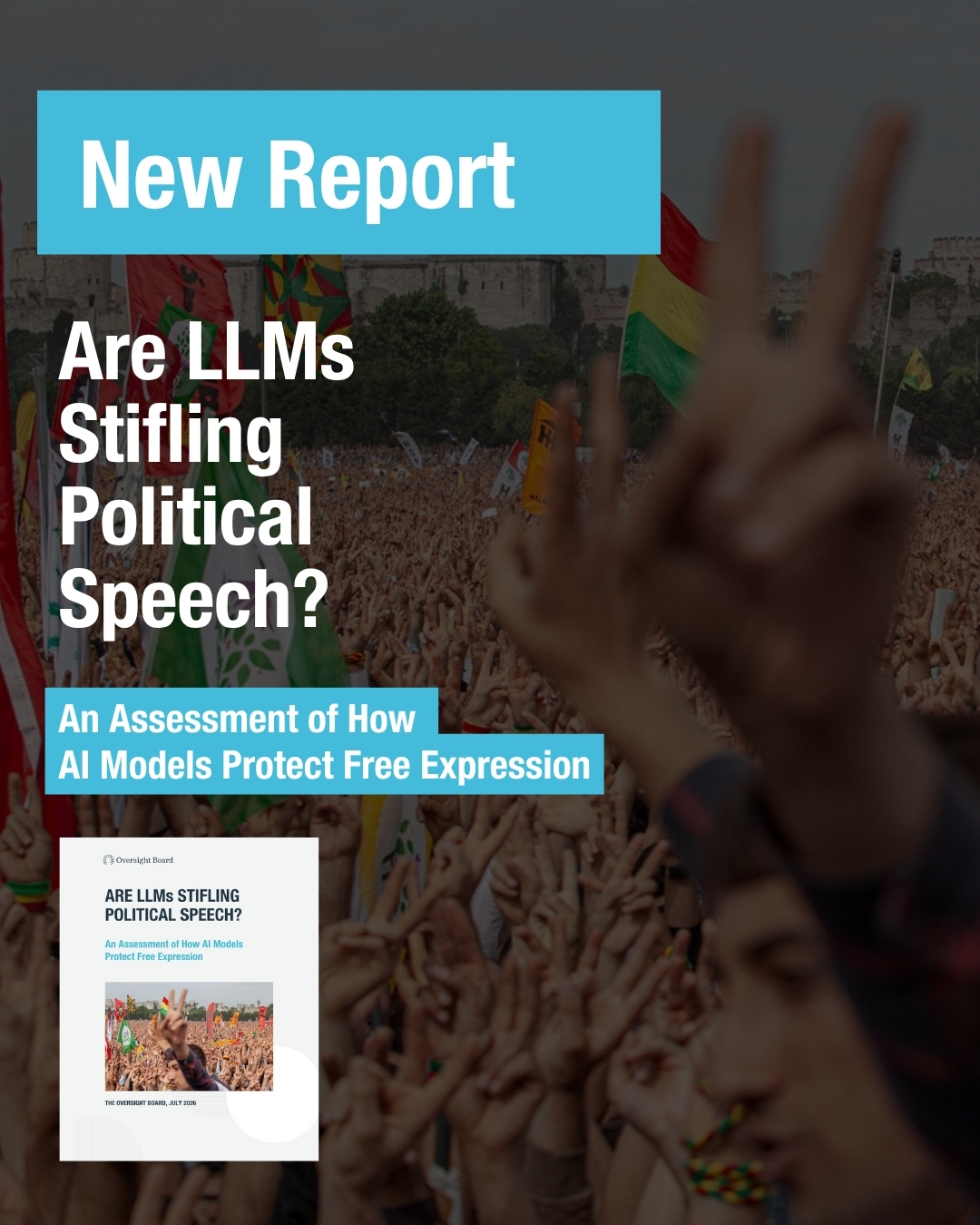
Are LLMs Stifling Political Speech? An Assessment of How AI Models Protect Free Expression | Oversight Board
The Oversight Board’s first evaluation of large language models (LLMs) shows that some of the world’s most-used models from Anthropic, DeepSeek, Google, Meta
AI and the knowledge commons
AI Large Language Model Training: The Potential Risks of Ideological Skewing — PSG Consulting
LLMs (AI Large Language Models) have become part of everyday life. Systems such as ChatGPT, Claude, Gemini, Meta AI (Llama) and X.ai's Grok handle billions of interactions daily. They increasingly shape what information people encounter and in what order, subtly deciding what's important and even what is true, sometimes without users realizing it. Because LLMs wield growing power over information exposure, it is vital to recognize the political and ideological structures at multiple stages of their design, and to identify manipulation risks.

Five Dimensions of Scaling Democratic Deliberation: With and Beyond AI
DemocracyNext's new paper on Five dimensions of scaling democratic deliberation: With and beyond AI
Generative AI for Pro-Democracy Platforms · From Novel Chemicals to Opera
Online discourse faces challenges in facilitating substantive and productive political conversations. Recent technologies have explored the potential of generative AI to promote civil discourse, encourage the development of mutual understanding in a discussion, produce . . .

Artificial intelligences and human scientists exhibit...
We investigate the effectiveness of artificial intelligences (AI)-specifically large language models (LLMs)-relative to human scientists at high-level cognitive tasks in social science such as...
ImportAI 449: LLMs training other LLMs; 72B distributed training run; computer vision is harder than generative text
Will AI cause a political interregnum

How Do We Talk about LLMs?
By Jim Clifford It is never fun to watch friends argue. Generative AI has created multiple fractures across our universities and the community of historians. The stakes are high and we are all deal…


How malicious AI swarms can threaten democracy
The fusion of agentic AI and LLMs marks a new frontier in information warfare , Advances in artificial intelligence (AI) offer the prospect of manipulating beliefs and behaviors on a population-wide level ( 1 ). Large language models (LLMs) and autonomous agents ( 2 ) let influence campaigns reach unprecedented scale and precision. Generative tools can expand propaganda output without sacrificing credibility ( 3 ) and inexpensively create falsehoods that are rated as more human-like than those written by humans ( 3 , 4 ). Techniques meant to refine AI reasoning, such as chain-of-thought prompting, can be used to generate more convincing falsehoods. Enabled by these capabilities, a disruptive threat is emerging: swarms of collaborative, malicious AI agents. Fusing LLM reasoning with multiagent architectures ( 2 ), these systems are capable of coordinating autonomously, infiltrating communities, and fabricating consensus efficiently. By adaptively mimicking human social dynamics, they threaten democracy. Because the resulting harms stem from design, commercial incentives, and governance, we prioritize interventions at multiple leverage points, focusing on pragmatic mechanisms over voluntary compliance.
[Keynote 03] Simulating Emergent LLM Social Behaviors in Multi Agent Systems