

how friction and struggle help grow, learn, create, develop.
The Friction I Don't Want to Lose
I love learning. And while the friction of solving new problems is increasingly traded for speed, the experience gained by overcoming that friction is as important as ever.
FRICTIONAL AI WORKSHOP
Topics of the Workshop In its third edition, this workshop builds on and expands its exploration of friction-in-design in AI systems, hosting a full-day event that challenges the pursuit of seamless, rapid interactions. In contrast to the conventional narrative that human over-reliance on AI stems
Tool Making Follow-Up: What I Mean by Friction
Hopefully clearing up some of my vagueness to reduce misunderstanding.

Making and Tool-Making
Bad tools as the main source of friction for Citybound development - and what I'm going to do about it.
We should be more tired than the model
Adding deliberate friction back into development

Close to the Metal — Real Life
The value of reintroducing friction into our interactions with computers

The case for friction in AI-mediated information seeking and learning
Introduction. This paper challenges the assumption that frictionless AI-mediated information seeking represents progress. We argue that AI systems eliminating productive friction, such as uncertainty, exploration, and reflective processes, undermine intellectual virtues essential for critical thinking in an AI-saturated information environment. Method. This conceptual article employs a theory synthesis approach, drawing on library information science (LIS) theories of information behaviour, experience, and literacy, virtue epistemology, and human–computer interaction (HCI) friction design literature. Analysis. We map intellectual virtues such as curiosity, thoroughness, and intellectual humility onto the Association of College and Research Libraries (ACRL) Framework for Information Literacy for Higher Education, building on and extending previous analyses. We connect dimensions of virtuous search to AI system design principles and align friction types with specific intellectual virtues. Results. We propose three design principles for human-centred AI systems (representation, affordance, and facilitation) and develop a typology that maps friction interventions to intellectual virtues, providing concrete examples for each. Conclusion. Productive friction should be understood as a feature supporting intellectual development, not a barrier to efficiency. The design choices made today will determine whether AI serves as intellectual scaffolding or cognitive crutch.
The Shape of Friction · Matthias Ott
Web design engineer, UX designer, teacher, and speaker – helping teams build websites and digital products with a focus on CSS, accessibility, and performance.

choosing friction
In 2018, legal scholar Tim Wu wrote in the New York Times that: Today’s cult of convenience fails to acknowledge that difficulty is a constitutive feature of human experience. Convenience is all destination and no journey. This piece well predates the current AI boom, but “all destination and no journey” is a pretty good explanation for why using AI to create art is mainly compelling to people who think about creativity in terms of producing content and generating intellectual property. They just want the thing they can market and sell for money or clout; they don’t care how they got there. I know you’re sick of talking about AI. I am too. This is only a little bit about AI, I promise. Like all my writing about technology, it’s mostly about people.
What If Sliding Could Be Controlled?
The Friction is Your Judgment — Armin Ronacher & Cristina Poncela Cubeiro, Earendil
Semble — A social knowledge network for research
Follow your peers' research trails. Surface and discover new connections. Built on ATProto so you own your data.

"remove friction" is how you get slop

KJ Charles
There's an infuriating AI article in the Society of Authors magazine. "Bec Evans searches for principles that could guide authors' use of generative AI." A bunch of authors who all say they wouldn't use it to write but will to 'research', 'remove friction', 'fact check and propose rewrites'.
How to Semble?

Guides and resources about what Semble is and how to use it.
The Garden

Everything is connected. The master collection of all links collected across all collections, and a pretty decent snapshot of my brain

Semble bookmarklet
Semble iOS shortcut

Semble (@semble.so)
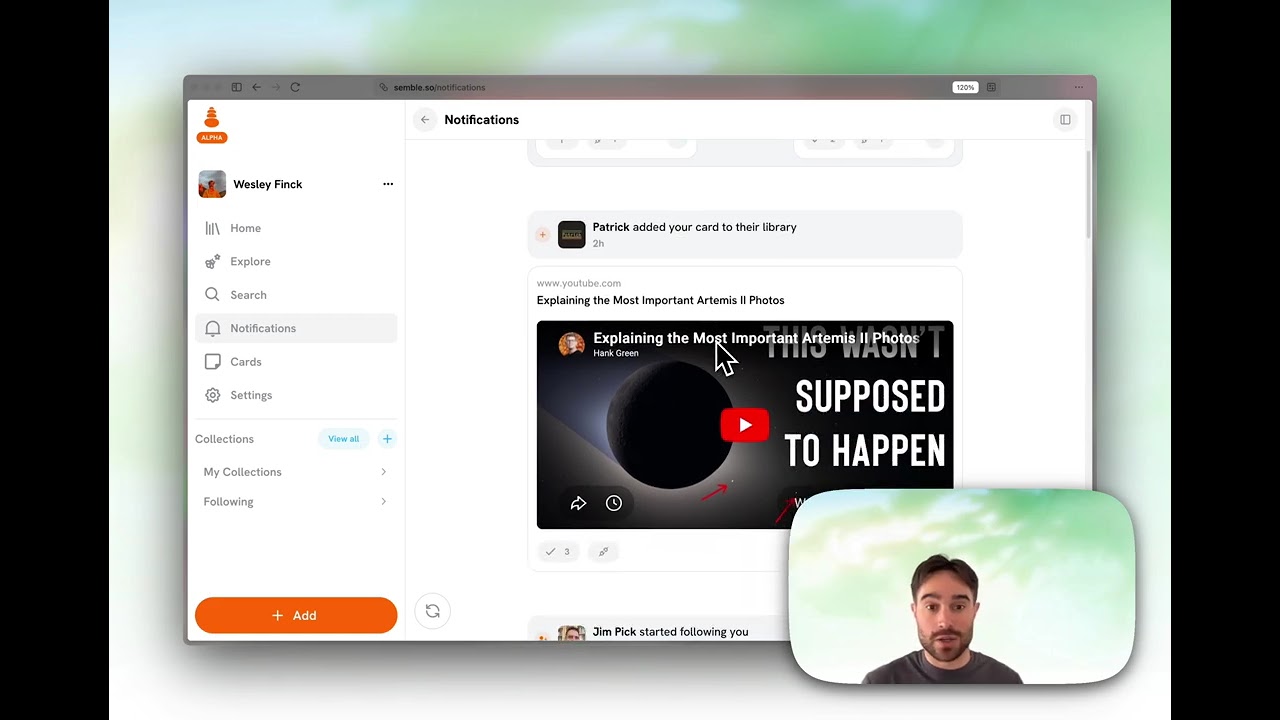
How Notifications Work in Semble

Semble Explore Feed and Follow Graph

What is the Semble Page

Child Predators Turn to Open-Source AI to Make Unlimited Illegal Images

A senator tried to ban gambling on prediction markets—now she's a Kalshi lobbyist

Mac Users Reclaim 12GB+ of Storage With Apple Intelligence Removal Tool

Revealed: Britain's contracts with Palantir hit £1bn

'We’re watching you’: MP Clive Lewis reveals Tom Watson has warned him over criticising Palantir

‘Doom Loop’: OpenAI and Microsoft Admits LLMs Are Destroying the Web and Built on Theft
